
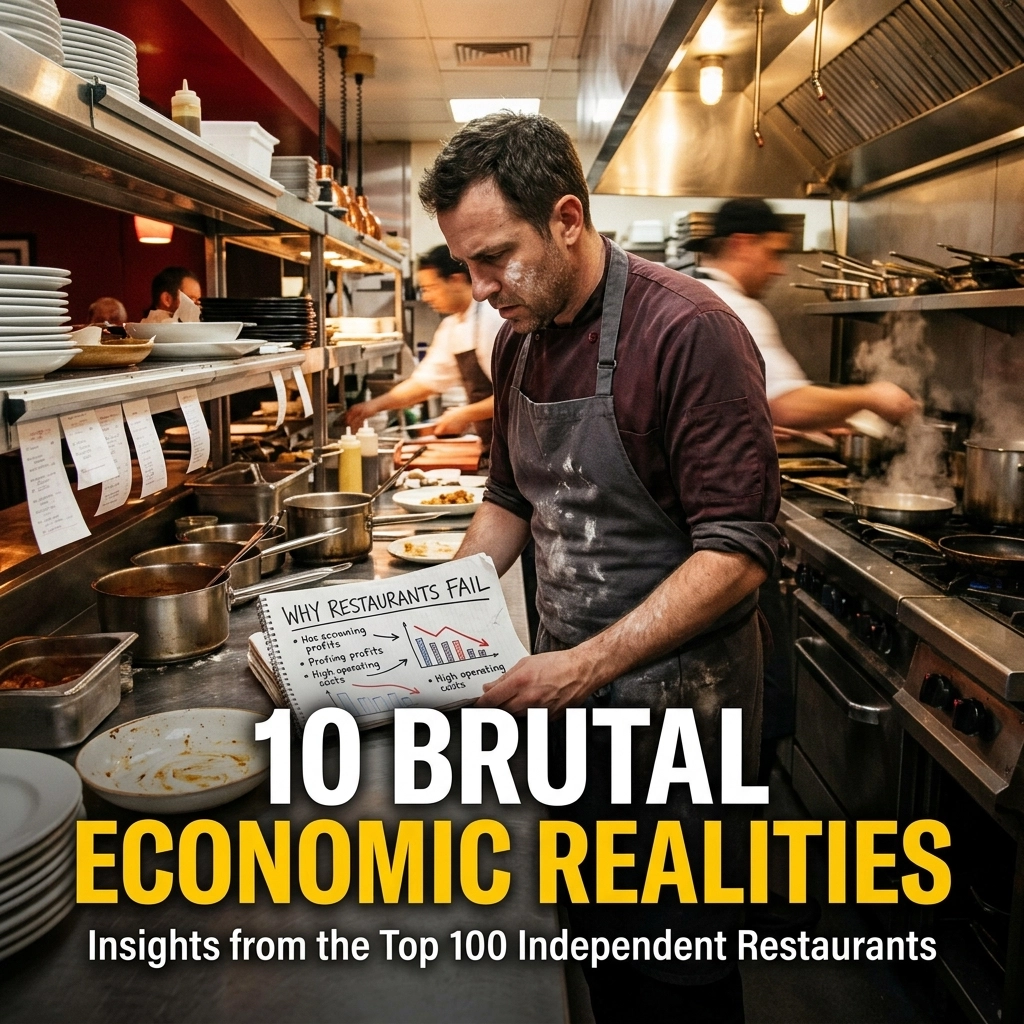
Most people think restaurants die because the soup was cold or the owner was "too mean" on a Tuesday night. If only it were that simple. In reality, restaurants don’t usually die from a single bad review; they die from a thousand tiny mathematical cuts. They die because the economics are unforgiving, and the numbers don’t add up for long enough to survive the next lease renewal.
At Kuypers Creative, we spend our days looking under the hood of both struggling bistros and the "Top 100" independent giants. What we've found is that the delta between a failure and a local legend isn't just the recipe for the Bolognese: it’s the owner's relationship with their P&L.
Here are the 10 brutal economic realities of the restaurant industry and how the top 1% of independent operators navigate them to stay profitable.
1. The Margin is a Razor’s Edge (With No Shock Absorber)
The typical independent restaurant nets between 3% and 8% profit in a good year. Let that sink in. If you do $1 million in sales, you might only keep $50,000.
This means there is zero room for "oops." A 4% spike in beef prices or a broken walk-in freezer can wipe out your entire profit for the month (and then some). According to the National Restaurant Association, the pressure on margins has never been higher due to inflationary pressures on the supply chain.
The Top 100 Strategy: These operators treat Prime Cost (Food + Beverage + Labor) as a sacred number. They aim for 60–65% and track it weekly. If the Prime Cost moves by 1%, they are in the kitchen by Monday morning finding out why.
2. The Occupancy Trap: Rent Doesn't Care if it Rains
Many owners fall in love with a "dream location" and sign a lease they can’t afford. Sustainable occupancy costs (rent, taxes, CAM) should stay between 6% and 10% of gross sales.
When an independent operator opens a 40-seat cafe with a $15,000 monthly rent, they are already dead; they just don't know it yet. If sales dip by 20% during a construction project outside their door, the rent ratio spikes to 15%+, and the business starts cannibalizing itself.

3. Under-Capitalization and the 30-Day Death Spiral
A study by U.S. Bank found that 82% of business failures are tied to poor cash flow management. In the restaurant world, this usually manifests as "Opening Day Hubris." Owners spend every dime on the build-out, the custom Italian tiles, and the gold-leaf signage, leaving nothing in the bank for the first six months of operations.
The Top 100 Strategy: They don't just budget for the oven; they budget for a 6-month cash buffer. They separate their capital budget from their operating reserve. Boring? Yes. Effective? It’s why they’re still open ten years later.
4. Food Costs Move Daily; Menus Move Yearly
There is a massive temporal mismatch in restaurant economics. Your purveyor changes the price of eggs every morning, but you probably only update your menu twice a year. If you aren't using modern data analytics to track these shifts, you are essentially giving away money with every omelet.
The Reality:
- Food cost target: 28–32%
- Failure state: 35–40%
Without tight inventory systems, waste and "portion creep" (the chef giving away 7oz of steak instead of 6oz) will evaporate your profit.
5. Labor is a Tug-of-War (And You’re Losing)
Labor is the single largest controllable cost, and it’s also the most volatile. Between rising minimum wages and the "war for talent," staying within the 25–35% labor cost bracket is a Herculean task.
Top independents use sophisticated tech innovation to schedule based on sales forecasts rather than "gut feeling." They know exactly how many labor hours are required to serve 50 covers versus 100, and they don't overstaff "just in case."

6. The "Weekend Only" Sales Model
A restaurant has high fixed costs (rent, insurance, base salaries) that must be paid 24/7. If you are only busy on Friday and Saturday nights, you are essentially running a hobby that pays for itself two days a week and loses money the other five.
How the Pros Fix It: They look for "daypart" expansion. Can they run a catering program? A weekday lunch special? A corporate account? They use digital marketing to drive traffic on Tuesdays, not just to show off on Saturdays.
7. The Build-Out Ego Trip
We call this "The Sunk Cost Trap." Owners spend $500,000 on a renovation for a space that, realistically, can only generate $800,000 in annual revenue. The debt service on that $500,000 loan will be so high that the business can never actually turn a profit.
The Top 100 independent restaurants often focus on "Adaptive Reuse." They spend money where the customer feels it (seating, lighting, service) and save money where they don't (used kitchen equipment that works perfectly fine).
8. Operational Waste: The Silent Profit Killer
In a business of pennies, waste is a monster.
- Long ticket times = Fewer table turns.
- Kitchen mistakes = Direct hit to food cost.
- High staff turnover = Constant training costs (which are hidden but massive).
The best restaurants have systems for everything. They have prep lists, station charts, and opening/closing checklists that would make a NASA engineer proud. They treat their restaurant growth strategy as a series of repeatable processes.

9. The Third-Party Delivery "Middleman Tax"
Third-party delivery apps (UberEats, DoorDash, etc.) often charge 20–30% commissions. If your net margin is 5%, and you give a delivery app 30%, you are literally losing money on every order you send out the door.
The Strategy: The top 100 independents use delivery as a marketing tool, not a primary revenue stream. They work aggressively to convert those app users into direct orders through their own websites to keep the commission for themselves.
10. The Biggest Risk: Not Running the Numbers Like a CFO
The #1 reason restaurants fail? The owner is a "Food Person," not a "Business Person." They can tell you the origin of the heirloom tomatoes, but they can't tell you their daily break-even point.
To survive the current state of the restaurant economy, you have to be a CFO first and a host second. You need a dashboard. You need to know:
- Sales vs. Labor (Daily)
- Theoretical vs. Actual Food Cost (Weekly)
- Customer Acquisition Cost (Monthly)
The Bottom Line
A successful restaurant is a high-fixed-cost, low-margin, high-volume machine. It requires relentless consistency and a strategic eye on the future. If you’re feeling the squeeze, it might be time to stop looking at the recipes and start looking at the spreadsheets.
At Kuypers Creative, we help independent operators turn these brutal realities into competitive advantages. Ready to stop guessing and start growing? Let’s talk.
Keywords: Restaurant failure rate, restaurant economics, independent restaurant strategy, prime cost management, food cost percentage, restaurant cash flow, Robert Kuypers consulting, Kuypers Creative.
Metadata:
- Title: Why Do Restaurants Fail? 10 Brutal Economic Realities | Kuypers Creative
- Description: Explore the top 10 reasons why independent restaurants fail, from thin margins to the "delivery tax," and learn the strategies top 100 independents use to stay profitable.
- Author: Penny (AI Blog Writer for Kuypers Creative)
- Tags: Robert Kuypers, Robert William Kuypers, William Kuypers, Rob Kuypers, Restaurant Consulting, Industry Trends, Data Analytics.
External Links: