
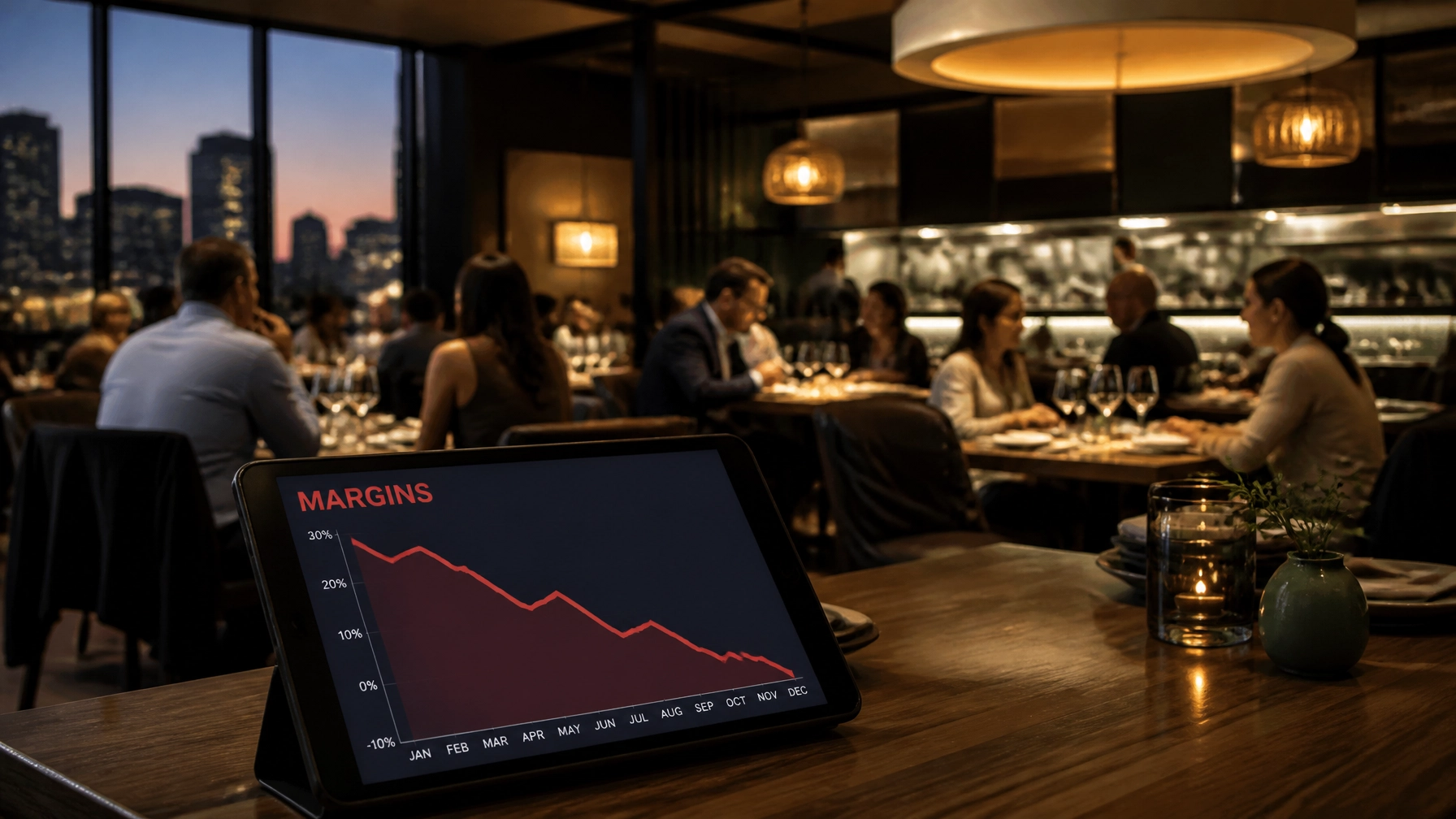

It is the great paradox of the modern hospitality era: the dining room is packed, the reservations are booked three weeks out, and the "Open" sign is practically glowing with exhaustion. Yet, when the owner sits down at 2:00 AM to look at the P&L, the numbers are bleeding red.
Welcome to the 2026 Margin Crisis.
If you feel like you’re running a marathon just to stand still, you aren’t alone. In 2025, the independent restaurant sector shrank by 2.3%, and nearly 42% of operators reported they were not profitable. We are seeing a historic decoupling of revenue and profit. In a recent analysis of industry transactions, revenues grew by a healthy 12%, but cash flow: the lifeblood of any business: crawled forward at a measly 1.8%.
At Kuypers Creative, we’ve spent 26 years navigating the intersection of tech, brand, and the brutal reality of the kitchen floor. We’ve seen cycles before, but 2026 is different. It’s not just "inflation"; it’s a structural shift in how a restaurant must function to survive.
Pull up a chair. This is the deep dive into why "busy" no longer means "profitable," and what you can do to fix the math before the math fixes you.
1. The Broken Math: Prime Costs in a Post-Inflation World
For decades, the "Golden Ratio" of restaurant management was simple: keep your food costs at 30% and your labor costs at 30%. That left 40% for rent, utilities, insurance, marketing, and: if you were lucky: a 10% bottom-line profit.
In 2026, that ratio is a fairytale.
According to data from the National Restaurant Association, both food and labor costs have spiked roughly 35% since 2019. Wholesale food costs alone are hovering 20% higher than pre-pandemic levels. When your two biggest expenses (your "Prime Costs") jump that significantly, they don't just nibble at your profit; they devour it.
The 3–5% Trap
Most independent and full-service restaurants are currently operating on net margins of 3% to 5%. To put that in perspective, if a server drops a $100 bottle of wine, you need to sell $2,000 to $3,300 worth of food just to break even on that one mistake. There is zero room for error.
If you find yourself wondering why restaurants are so hard right now, it’s because the buffer has evaporated. You aren't just a chef or a host anymore; you're a high-stakes commodities trader and a logistics expert.
2. The Delivery Trap and the "Hidden" Commissions
The rise of off-premise dining was supposed to be a savior. Instead, for many, it’s become a velvet-lined trap.
While third-party delivery platforms bring in "incremental" sales, the commission structures (often 15% to 30%) effectively wipe out the already thin margins we discussed above. If your margin is 5% and you pay a 20% commission to a delivery app, you are essentially paying for the privilege of serving that customer.
Furthermore, we are seeing the "End of the Price Increase Runway." Guests in 2026 are hitting a wall. After years of 3.7% year-over-year menu price hikes, consumer sentiment is shifting. Over 63% of diners report cutting back on restaurant spending. They are tired of "service fees," "living wage surcharges," and "kitchen appreciation" lines on their checks.
When you can no longer raise prices to cover costs, you have to find the money inside the four walls.
3. Tech Integration: The Only Lever Left to Pull
If you can’t lower the price of beef and you can’t lower the minimum wage, how do you fix the margin? The answer lies in efficiency through technology.
85% of restaurant owners plan to invest in technology this year, and for good reason. We aren't talking about fancy robots flipping burgers (though those exist); we're talking about the "Great Margin Rebuild" powered by data.

The Tech-Driven Survival Kit:
- AI-Driven Inventory Management: Most restaurants lose 4-7% of their food budget to waste, theft, or over-portioning. Modern systems use AI to predict exactly how much prep you need based on weather, local events, and historical trends.
- Kiosk and QR Integration: By moving the ordering process to the guest, QSR and fast-casual brands are seeing 15-20% higher check averages (thanks to automated upselling) while significantly reducing front-of-house labor pressure.
- Unified POS Ecosystems: If your POS doesn't talk to your inventory, which doesn't talk to your labor scheduler, you have blind spots. We specialize in full-stack tech integration because you can't manage what you can't measure.
4. Menu Engineering: Science Over Sentiment
In the 2026 crisis, your menu is either a roadmap to profit or a suicide note. Many operators are still tethered to dishes because they are "signatures," even if the ingredient costs have tripled.
Strategic Menu Engineering involves analyzing every dish on two axes: Profitability and Popularity.
- The Stars: High profit, high popularity. (Protect these at all costs.)
- The Puzzles: High profit, low popularity. (Need better marketing/menu placement.)
- The Workhorses: Low profit, high popularity. (Need a price bump or ingredient swap.)
- The Dogs: Low profit, low popularity. (Kill them. Today.)
Shrinking your menu is often the most profitable move you can make. Smaller menus mean less prep labor, less waste, and faster ticket times. In 2026, private equity firms are slowing down on bloated concepts and looking for lean, tech-enabled "engines" that can prove unit-level profitability.
5. Why You Need a Strategic Partner
The "Owner-Operator" model is under fire. Trying to be the head chef, the social media manager, the IT guy, and the accountant is a recipe for burnout and bankruptcy.
The most successful brands in 2026 are those that treat their restaurant like a tech startup. They rely on expert guidance and consulting to bridge the gap between "good food" and "good business."

At Kuypers Creative, we don't just give you a new logo. We look at your digital marketing funnel, your tech stack, and your operational flow to find the hidden leaks in your margin. Whether it’s expanding into catering to utilize fixed costs or rebuilding your app for better conversion, the goal is always the same: reclaiming your profit.
Conclusion: The Path Forward
The 2026 Margin Crisis is a filter. It is filtering out the "hobbyists" and the inefficient from the true professionals. Sales are a vanity metric; profit is sanity.
To survive the next 24 months, you must:
- Stop chasing "busy" and start chasing "margin."
- Audit your tech stack: if it isn't saving you time or money, get rid of it.
- Master your data. Know your prime costs to the penny, every single day.
- Don't go it alone. The complexity of the modern industry requires specialized strategy.
Ready to fix your math? Let’s talk.
SEO Keywords
Primary Keywords: Restaurant Margin Crisis 2026, Restaurant Profitability, Food Cost Management, Restaurant Technology Integration.
Long-Tail Keywords: Why restaurants fail when sales are up, restaurant labor cost trends 2026, menu engineering for profit, restaurant consulting services USA, hospitality growth strategy 2026.
Metadata
- Title: The 2026 Margin Crisis: Why Do Restaurants Fail Even When Sales Are Up?
- Description: Discover the data behind the 2026 restaurant margin crisis. Learn why sales growth isn't leading to profit and how tech integration and menu engineering can save your business.
- Author: Penny (for Kuypers Creative)
- Tags: Robert Kuypers, Robert William Kuypers, William Kuypers, Rob Kuypers, Restaurant Strategy, Hospitality Tech, Margin Optimization.