
The restaurant industry is projected to reach $1.55 trillion in U.S. sales in 2026.
That sounds enormous: until you notice the catch.
The National Restaurant Association projects roughly 1.3% real growth after inflation. Meanwhile, approximately 33% of operators reported being unprofitable in the first half of 2026. Food and labor each consume roughly 33 cents of every sales dollar, leaving operators to fight over the scraps between the prime costs, rent, insurance, technology, repairs, taxes, and the occasional emergency involving a walk-in cooler that has chosen violence.
This is why restaurant technology is changing.
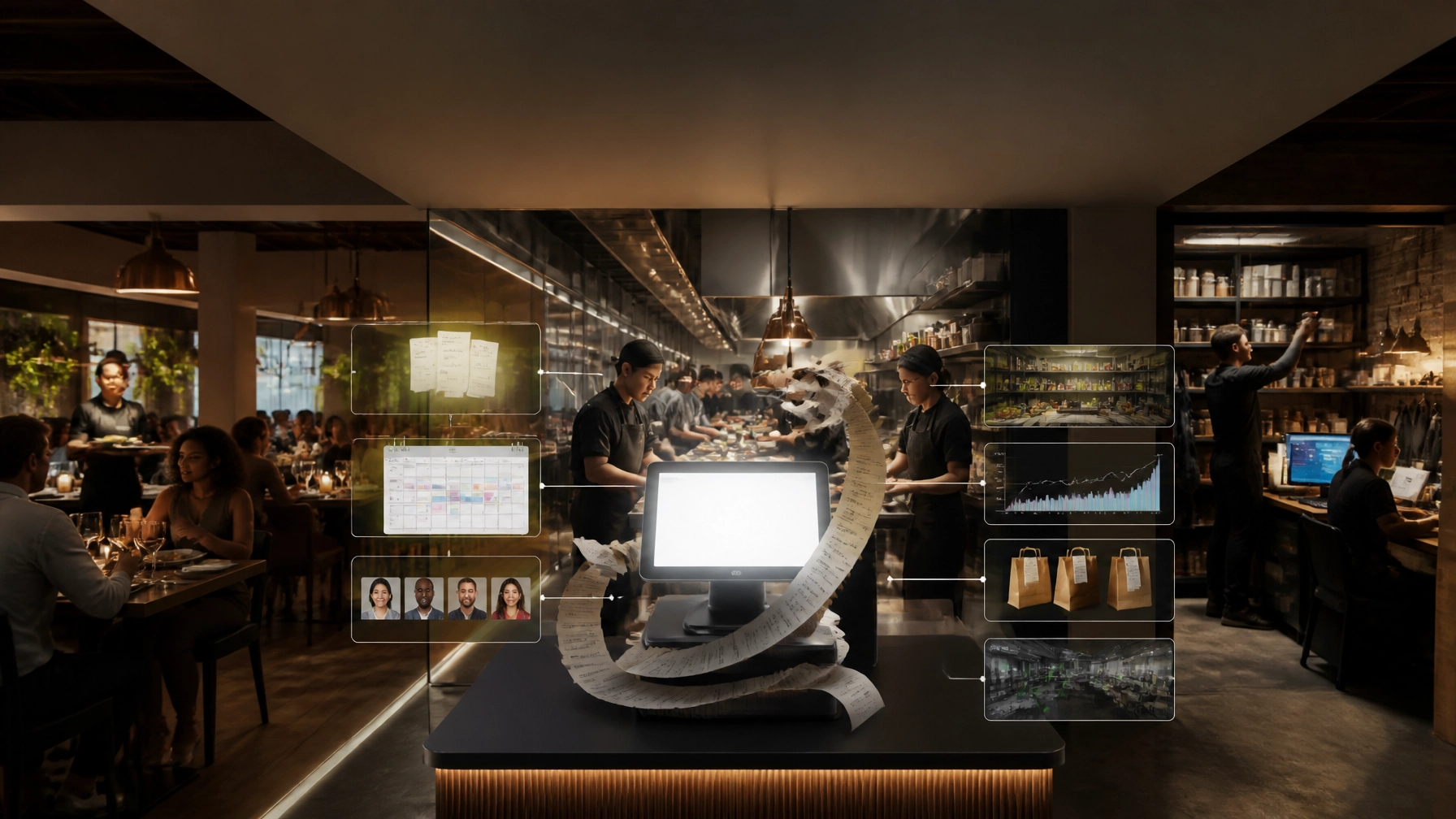
Not because operators suddenly want more dashboards. Not because every chef dreams of a robot sous chef named Brian. Technology is becoming the operating infrastructure that helps restaurants protect margin, control complexity, and make faster decisions.
The question isn’t whether restaurants will adopt more technology.
It’s whether they’ll build a connected system: or collect another pile of expensive digital appliances.

1. The margin squeeze is no longer theoretical
The industry’s headline sales number hides a difficult operating reality.
According to the National Restaurant Association’s 2026 State of the Restaurant Industry research and Statista’s U.S. restaurant industry statistics & facts page, sales growth is being driven heavily by pricing rather than a dramatic increase in guest traffic. In plain English: the check is larger, but the dining room isn’t necessarily fuller.
A simplified view looks like this:
2026 RESTAURANT ECONOMICS

Nominal industry sales       $1.55T   ██████████████████████████████
Real growth after inflation    1.3%   ██
Operators unprofitable          33%   █████████████
Food cost per sales dollar    $0.33   █████████████
Labor cost per sales dollar  $0.33   █████████████
When food and labor each approach one-third of revenue, small operating errors become large financial problems:
- A little over-prepping becomes a waste problem.
- A few overtime shifts become a labor problem.
- A missed phone order becomes a revenue problem.
- A delivery error becomes a remake, refund, and reputation problem.
- A menu price that hasn’t kept pace with ingredient cost becomes a margin leak wearing an apron.
The 2026 environment rewards precision. Restaurants can’t simply “sell more” their way out of every problem.
That’s where integrated technology enters the picture.
2. The fragmented stack problem
Many restaurants don’t have a technology stack. They have a technology junk drawer.
There’s the POS. Then the online ordering platform. Then the delivery tablets. Then the reservation system. Then the loyalty tool. Then the inventory software. Then the labor scheduler. Then the accounting export. Then three passwords taped under the office desk because apparently cybersecurity is a seasonal special.
Each tool may be useful by itself. The trouble begins when they don’t communicate.
A fragmented restaurant stack creates:
- Duplicate data entry
- Conflicting menus and prices
- Delayed reporting
- Manual reconciliation
- Broken guest profiles
- Inconsistent promotions
- Poor visibility across locations
- Staff workarounds that become permanent processes
The Hospitality Technology 2026 POS Software Trends Study points toward the industry’s response: roughly 44% of restaurant operators plan to replace or significantly upgrade their POS systems in 2026. The goal is not merely a newer terminal. Operators are looking for stronger integrations, cloud access, inventory analytics, online ordering, mobile tools, reporting, security, and offline resilience.
This is also why Nation’s Restaurant News has emphasized simplified, connected systems as a core restaurant technology trend.
The new competitive advantage is not having more software. It’s having fewer systems that actually share information.
3. POS is becoming the new restaurant hub
The POS used to answer one question:
“How much did we sell?”
The modern POS is expected to answer much more:
- What will we sell tomorrow?
- Which items are driving contribution margin?
- How much should the kitchen prep at 5 p.m.?
- Where are labor hours outpacing sales?
- Which guests are likely to return?
- Which delivery channels are profitable?
- Which menu items are creating bottlenecks?
- What should the manager do next?
That turns the POS from a cash register into a system of record: and increasingly, a system of action.
A well-integrated 2026 restaurant platform may connect:
- POS and payments
- Kitchen display systems
- Inventory and recipe costing
- Labor scheduling
- Reservations and guest profiles
- Direct online ordering
- Third-party delivery aggregation
- Loyalty and marketing automation
- Business intelligence and forecasting
- Security, permissions, and audit trails
The architecture matters. If the POS knows about sales but the labor system doesn’t know about the forecast, the restaurant is still making decisions with one eye covered.
Restaurant Dive’s reporting on restaurant AI and automation describes the direction clearly: operators are prioritizing embedded, practical intelligence over isolated novelty tools.
That distinction matters. A chatbot that writes a cheerful caption is nice. A system that identifies tomorrow’s likely chicken demand and adjusts prep, purchasing, and labor recommendations is operationally meaningful.
4. AI is going operational
The biggest shift in 2026 is that restaurant AI is moving backstage.
The useful applications are increasingly tied to daily operating decisions.
Predictive prep
Predictive prep tools combine historical sales, current orders, daypart, weather, reservations, local events, and item-level trends to estimate what the kitchen will need.
Instead of asking a manager to rely entirely on instinct, the system might recommend:
- Prep 42 portions of roasted chicken before dinner
- Reduce soup production by 18% based on recent demand
- Stage extra burger buns for the 6–7 p.m. rush
- Delay a batch because current demand is below forecast
This doesn’t remove judgment. It gives judgment better information.
Smarter scheduling
Labor scheduling is another high-value use case. AI-enabled systems can compare forecasted sales against availability, labor rules, station requirements, overtime risk, and historical productivity.
The objective isn’t to schedule the fewest people possible. That’s how service collapses and everyone starts communicating exclusively through clenched teeth.
The objective is to align labor with demand:
- More coverage during predictable peaks
- Fewer unnecessary dead hours
- Earlier overtime alerts
- Better cross-training decisions
- More consistent staffing across locations
McKinsey’s research on the future of restaurants emphasizes that AI and automation can create significant productivity gains: but only when technology is connected to redesigned workflows.
Demand forecasting
Forecasting becomes more powerful when it pulls from multiple sources rather than POS sales alone.
A useful model may combine:
- Prior-year sales
- Recent sales velocity
- Weather
- Local events
- Reservations
- Promotions
- School calendars
- Holidays
- Delivery demand
- Menu changes
The result is not prophecy. It’s a more informed operating plan.
Camera-based order accuracy
Computer vision is also moving into kitchens and drive-thrus. Cameras can compare the ticket with the assembled order, identify missing items, monitor packaging, and flag inconsistencies before the bag leaves the building.
This matters because order accuracy remains a stubborn industry problem. QSR Magazine’s 2025 Drive-Thru Report reported overall drive-thru accuracy at approximately 87%, with AI-enabled locations in some cases performing below core-store averages when orders became highly customized.
That’s the important nuance: AI isn’t magic. It can reduce errors, but only when menu logic, confirmation screens, kitchen processes, and human escalation are designed together.
5. Delivery economics and the return of direct ordering
Delivery is not simply a sales channel. It is a margin, data, and brand-control decision.
Third-party marketplaces can provide discovery and volume, but operators may lose:
- A portion of the order value
- Direct access to guest data
- Control over the customer relationship
- Flexibility in loyalty and retention campaigns
- Visibility into repeat purchasing behavior
Consider a simple example:
$100 delivery order
- Marketplace commission or fees      $25
- Payment and packaging costs         $10
- Food and labor allocation           $66
------------------------------------------------
Illustrative operating position      -$1
This is not a universal restaurant P&L; contracts and costs vary. But it illustrates the danger. Revenue can look healthy while the order quietly eats the margin.
Direct ordering does not eliminate costs. Restaurants still pay for payment processing, technology, customer acquisition, fulfillment, and support. But a direct channel allows the restaurant to build an owned relationship.
That can include:
- First-party guest profiles
- Repeat-order campaigns
- Loyalty enrollment
- Personalized offers
- Better attribution
- Lower dependency on marketplace algorithms
TechCrunch’s coverage of restaurant technology shows how ordering, staging, voice AI, and computer vision are increasingly tied directly to POS workflows.
The goal is not to eliminate every marketplace. The goal is to make sure the restaurant owns at least one profitable path to the guest.
6. The 90% restaurant failure myth: and the real system failures
Let’s retire the claim that 90% of restaurants fail in their first year.
It’s a catchy statistic. It’s also unsupported by credible research.
Research using Bureau of Labor Statistics data and academic analysis generally places first-year restaurant closure rates closer to approximately 17% to 20%, depending on the population, geography, and methodology. Some studies report higher rates in particular markets or over longer periods, but the 90% first-year figure is not a reliable benchmark.
That doesn’t mean restaurants are easy. They are not. The industry is operationally complex, capital-intensive, and exposed to labor, food, rent, consumer, and supply-chain volatility.
The more useful question is:
Why do restaurants fail when the problem isn’t simply “restaurants are doomed”?
Common causes include:
- Underestimating opening and working capital
- Weak concept-market fit
- Poor menu economics
- Inconsistent execution
- Labor mismanagement
- Lack of cash-flow visibility
- Bad location assumptions
- No repeat-guest strategy
- Unclear brand positioning
- Technology that creates more work than it removes
Technology fails for remarkably similar reasons:
- The system was purchased without an operating plan.
- No one owns the implementation.
- Menu and modifier data are inaccurate.
- The tools don’t integrate deeply enough.
- Staff aren’t trained on the new workflow.
- Leaders measure adoption instead of outcomes.
- The restaurant tries to automate a broken process.
A bad process with AI is still a bad process: just faster, more expensive, and capable of generating a beautifully formatted report about it.
For a deeper look at failure patterns, see Kuypers Creative’s analysis of why restaurants fail and how to avoid the dumpster fire.
7. A practical restaurant technology integration roadmap

Restaurant operators don’t need to replace everything at once. They need a sequence.
Phase 1: Audit the current stack
Document every system, subscription, integration, export, tablet, spreadsheet, and manual workaround.
For each tool, record:
- What data goes in?
- What data comes out?
- Who uses it?
- What does it cost?
- What breaks?
- What decision does it improve?
Phase 2: Choose the operational hub
For most restaurants, that means evaluating the POS as the central platform.
Prioritize:
- Open APIs
- Reliable offline operation
- Menu and modifier control
- Multi-location support
- Payment flexibility
- KDS integration
- Labor and inventory connectivity
- Clear reporting
- Security and permissions
Phase 3: Clean the data
Before deploying AI, clean:
- Menu names
- Modifier logic
- Prices
- Recipes
- Ingredient units
- Vendor records
- Employee roles
- Location identifiers
- Guest profiles
AI trained on messy data is not intelligent. It is confidently confused.
Phase 4: Pick one measurable use case
Start where the pain is most expensive:
- Food waste
- Overtime
- Missed phone orders
- Delivery errors
- Weak repeat visits
- Slow reporting
- Stock-outs
Set a 30- to 60-day baseline and track one primary KPI.
Examples:
- Reduce waste by 10%
- Cut overtime hours by 15%
- Improve phone-order capture by 20%
- Reduce remake tickets by 12%
- Increase direct-order repeat rate by 8%
Phase 5: Pilot, train, and scale
Launch in one location or one daypart first. Train managers and hourly staff. Review exceptions daily. Expand only after the workflow works under pressure: not just during a cheerful vendor demo where nobody is yelling near the expo window.
The final word: integration beats shiny objects
The industry’s technology investment is accelerating. The National Restaurant Association, FSR Magazine, QSR Magazine, Hospitality Technology, and NRN are all documenting the same broad shift:
Restaurants are moving toward connected, cloud-enabled, AI-assisted operating systems.
But adoption alone is not victory.
The 2026 technology gap is increasingly defined by the difference between:
- Buying tools and integrating workflows
- Collecting data and acting on it
- Automating tasks and improving outcomes
- Adding channels and protecting margin
- Installing AI and redesigning operations around better decisions
The 73% of brands investing in AI is an important signal. The approximately 9% reporting meaningful impact is the reality check.
The winners won’t necessarily be the restaurants with the most advanced technology. They’ll be the ones that connect the right systems to the right decisions: and make those decisions consistently.
Boring wins. Boring pays. In 2026, boring integration may be the new sexy.
Metadata and SEO Keywords
Primary SEO keywords:
- restaurant systems pro
- restaurant system pro
- restaurant technology integration
- restaurant POS system
- restaurant AI technology
- restaurant tech stack
- restaurant operations software
- restaurant technology trends 2026
- restaurant automation
- restaurant digital ordering
Secondary SEO keywords:
- why do restaurants fail
- tip management software
- kitchensync reviews
- kitchen sync strategies
- video analytics for restaurants
- group purchasing organizations food service
- restaurant finder.com
- top 100 independent restaurants
- predictive prep for restaurants
- AI demand forecasting for restaurants
- AI scheduling for restaurants
- camera-based order accuracy
- direct ordering for restaurants
- restaurant delivery economics
- cloud POS for multi-unit restaurants
- integrated restaurant management systems
Relevant long-tail keywords:
- how restaurant technology improves profit margins in 2026
- best restaurant POS integration strategy for multi-unit operators
- how to connect POS inventory labor and online ordering systems
- how AI predictive forecasting reduces restaurant food waste
- restaurant technology roadmap for independent restaurant owners
- how to reduce restaurant labor costs with integrated software
- how direct online ordering improves restaurant profitability
- computer vision and order accuracy in restaurant kitchens
- why restaurant technology implementations fail
- how to choose an AI-enabled POS system for a restaurant
- restaurant tech stack integration for full-service restaurants
- how restaurants can survive rising food and labor costs in 2026
Internal links:
- Kuypers Creative
- Tech & Innovation
- Restaurant Growth Strategy
- Data & Analytics
- The Integration Paradox
Author and brand tags:
- Robert Kuypers
- Robert William Kuypers
- William Kuypers
- Rob Kuypers
- Kuypers Creative
Hashtags:
#RestaurantTechnology #RestaurantTech #RestaurantAI #POSSystems #RestaurantOperations #HospitalityTechnology #RestaurantGrowth #Foodservice #RestaurantOwners #RestaurantLeadership #DigitalOrdering #RestaurantAutomation #AIinRestaurants #RestaurantMarketing #RestaurantConsulting #RestaurantSystems #RobertKuypers #KuypersCreative