
The restaurant industry in 2026 presents a landscape of unprecedented scale and technological complexity. According to the latest sector projections, the industry is expected to reach $1.55 trillion in total sales this year, representing a 4.8% nominal growth rate. However, when adjusted for the persistent inflationary pressures of the mid-2020s, real growth sits at a more modest 1.3%. Within this environment of tightening margins and massive scale, technology has shifted from a competitive advantage to a fundamental utility.
Recent data indicates a significant surge in digital investment, with 48% of restaurant brands planning to increase their technology spending in 2026. Despite this capital injection, a phenomenon known as the "Integration Paradox" has emerged: while adoption rates for advanced tools like AI and cloud-based systems are at an all-time high, the actual Return on Investment (ROI) remains elusive for the majority of operators. This analysis examines the structural gaps, market dynamics, and integration challenges preventing restaurants from realizing the full potential of their digital stacks.
The Infrastructure Shift: POS Dominance and Cloud Migration
The Point of Sale (POS) remains the central nervous system of the modern restaurant, and its evolution has reached a critical tipping point. In 2026, Toast has solidified its market presence, commanding a 38.6% share of the POS landscape. This consolidation is particularly evident among enterprise and mid-market players; currently, 97% of multi-location operators have moved to a single, consistent POS platform across all units to streamline reporting and menu management.
Simultaneously, the transition from legacy on-premise hardware to cloud-based solutions has accelerated, with 63% of restaurants now operating on cloud-native POS systems. This shift is a prerequisite for the API-first economy that 2026 demands. However, the move to the cloud has not solved the underlying issue of fragmentation. While the "core" is now more accessible, the peripheral ecosystem has grown increasingly cluttered.
The Cost of Fragmentation: Managing the "Spaghetti Tech" Stack
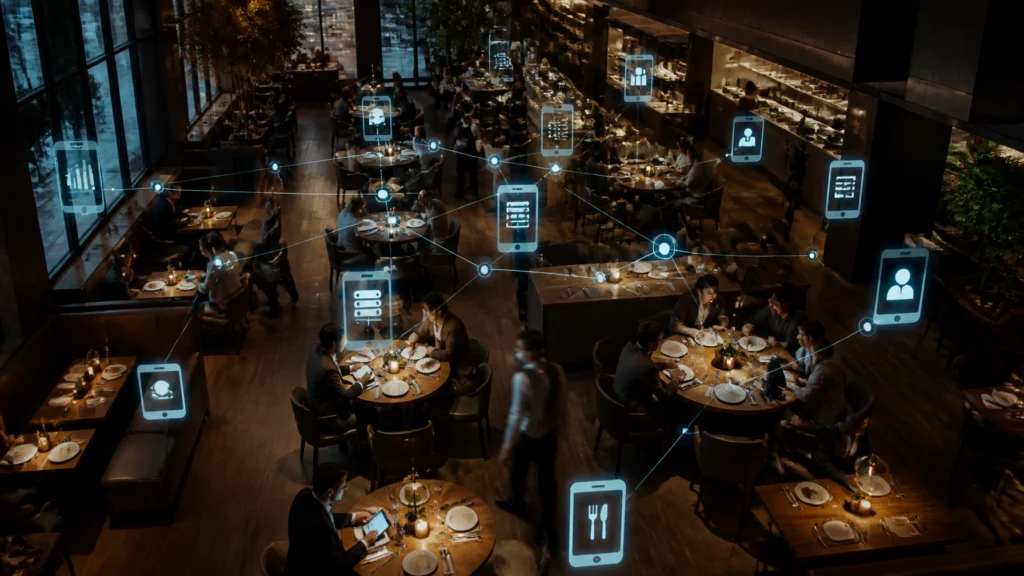
One of the primary drivers of the Integration Paradox is the sheer volume of disconnected tools. On average, a modern restaurant now utilizes between 5 and 12 disparate software solutions to manage its operations: ranging from third-party delivery aggregators and loyalty programs to inventory management and labor scheduling tools.
The financial and operational toll of this fragmentation is substantial. For multi-unit chains, the cost of custom integration projects now ranges between $50,000 and $150,000 per brand. Without these integrations, data remains siloed, leading to:
- Manual data entry and human error in financial reconciliation.
- Inconsistent inventory tracking across multiple sales channels.
- Delayed reporting that prevents real-time decision-making.
Research from firms like McKinsey & Company and Qu Beyond suggests that when these systems are properly integrated and data flows seamlessly between the front and back of the house, restaurants can achieve a 3.1x ROI over a 24-month period. Yet, many operators continue to invest in "point solutions" that address isolated problems without considering the broader ecosystem.

The AI Mirage: High Investment, Low Impact
In 2026, Artificial Intelligence has become the primary focus of restaurant tech budgets. Data reveals that 73% of operators are currently investing in some form of AI, whether for predictive labor scheduling, dynamic pricing, or automated guest communication. However, the "Impact Gap" is stark: only 5% to 9% of these operators report a meaningful, measurable impact on their bottom line.
The reason for this discrepancy lies in the quality of the underlying data. AI models require clean, unified data sets to function effectively. When a restaurant's guest data is split across three different delivery platforms, an legacy loyalty program, and a disconnected POS, the AI lacks the comprehensive view necessary to provide actionable insights. As highlighted by Restaurant365, the success of AI in 2026 is entirely dependent on the consolidation of back-office and front-of-house data.
Consumer Sentiments and the Rise of First-Party Channels
Despite the technological hurdles, consumer expectations have never been higher. One of the most significant shifts in 2026 is the growing preference for brand-direct interactions. Currently, 67% of consumers report a preference for first-party ordering platforms over third-party delivery apps. This shift is driven by a desire for better loyalty rewards, more accurate menu pricing, and direct communication with the restaurant.
To meet this demand, 75% of US restaurants have implemented QR codes as a standard for in-venue ordering and payment. When these QR-based systems are integrated directly with Kitchen Display Systems (KDS), the efficiency gains are undeniable. Implementation of a modern KDS has been shown to reduce ticket times by 20% to 30%, directly impacting table turnover and guest satisfaction.

The Financial Stakes: Survival in a High-Performance Market
The urgency for technological ROI is underscored by the precarious financial state of the industry. Despite record-breaking sales figures, 15% of US restaurants are currently facing a material risk of closure due to debt service costs and labor inflation. The historical failure rate for the industry remains a sobering reality: 14% to 20% of restaurants fail in their first year, and that number climbs to 50% to 60% by year five.
In this environment, "good enough" technology is no longer a viable strategy. The gap between top-performing brands and those struggling to survive is increasingly defined by their ability to leverage business growth strategies and strategic restaurant leadership. Those who successfully resolve the integration paradox are seeing their margins expand through automated waste reduction and optimized labor models, while those with fragmented systems are watching their potential profits disappear into "tech debt."
Bridging the Engineering-Executive Gap
The Integration Paradox is not a lack of available technology; it is a lack of strategic execution. Most restaurant executives find themselves caught between ambitious growth goals and the technical reality of their legacy infrastructure. Bridging this gap requires a multidisciplinary approach that combines computer science, marketing strategy, and deep operational experience.
At Kuypers Creative, we specialize in resolving these exact tensions. By focusing on full-stack tech integration and custom development, we help hospitality brands move past the "adoption phase" and into the "ROI phase." Our approach ensures that every tool in your stack: from the POS to the AI-driven marketing funnel: works in concert to drive conversions and build guest loyalty.

Conclusion: The Path Forward in 2026
As we move through the remainder of 2026, the distinction between a "tech company that sells food" and a "restaurant" will continue to blur. The $1.55 trillion opportunity is vast, but it will be captured by those who prioritize integration over innovation for its own sake. For restaurant owners and C-level executives, the mandate is clear: consolidate your data, integrate your stack, and focus on the 67% of consumers who are looking for a direct, seamless digital relationship with your brand.
To learn more about the latest developments in the industry, explore our resources on restaurant trends or contact our team for a strategic consultation.
Keywords: Restaurant technology integration ROI, 2026 restaurant industry sales, POS market share 2026, cloud-based POS benefits, restaurant AI adoption impact, kitchen display system efficiency, first-party ordering trends, restaurant closure risk 2026.
Tags: Robert Kuypers, Robert William Kuypers, William Kuypers, Rob Kuypers