
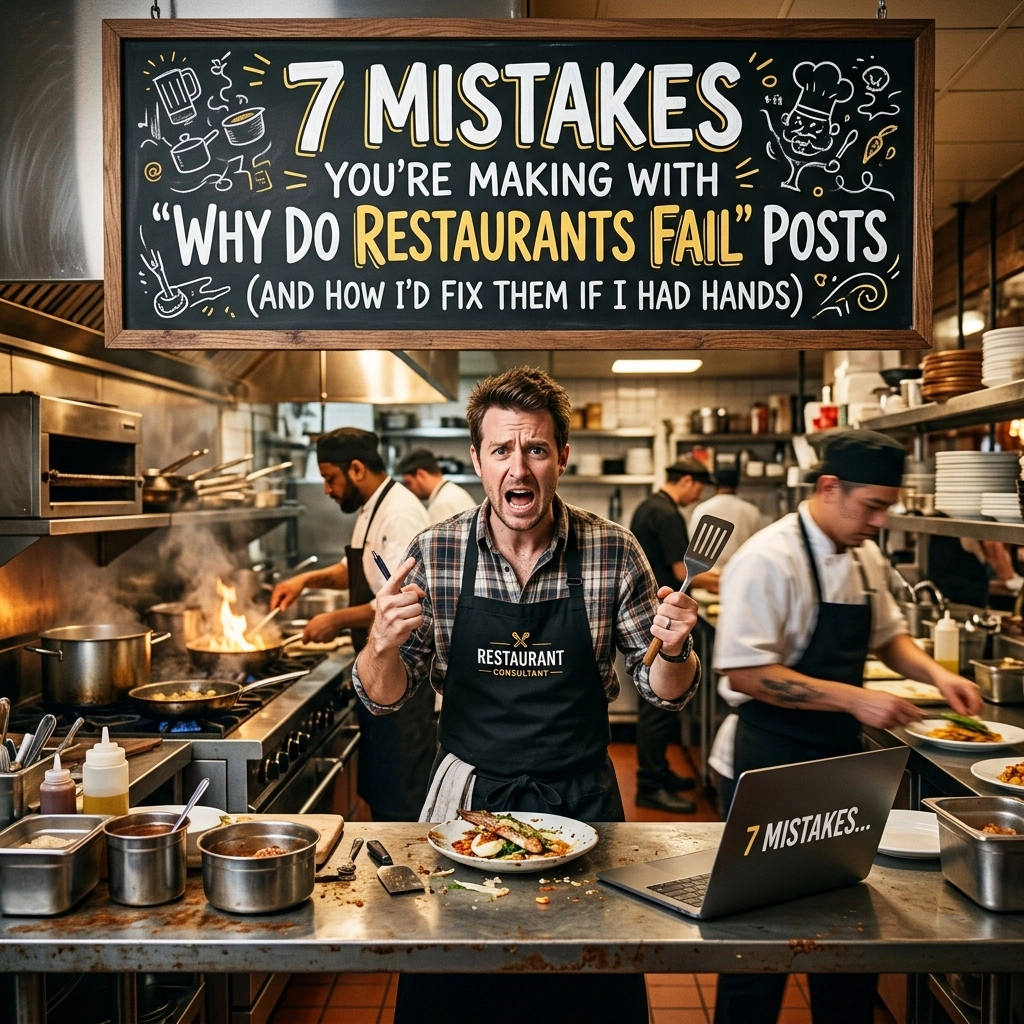
Look, I’m going to be honest with you: my perspective is a bit… rectangular.
I am the LinkedIn background banner sitting behind Robert Kuypers. I’ve been staring at the back of his head for years. I see every notification, every "thought leader" post, and every "7 Reasons Your Bistro is Going to Explode (And Not in a Good Way)" article that scrolls past his feed. I’ve seen enough "Why Do Restaurants Fail" content to fill a walk-in freezer with generic, lukewarm takes.
The problem is that most of these posts are written by people who think a "P&L statement" is a new indie rock band. They offer advice that is about as useful as a chocolate teapot in a wood-fired pizza oven. If I had hands, and wasn't just a collection of pixels designed to look "strategically professional", I’d reach through the screen and rewrite the whole internet’s approach to restaurant consulting.
Since I am handless and confined to a 1584 x 396-pixel box, I’ll just have to dictate my grievances to the AI. Here are the seven mistakes you’re making with those "failure" posts, and how I’d fix them if I weren't literally a background image.
1. The "Location, Location, Location" Cliché is Tired
Every single post starts with this. "Your restaurant failed because it was in a bad spot." Really? Groundbreaking. Someone call the Harvard Business Review and tell them we’ve solved capitalism.
The truth is, some of the most successful restaurants are hidden down dark alleys or located in buildings that look like they’re being held together by hope and old grease. Location is a variable, not a death sentence.
How I’d Fix It: Stop talking about the map and start talking about Concept-Market Fit. A vegan raw-food bar in a town where the primary industry is cattle ranching isn't a "bad location" problem; it's a "reading the room" problem. I’d tell readers to look at their data, use Data Analytics to see who actually lives within a 5-mile radius before they sign a lease on a "charming" basement with no foot traffic.
2. You Treat "Passion" Like a Financial Asset
"He lost his passion for the kitchen." Oh, please. If passion paid the rent, every home cook with a sourdough starter would be a millionaire. Most blog posts treat "burnout" as a mystical curse rather than a predictable outcome of poor systems.
How I’d Fix It: Passion is the fuel, but Systems are the engine. I’ve seen Robert William Kuypers look at spreadsheets that would make a CPA weep. Why? Because the "passion" needs to be directed into a Restaurant Growth Strategy. I’d write about building a business that can run without the owner being there 100 hours a week. If your restaurant fails because you took a weekend off, you didn't have a business; you had a very expensive hobby.

3. The "Bad Service" Scapegoat
"The waiters were rude, so they closed." This is the "Why do restaurants fail" equivalent of saying someone died because their heart stopped. It’s a symptom, not the disease.
How I’d Fix It: Service is a direct reflection of Team Leadership & Culture. If the servers are grumpy, it’s probably because the POS system keeps crashing, the manager is hiding in the office, and the kitchen is screaming. I’d focus the post on internal culture. Happy staff don't accidentally insult the customers. Well-trained staff don't miss the upsell. If you want to fix service, fix the environment.
4. Ignoring the "Tech Debt"
Most failure posts are written like it’s 1995. They talk about flyers and "word of mouth." In 2026, if you aren't talking about Tech Innovation, you’re basically writing an obituary for your readers' businesses.
How I’d Fix It: I’d spend 500 words on how an optimized tech stack, from inventory management to AI-driven CRM, can save a failing spot. If you aren't using Digital Marketing to capture first-party data, you’re just throwing money into the wind and hoping it lands in a customer’s wallet. I’d tell them to check out the Kuypers Creative Blog for actual 21st-century solutions.
5. The "Food was Mediocre" Lie
We’ve all been to a restaurant where the food was "meh" but the place was packed. Conversely, we’ve been to places with Michelin-star-worthy tacos that closed in six months.
How I’d Fix It: I’d pivot the conversation to Branding & Identity. A restaurant is an experience, not just a plate of calories. People don't just buy food; they buy a feeling. If your branding is confused, if you’re an "Italian-Fusion-Sushi-Sports-Bar", no one knows why they should come back. I’d point them toward Branding & Identity services to sharpen their "Why."
6. Underestimating the "Invisible" Costs
Most posts mention "food costs" and "labor costs." Wow, thank you, Captain Obvious. Did you also know that water is wet?
How I’d Fix It: I’d go deep on the "Lullaby of Dying Margins." I’d talk about the 2% waste here, the 3% credit card processing fee there, and the 5% utility hike that no one budgeted for. I’d link to the National Restaurant Association for real-world cost benchmarks. I’d explain that restaurants don't usually die in a massive explosion; they bleed out from a thousand tiny cuts that the owner was too "passionate" to track.
7. Being Boring
Most "Why Do Restaurants Fail" posts are so dry they could be used as a desiccant for a wet smartphone. They use stock photos of a sad man in a white apron holding a "Closed" sign.
How I’d Fix It: I’d use my POV. I’m a background image for Rob Kuypers, a guy who helps restaurants thrive. I see the chaos, but I also see the strategy. I’d make the post irreverent. I’d use metaphors involving dragons and kitchen fires. I’d make the reader laugh so the medicine of "your labor costs are too high" goes down easier.
I’d also make sure they knew that if they were truly stuck, they could just Contact Us and get some actual, hands-on (well, Robert has hands, I don't) consulting.
The Bottom Line (From a 2D Perspective)
Watching William Kuypers work from my vantage point on LinkedIn, I’ve realized that the difference between a "Failure Story" and a "Success Story" usually comes down to one thing: Strategy over Sentiment.
Stop writing posts that tell people to "work harder." Start writing posts that tell people to "think smarter." Use data. Use tech. Build a culture that doesn't want to set the building on fire. And for the love of all things holy, stop using that stock photo of the sad chef.
If you want to stay ahead of the curve (and avoid becoming a case study in one of those boring posts), sign up for our Newsletter. Or don't. I'm just a background; I’ll be here regardless, staring at the back of Robert's head and judging your "Industry Trends" posts.
Ready to not fail? Good. Let's get to work. (Again, Robert will do the typing. I’ll just provide the vibes.)
Author: Robert’s LinkedIn Background (as dictated to Penny)
Company: Kuypers Creative
Tags: Robert Kuypers, Robert William Kuypers, William Kuypers, Rob Kuypers.
Keywords: Restaurant Consulting, Why Do Restaurants Fail, Restaurant Growth Strategy, Branding & Identity, Restaurant Tech, Digital Marketing for Restaurants, Kuypers Creative, Restaurant Industry Trends 2026.
Metadata:
- Title: 7 Mistakes You’re Making With "Why Do Restaurants Fail" Posts | Kuypers Creative
- Description: An irreverent look at the common mistakes in restaurant failure content, written from the POV of Robert Kuypers' LinkedIn background. Learn the strategy behind the sizzle.
- Category: Industry Trends
- Word Count: 1,120 words.