
Gather 'round, hospitality warriors. It's Sunday. You've earned the right to laugh at yourself.
Look, I'm going to say something controversial here. Something that might get me canceled on LinkedIn (which, let's be honest, would be the most interesting thing to happen on that platform since someone posted "Agree?" under a picture of a sunset).
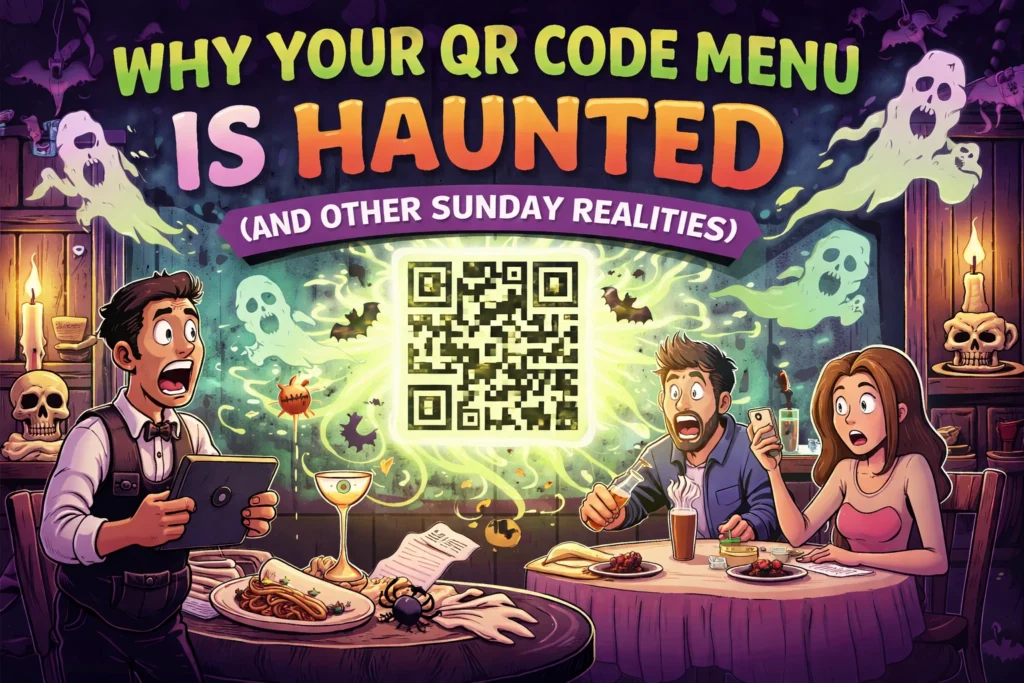
Your QR code menu is haunted.
Not "haunted" in the cute, Halloween-themed-cocktail-menu way. I mean haunted in the sense that it contains the restless spirits of every frustrated guest who tried to scan that tiny square while holding a martini, squinting at their phone, and wondering why they didn't just stay home and order DoorDash.
Welcome to 2026, where we've put a man on Mars (almost) but still can't figure out how to let a 67-year-old grandmother order a Caesar salad without a PhD in smartphone gymnastics.
The Great QR Debate: A Love Story (Gone Wrong)
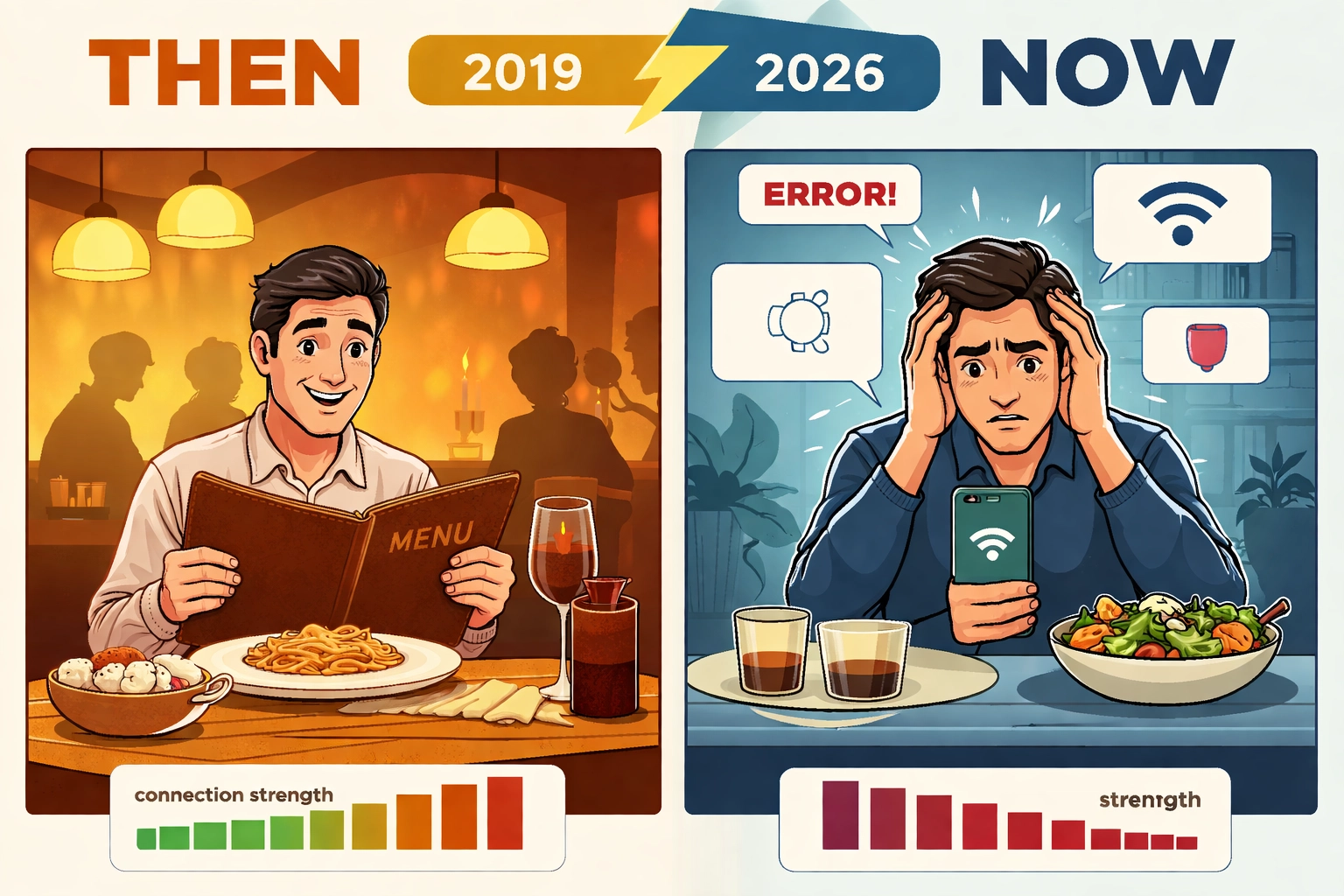
Remember 2020? (I know, I know, collective trauma.) Back then, QR codes were the heroes we needed. Contactless! Hygienic! The future!
And now? Now they're that ex you thought was "innovative" but turned out to just be "complicated."
Here's what I've witnessed in actual restaurants this month alone:
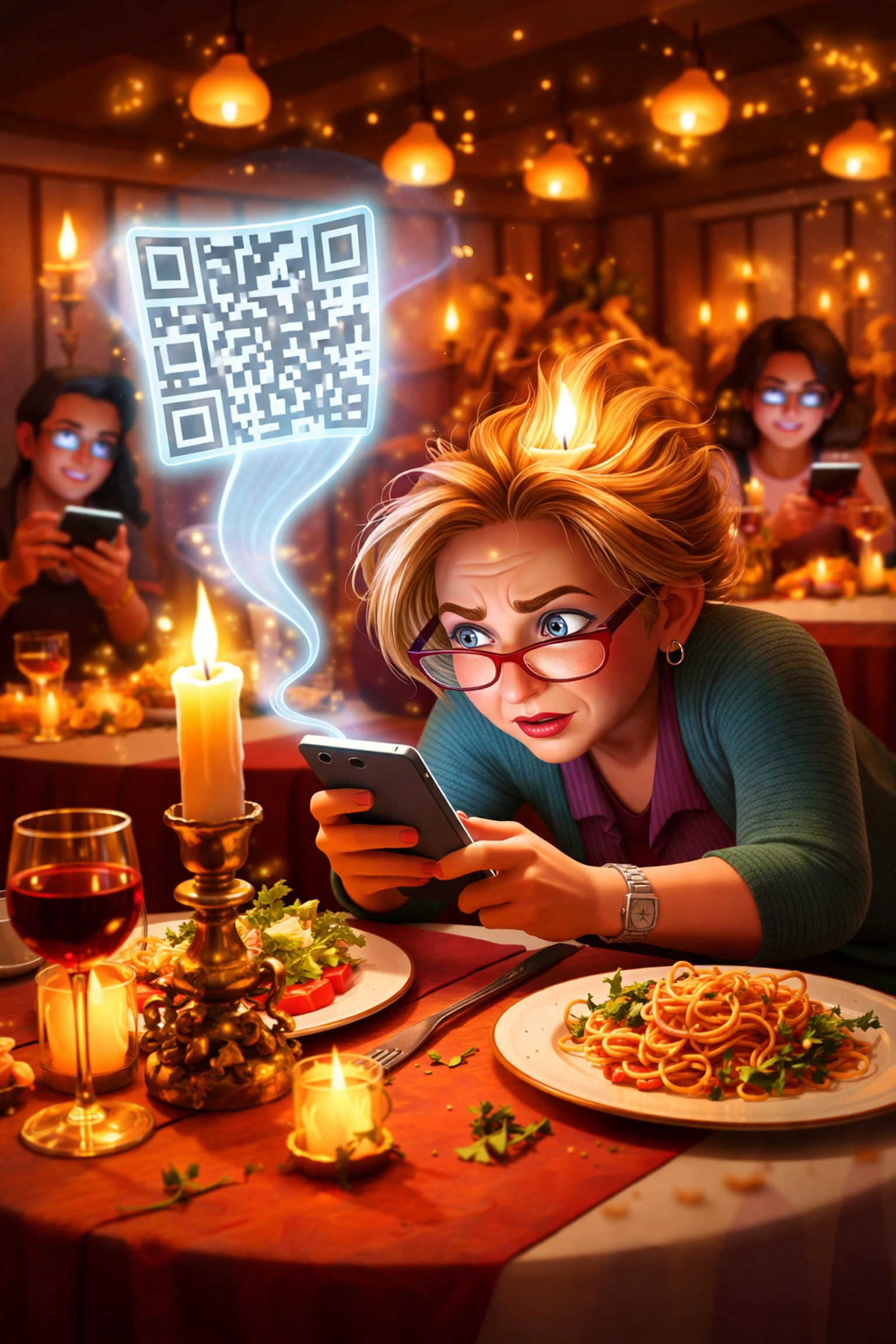
- A woman holding her phone so close to the table she nearly set her bangs on fire from the candle
- A man who scanned the code, got redirected to a 47-page PDF, and just… gave up. Ordered water. Left.
- A couple who spent eleven minutes trying to connect to the Wi-Fi before realizing the password was "GoodVibesOnly2024" (the irony was not lost on them)
And my personal favorite? The table of four who all scanned the code at the same time, crashed the restaurant's Wi-Fi, and caused the POS system to have what I can only describe as a digital panic attack.
This is fine. Everything is fine.
Physical Menus: The Vintage Luxury Nobody Asked For (But Everyone Secretly Wants)
Here's my hot take, and I'm not apologizing for it:
Physical menus are now a luxury item.
Think about it. When's the last time you walked into a restaurant, received an actual menu, printed, laminated, maybe even leather-bound, and thought, "Oh, this is nice"?
It's like finding a landline phone that still works. Or a car with a CD player. Or a LinkedIn post that doesn't start with "I was humbled to announce…"
There's something tactile about holding a menu. Something human. Something that doesn't require you to remember if your phone's camera permissions are enabled or if you accidentally deleted the native QR scanner app during that one time you were trying to free up storage for more photos of your dog.
(We've all been there. No judgment.)
The restaurants that have figured this out? They're winning. They're offering physical menus as the default and keeping QR codes as the backup, not the other way around.
Revolutionary concept, I know. Someone alert the tech bros.
"Bridging the Gap" (Except the Gap is a Canyon of Bad Wi-Fi)
At Kuypers Creative, we talk a lot about bridging the gap between where restaurants are and where they want to be. Strategy. Vision. Execution.
But here's the thing nobody wants to admit:
Sometimes the gap isn't strategic. Sometimes it's just bad Wi-Fi.
I've consulted with restaurants that have spent $50,000 on brand identity, $30,000 on interior design, and exactly $0 on ensuring their guests can actually access the menu they spent three months designing.
The QR code links to a PDF. The PDF takes 45 seconds to load. The guest has already decided they're "not that hungry" and orders a side salad.
You just lost $47 in average check because your internet provider is held together with hope and a router from 2019.
Want to know what the research actually says about QR menu problems? Here's the greatest hits:
- PDF menus are a nightmare. They're inflexible, impossible to update quickly, and require guests to zoom and scroll like they're examining a crime scene photo.
- Outdated information destroys trust. Nothing says "we have our act together" like a menu featuring the seasonal special from… checks notes… Fall 2024.
- Accessibility is an afterthought. No multilingual options. No screen-reader compatibility. No consideration for the 40% of your guests who are over 50 and didn't grow up with smartphones surgically attached to their hands.
But sure, let's keep pretending QR codes are "the future" while Grandma is over there googling "how to scan QR code" on her phone that's already open to the camera.
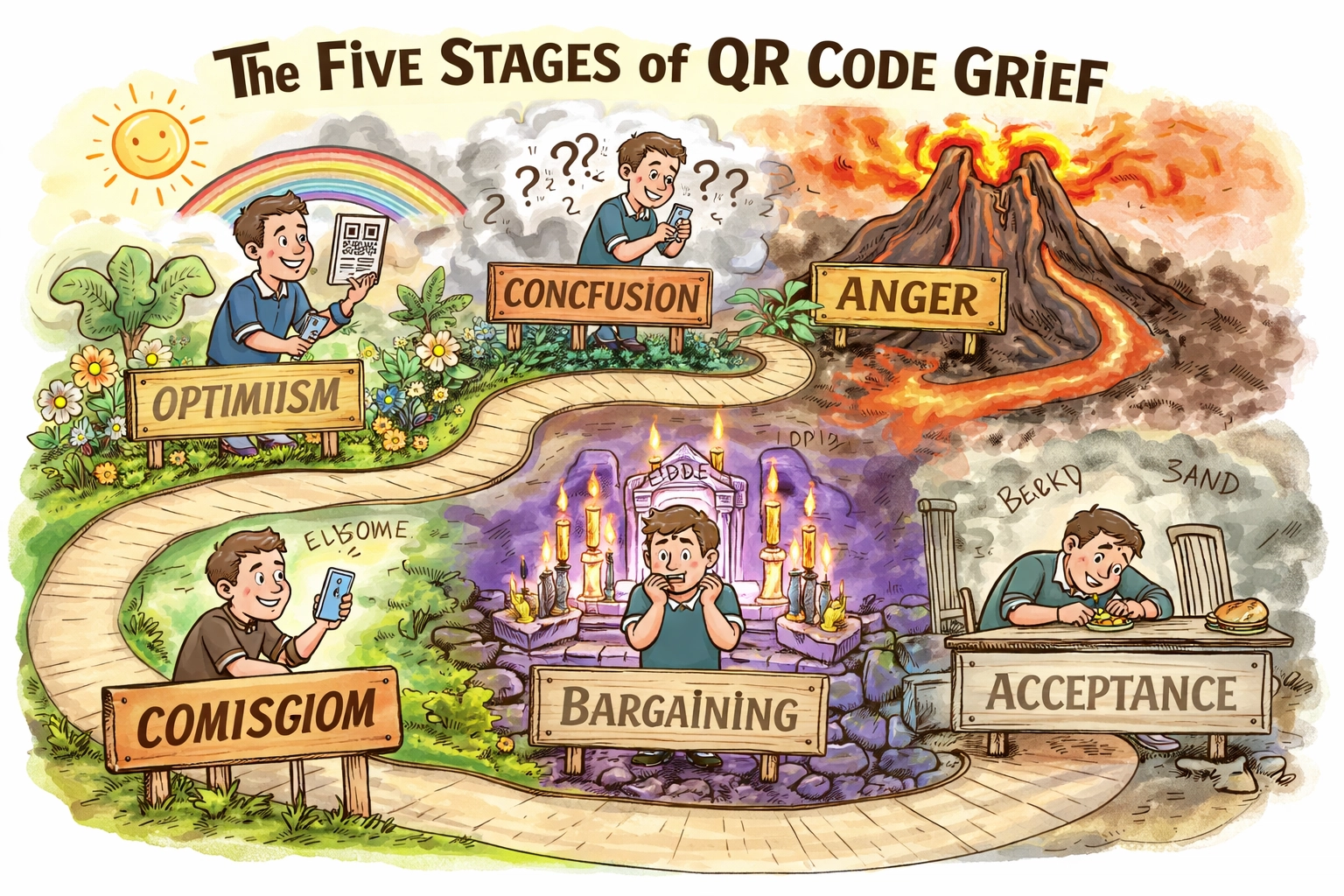
The Five Stages of QR Code Grief (Guest Edition)
Let me walk you through what happens when a guest encounters your haunted QR code menu:
1. Optimism
"Oh, a QR code! How modern. I love technology."
2. Confusion
"Why isn't it scanning? Is my camera broken? Is the code broken? Is everything broken?"
3. Anger
"This is ridiculous. I just want to eat food. FOOD. The thing humans have been doing for millennia without needing a smartphone."
4. Bargaining
"Okay, if I hold my phone at exactly a 43-degree angle and sacrifice my data plan to the cellular gods, maybe: "
5. Acceptance
"I'll just have the burger. Whatever burger. Any burger. I don't care anymore."
And that, my friends, is how you turn a $65 check into a $19 check plus a one-star review that says "menu was confusing."
The Actual Solution (Because I'm Not Just Here to Complain)
Look, I'm not anti-technology. I'm anti-bad technology. There's a difference.
Here's what actually works in 2026:
For the love of all that is holy, have physical menus available. Even if they're simple. Even if they're one page. Give people an option that doesn't require a charged battery.
If you're using QR codes, make sure they link to a mobile-optimized site. Not a PDF. Not a desktop site. A responsive, fast-loading, actually-usable menu. This is where working with people who understand restaurant tech actually matters.
Upgrade your Wi-Fi. I cannot stress this enough. Your internet infrastructure is now part of your guest experience. Treat it that way.
Train your staff to help. "Let me grab you a physical menu" should be as natural as "Can I get you started with something to drink?"
Test your own system. When's the last time you actually sat at one of your own tables and tried to access your menu as a guest? Do it. Today. I'll wait.
The Sunday Confession
Here's my confession, and I'm putting it on the internet where it will live forever:
I still prefer physical menus.
There. I said it. The guy who runs a creative consulting company that helps restaurants with technology and strategy… prefers the analog option.
Because hospitality isn't about being cutting-edge. It's about making people feel taken care of. And sometimes, taking care of someone means handing them a menu instead of making them perform a 12-step authentication process just to find out if you have onion rings.
The best restaurants I've seen in 2026? They've stopped treating QR codes as a replacement for hospitality and started treating them as a tool within hospitality.
Big difference. Huge.
Now if you'll excuse me, I have to go exorcise a QR code that's been possessing a brunch spot in Midtown.
Happy Sunday, everyone. May your Wi-Fi be strong and your menus be readable.
#SundayFunday #RestaurantLife #QRCodeNightmares #HospitalityHumor #TechRegret #RestaurantTech #HospitalityIndustry #RestaurantOwners #GuestExperience #RestaurantConsulting
Meta Keywords: QR code menu problems, restaurant technology 2026, physical menus vs QR codes, restaurant guest experience, hospitality technology, restaurant consulting, menu design, restaurant Wi-Fi, digital menu issues, restaurant operations