
It’s 7:15 PM on a Friday. Your lead server just dropped a tray of martinis, Table 4 has been waiting for their check for twenty minutes (they’re currently staring at their watches like they’re timing a bomb), and the kitchen is backed up because the expeditor decided today was a great day to have an existential crisis. You are one person. You have two eyes. And unless you’ve figured out how to clone yourself, which, if you have, please email me immediately because we have a consulting gig for you, you are physically incapable of seeing every bottleneck, safety hazard, and missed service cue on your floor.
But what if your cameras weren’t just "security" cameras? What if they were the smartest members of your management team?
Welcome to the era of Video Analytics. It’s not just about catching someone pocketing a twenty from the till (though it does that too). It’s about turning your video feed into a fountain of actionable data that keeps your margins from becoming a "lullaby of dying profits."
Ready? Aprons on. Let’s look at why this tech is the ultimate game-changer for restaurant floor management.
From "Security" to "Strategy"
For decades, restaurant CCTV has been a passive observer. It sits there, collecting dust and grainy footage of the back alley, only to be consulted when something goes wrong. It’s reactive. It’s the digital equivalent of a "Wet Floor" sign that you put out after someone has already done a backflip into the salad bar.

Video analytics changes the game by shifting from reactive to proactive. By using AI to "watch" the floor, the system can identify patterns, anomalies, and specific behaviors in real-time. We’re talking about a system that understands the difference between a busy line of customers and a bottleneck that’s about to cause a walk-out. According to Nations Restaurant News, the integration of AI in physical spaces is one of the top trends for 2025 and 2026.
As I’ve mentioned in my LinkedIn posts, the "eyes" of your restaurant are your most underutilized asset. If you aren't using your video feed to optimize your flow, you're essentially flying a plane with the windows blacked out.
1. The Death of the "He Said, She Said" (Safety & Compliance)
We’ve all been there. A customer claims they slipped on a grape. A server claims they followed all the closing procedures. In the old days, you’d spend four hours scrubbing through footage that looks like it was filmed through a potato.
With modern video analytics, the system identifies the "grape incident" the moment it happens. AI can detect spills or debris on the floor and send an instant alert to the manager’s smartwatch. “Hey, there’s a hazard in Zone B.” You fix it before the lawsuit even has a chance to germinate.
It’s also about compliance. Are your cooks wearing their hairnets? Is the prep team following the "First In, First Out" (FIFO) rule? Instead of hovering like a helicopter parent (which we all know ruins team leadership and culture), you get a daily report of compliance scores. Boring wins. Boring pays. Boring is the new sexy.
2. Labor Optimization (The Real Goldmine)
Labor is likely your biggest headache. It’s the dragon you’re constantly trying to slay. Usually, we schedule based on "gut feeling" or last year's sales. But sales don't tell the whole story. Sales don't tell you that your host stand was slammed at 4 PM, but everyone sat themselves because the host was doing a bathroom check.
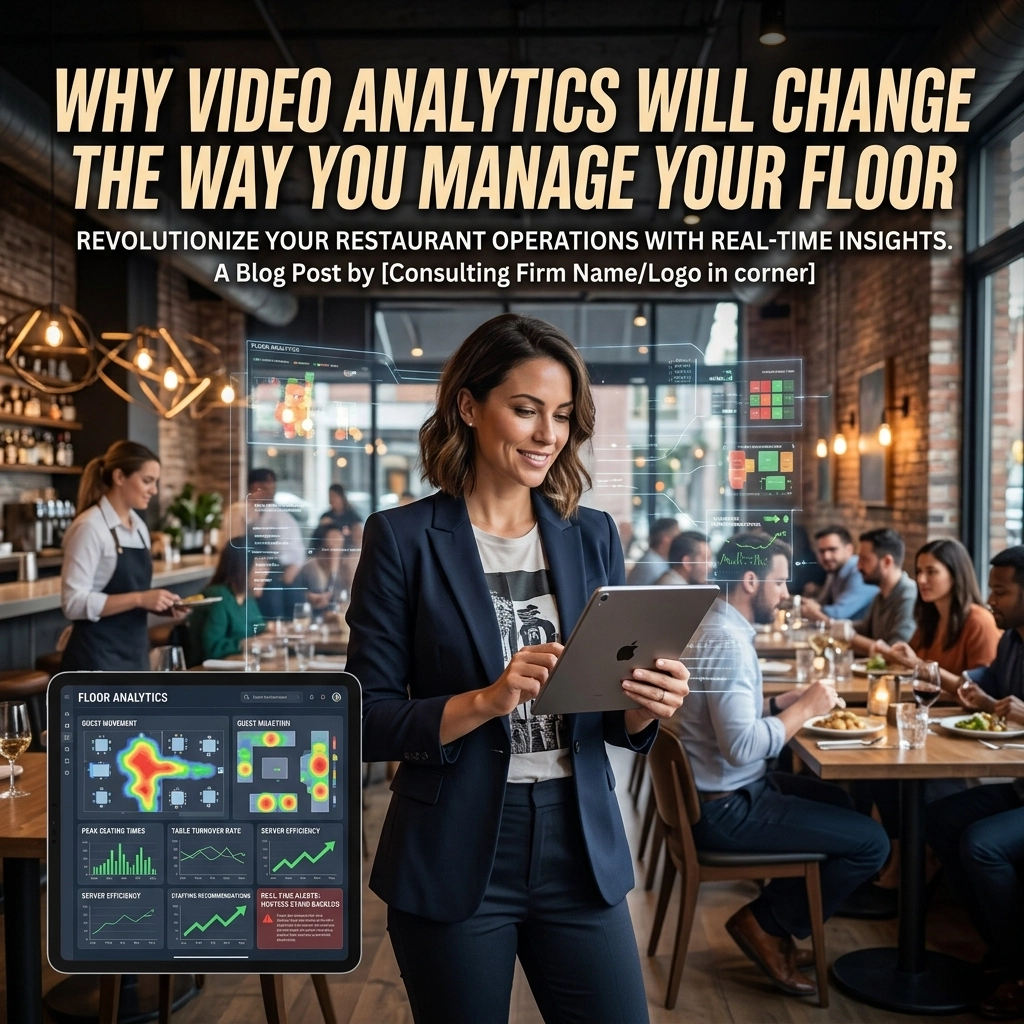
Video analytics provides Heat Maps.

These maps show you exactly where people congregate and where the "dead zones" are. You might find that your expensive patio is actually a desert most of the day, while your bar area is packed to the point of discomfort.
- Dwell Times: How long is a guest standing at the host stand before being greeted?
- Service Cycle Times: How long from the moment the food hits the pass to the moment it hits the table?
If your data shows that guests are lingering for 15 minutes after paying their bill, you don't need more servers: you need a strategy to turn those tables faster. Check out our deep dive on restaurant growth strategy for more on this.
3. Loss Prevention: Beyond the Cash Drawer
Let’s be honest: loss prevention is usually about internal theft. But it’s also about "sweethearting" (giving away free drinks to friends) and "void" manipulation.
Advanced video analytics connects directly to your POS system. If a "Void" is rung up, the system automatically bookmarks that exact moment in the video. You don’t have to search; the "dragon" is served to you on a silver platter. According to Spot AI, restaurants using AI-driven video intelligence see an average reduction in "shrinkage" of up to 25%. That’s pure profit going back into your pocket.

4. The "Guest Experience" Dashboard
We often think of data analytics as something that happens behind a computer screen, far away from the guest. But video analytics is the bridge.
Imagine getting a notification that "Table 12 has been without a drink for 8 minutes." Or "Queue length at the counter exceeds 5 people; open Register 3." This is how you manage a floor in 2026. You aren't guessing where the fire is; the system is showing you the smoke before the curtains catch fire.
This level of tech integration is part of the broader restaurant technology trends for 2025 that we are seeing across the industry. It’s about moving from "Management by Walking Around" to "Management by Exception." You only intervene when the data tells you something is off.
How to Implement Without Looking Like "Big Brother"
I know what you’re thinking. "Rob, my staff is going to think I’m running a high-security prison."
Here is the secret: Transparency.
When you introduce video analytics, don't frame it as a tool to "catch" people. Frame it as a tool to support them.
- "We are using this to see when you're overwhelmed so we can send help."
- "We are using this to prove that you did follow safety protocols if a customer makes a false claim."
- "We are using this to make sure the kitchen isn't hanging you out to dry."
When the team sees that the tech helps them make more tips (through faster table turns) and experience less stress (through better scheduling), they’ll embrace it. If you want to know more about the "why" behind these shifts, read our article on why restaurants are hard.
The Bottom Line
The restaurant industry is a game of inches. A 1% shift in labor cost or a 2-minute reduction in table turn time can be the difference between a thriving business and a "For Lease" sign in the window. Video analytics isn't a luxury anymore; it's a survival tool.
Stop looking at your cameras as a way to see what happened yesterday. Start using them to see what’s happening right now.
Ready to level up your floor management? Whether you need a full tech innovation overhaul or just a partner to help you navigate the data, Kuypers Creative is in your corner. Let’s get to work.
Ready? Aprons on.
Keywords & Metadata
Keywords: Restaurant Video Analytics, Floor Management Tech, Restaurant AI, Hospitality Operations, Loss Prevention, Restaurant Labor Optimization, Heat Mapping for Restaurants, AI Safety Monitoring.
Long-tail Keywords: How video analytics improves restaurant efficiency, reducing restaurant labor costs with AI cameras, pro-active restaurant safety management systems, using data to improve guest experience.
Meta Description: Discover how video analytics is transforming restaurant floor management from reactive security to proactive strategy. Learn how heat maps and AI can optimize labor and increase profits.
Tags:
Robert Kuypers, Robert William Kuypers, William Kuypers, Rob Kuypers, Kuypers Creative, Restaurant Technology, Data Analytics, Hospitality Trends 2026.