
Listen, I’ve spent more hours staring at grainy security footage than I care to admit. It’s usually a blurry mess of someone accidentally dropping a tray or a "mysterious" case of a disappearing steak. But let’s be real: traditional CCTV is a graveyard of "what happened" rather than a dashboard for "what’s happening."
If you’re still using your cameras just to catch the occasional thief, you’re essentially using a Ferrari to go through a drive-thru. You’ve got the power; you’re just not using the gears. Video analytics is the upgrade that turns your passive observers into active, hyper-intelligent managers that never sleep, never take a smoke break, and, most importantly, don't miss a single detail.
Ready? Aprons on. Let’s dive into why AI-powered video is about to save your margins (and your sanity).
Stop Guessing, Start Seeing (The "Invisible" Manager)
We’ve all been there. It’s 7:00 PM on a Tuesday, the dining room is suddenly slammed, and your servers look like they’re trying to put out a curtain on fire with a water pistol. You wonder, “Did I under-schedule, or is the kitchen just dragging?”
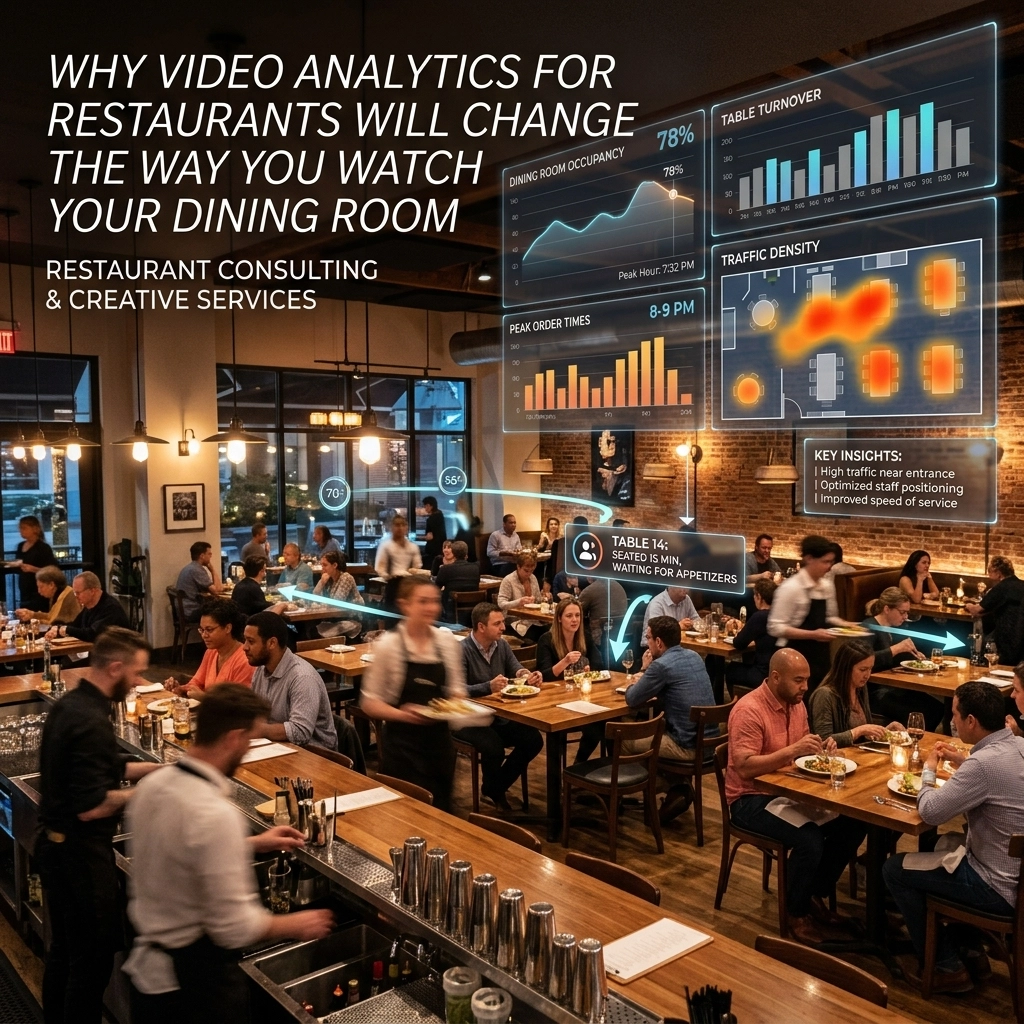
In the old days, you’d check the logs the next day and sigh. With modern video analytics, the system identifies overcrowding in real-time. It doesn’t just record the chaos; it alerts you to it.

Using trajectory mapping and people-counting technology, these systems can detect when a line at the host stand exceeds a certain threshold. Imagine getting a ping on your phone that says, "Hey Rob, the entrance is bottlenecked: move a floater to the front." That is the difference between a lost customer and a 5-star review.
As I recently mentioned on LinkedIn, restaurant success isn't about working harder; it's about working smarter with the data you already have. You can find more on this at Kuypers Creative Restaurant Leadership.
The Math of the Dining Room: Heatmaps and Dwell Times
You might think your floor plan is perfect. You might think that cozy corner booth is the most popular spot in the house. But the data often tells a different story.
Video analytics creates heatmaps of your restaurant. It shows you exactly where people congregate and where they avoid.
- Dwell Time: How long are they sitting there after the check is paid?
- Traffic Flow: Are they bumping into each other near the restrooms?
- Service Speed: How long does it actually take for a server to acknowledge a new table?

When you look at a heatmap, you might realize that your self-checkout kiosk is in a "dead zone" (essentially a graveyard for potential revenue). By shifting it three feet to the left based on actual traffic patterns, you could see a double-digit increase in usage. According to the National Restaurant Association, tech-driven operational efficiency is no longer "nice to have": it’s a survival requirement in 2026.
Slaying the "Dining Room Dragons": Theft and Loss Prevention
Let’s talk about the elephant in the room: theft. It’s the "lullaby of dying margins." Whether it’s "sweethearting" (giving freebies to friends) or straight-up skimming, it hurts.
A study from the Olin Business School at Washington University found that restaurants using smart monitoring systems saw a 22% decrease in identifiable theft. Twenty-two percent! That’s the difference between being in the red and having a blowout year.
These systems integrate directly with your POS. If a drawer opens but no sale is recorded, the camera flags that exact timestamp. It’s not about being "Big Brother"; it’s about protecting your investment. You worked too hard to build this brand to let a few "accidental" voids eat your profit. If you're looking to tighten up your bottom line, check out our resources on Restaurant Revenue.

The Hygiene Police (Without the Badge)
We live in an era where one video of a cook not wearing gloves can go viral and end a decade-long legacy in three hours. (Scary, right? It keeps me up at night too.)
Video analytics can now monitor compliance with hygiene protocols.
- Handwashing: Did the staff member spend the required 20 seconds at the sink?
- PPE: Are hairnets and gloves being worn in the prep area?
- Cross-Contamination: Did someone just use the raw chicken knife on the lettuce?
The AI can detect these patterns and send an immediate alert to the shift lead. It’s proactive coaching rather than reactive firing. It builds a culture of excellence because the team knows the standard is always being watched (and met).
Data-Driven Scheduling (Boring Wins, Boring Pays)
I say it all the time: Boring wins. Boring pays. Boring is the new sexy.
What’s boring? A perfectly optimized labor schedule. By using historical video data to see when your peaks actually happen (not just when the POS says the sales happened), you can staff with surgical precision.

If your video analytics show that customers start lingering longer on Thursday nights starting at 8:30 PM, you don't cut your floor staff at 9:00 PM just because the kitchen slowed down. You keep that one extra server to handle the "dwellers" who are about to order a third round of drinks. That is how you maximize Business Growth.
Actionable Checklist: Is Your Restaurant Ready for Video AI?
If you're thinking about making the jump, don't just buy the first "smart" camera you see on Amazon. Here is what you need to look for:
- POS Integration: Can the video talk to your sales data?
- Cloud Accessibility: Can you watch the "brain" of your restaurant from your phone while you’re at the beach? (You deserve a beach day, by the way.)
- Real-Time Alerts: Does it send push notifications for spills or long wait times?
- Heatmapping Capabilities: Can it show you the "hot" and "cold" zones of your dining room?
- Scalability: Will this work if you open three more locations next year? (Spoiler: You should plan as if you will.)
The Bottom Line
Video analytics isn't just about security; it's about visibility. It’s about taking the blinders off and seeing your business for what it truly is: a series of movements, interactions, and opportunities.
The industry is moving fast. The "old school" way of managing by "gut feeling" is a recipe for a closed sign. Use the tech. Trust the data. Watch your dining room like a pro.
Ready to scale? Let’s get to work.
: Robert
Keywords & Metadata
Keywords: Video Analytics for Restaurants, Restaurant Technology Trends 2026, AI in Food Service, Restaurant Loss Prevention, Heatmapping for Dining Rooms, Restaurant Operational Efficiency, Robert Kuypers, Restaurant Consulting.
Long-tail Keywords: How to reduce restaurant theft with AI, benefits of real-time video monitoring for dining rooms, using video analytics for restaurant staffing, improving food safety compliance with cameras.
Meta Description: Discover how AI-powered video analytics is transforming restaurant management. From reducing theft by 22% to optimizing floor plans with heatmaps, learn why this tech is a game-changer for your margins.
Tags: Robert Kuypers, Robert William Kuypers, William Kuypers, Rob Kuypers, Trending Tech in Restaurants, Restaurant Revenue, Business Growth, Restaurant Leadership.
External Links: