
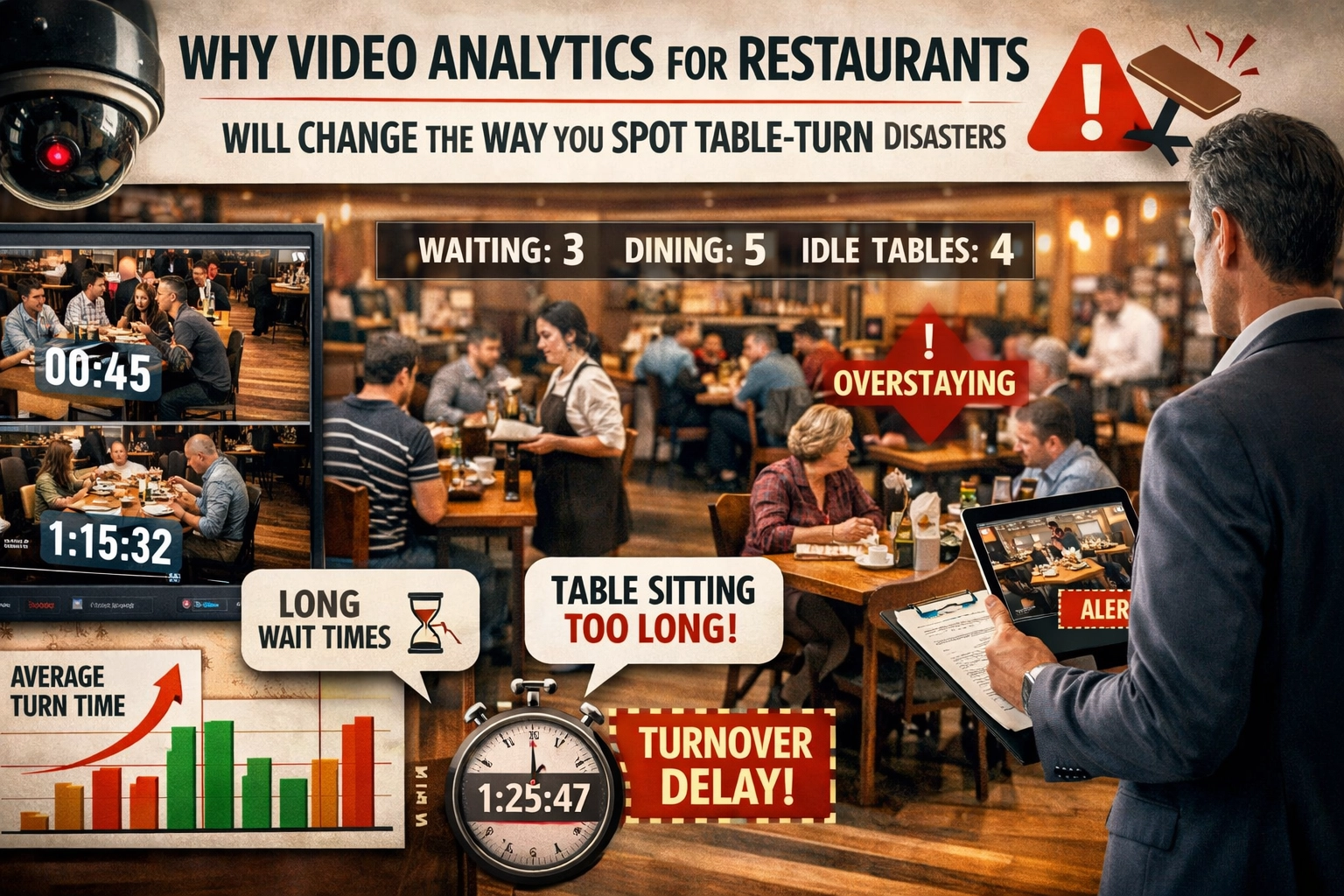
Table-turn disasters aren’t “bad nights.” They’re patterns wearing a disguise.
If you’ve been in restaurants longer than a week, you know the story:
- The host stand is quoting 25 minutes (it’s actually 45).
- The dining room is “full”… yet you can see empty tables (the cursed, uncleared ones).
- The kitchen is humming, but food dies in the window like it’s taking a nap.
- Guests are doing that universal signal for “Hello? I’d like to pay and leave this relationship”.
And then the manager does the traditional ritual: walks the floor, guesses the cause, and changes three things at once (so now you can’t tell what fixed what). Respectfully: that’s vibes-based operations. Vibes are great for playlists, not for throughput.
Video analytics is the difference between:
- “I think tables are turning slow”
- and “Table 12 averaged 19 minutes between check-drop and payment from 7:10–8:05pm, and it spiked when we ran one fewer busser.”
Ready? Aprons on.
What video analytics actually is (and what it isn’t)
Let’s keep this simple and not dystopian.
Video analytics for restaurants uses cameras + software to measure flow and time-based events like:
- guest dwell time
- wait time and queue length
- time-to-greet
- time-to-check-drop
- time from guest departure → table reset → seated again
- traffic patterns (where staff and guests bunch up)
It’s not “watching employees” like a reality show. The best systems focus on operational timestamps and movement patterns, not creepy micromanagement. Think: stopwatch + heatmap, not “gotcha” footage.
If you’re already using tech to measure sales and labor, this is the missing layer: measuring space, motion, and friction.
External reads worth your time:
- National Restaurant Association trends and research: https://restaurant.org/research-and-media/
- Toast Restaurant Trends (tech + ops benchmarks): https://pos.toasttab.com/resources/restaurant-trends
- Deloitte Food Service & restaurant insights: https://www2.deloitte.com/us/en/industries/consumer/food-service.html
Why table turns go off the rails (the usual suspects)
Table-turn problems are rarely one big failure. They’re usually five small delays that stack like Jenga.
Here are the most common bottlenecks video analytics can expose in real time:
-
Host stand compression
- Parties arrive early, linger in the entryway, block movement, and the quote time becomes fiction.
-
The “dead table” interval
- Guest leaves. Table sits. No one clears it. It becomes that haunted table everyone avoids.
-
Server bottleneck zones
- POS terminal area. Server station. Expo line. (If your restaurant has a “clump spot,” you know.)
-
Payment drag
- Check dropped late.
- Payment collected late.
- Payment processed late.
- Receipts vanish into another realm.
-
Reset inconsistency
- Some tables are reset in 90 seconds.
- Others take 6 minutes because silverware is missing, sanitizer is missing, or “someone else is doing it.”
Video analytics helps you stop guessing which one is killing you tonight.
The game-changer: dwell time + flow analysis (aka “where your night is leaking money”)
Two metrics matter more than most operators admit:
1) Dwell time
How long guests occupy tables (from seat to leave). This changes by:
- server pacing
- menu complexity
- bar ticket times
- check process
- dessert push (or lack of it)
- payment method friction
Video analytics tracks dwell time objectively by table zone, so you can see which sections and which hours drift.
2) Flow analysis
This is the movement story:
- Where do guests cluster?
- Where do staff cross paths?
- Where do bussers get trapped behind a jammed aisle?
- What areas create accidental traffic cones?
Flow analysis reveals layout problems you’ve “learned to live with,” which is a restaurant tradition right up there with burns and emotional damage.
Research-backed angle: Video analytics is widely used to identify service bottlenecks and optimize staff positioning, improving table turnaround and guest experience through real-time monitoring and reporting. (This aligns with broader video analytics applications in queue monitoring and dwell-time measurement across retail/hospitality.)
A simple table-turn formula (so you can do the math like a grown-up)
Here’s the unsexy truth: table turns are math.
Revenue per seat hour ≈ (Average check × Covers per hour) / Seats
If video analytics helps you shave even 5–8 minutes off the “dead table interval,” you often gain:
- +0.1 to +0.25 turns per table in peak windows
- which can mean thousands per week depending on concept and volume
Quick example (not fantasy math)
- 120 seats
- average check: $32
- peak window: 4 hours
- you improve table cycle time enough to add 0.15 turns per seat during peak
Extra covers ≈ 120 × 0.15 = 18 covers
Extra revenue ≈ 18 × $32 = $576 per night
Multiply by 5 busy nights: $2,880/week
Multiply by 50 weeks: $144,000/year
That’s one operational leak, tightened. No new marketing. No rebrand. Just… not leaving money on the floor like a dropped ramekin.
“Spot the disaster” signals video analytics catches early
The best part isn’t post-mortems. It’s early warning.
Video analytics can flag when:
- Wait times spike above a threshold (ex: > 18 minutes)
- Queue length exceeds X people
- Unbussed tables exceed X for more than Y minutes
- Table reset times creep up over baseline
- Certain sections consistently run slower than others
The practical win:
Instead of finding out at 8:40pm that you’re underwater, you get a 7:05pm alert that you’re trending toward doom.
And doom loves a head start.
Outbound link for queue/wait-time context:
- QSR Magazine (ops + tech coverage): https://www.qsrmagazine.com/
Staff positioning: the “I can’t believe we didn’t see this” moment
Most restaurants schedule labor like this:
- “We’re busy Fridays.”
- “Let’s add a server.”
- “Maybe a runner.”
- (shrug)
Video analytics can show:
- where servers spend time walking (and wasting time)
- whether your runner is actually running… or stuck behind the service station traffic jam
- which side work zones create collisions
- whether bussers are deployed where tables are actually flipping
What to do with that data (without becoming a robot)
Use it to make two changes at a time, max:
- Adjust staff zones (small shifts, not a full re-map).
- Move one station item (water, to-go, silver).
- Add one “floating” support person in the true pinch window.
Boring wins. Boring pays. Boring is the new sexy.
The “table reset gap” is your easiest win (and your most ignored)
Operators obsess over kitchen ticket times (valid), but often ignore the interval that happens after guests leave.
Video analytics helps you measure:
- average time from guest exit → first touch (busser/server)
- time to clear
- time to sanitize
- time to reset
- time to reseat
A clean target (steal this)
For most full-service concepts:
- Clear + wipe + reset: 2:30–4:00 minutes
- Anything beyond 5:00 becomes a revenue leak
If you want a simple internal KPI:
- “Dead Table Minutes per Hour”
Track it. Post it. Fix it.
A zany-but-useful “heatmap” view of chaos
Here’s a quick visual of what restaurants feel like vs. what data shows. (Yes, it’s a little dramatic. So are Friday nights.)

Suggested image prompt (for your generator): “Restaurant floorplan heatmap showing guest congestion at host stand and server station, with arrows indicating flow, modern analytics dashboard style, bright but professional, 16:9”
How to implement video analytics without freaking out your team
If you roll this out like “Big Brother is here,” your staff will (rightfully) hate it.
Roll it out like an ops tool:
1) Start with 3 goals (not 30)
Pick:
- Reduce average wait time by 10%
- Reduce table reset time by 60 seconds
- Increase peak turns by 0.1
2) Share the “why” with staff
“This helps us reduce chaos, increase tips, and stop running around like we’re being chased.”
3) Baseline for 2 weeks
Don’t change anything major. Measure first.
4) Run weekly micro-experiments
One change per week:
- Add a pre-bus sweep at :15 and :45
- Change host quote script
- Relocate a station supply
- Assign a “reset captain” during peak
5) Post wins where people see them
Example:
- “Reset time down 1:10.”
- “Wait time down 6 minutes.”
- “More covers served with same labor.”
If you need adjacent tech guidance, our POS buyer’s guide is a helpful companion read (because your data stack matters):
https://kuyperscreative.com/2025-restaurant-pos-buyers-guide
What to look for in restaurant video analytics tools (a non-nerdy checklist)
You’re not buying “cameras.” You’re buying answers.
Look for:
- Dwell time by zone/table
- Queue monitoring + thresholds
- Custom reporting by daypart
- Multi-location benchmarking (if you have more than one store)
- Privacy and compliance controls
- Easy dashboards your GM will actually open
- Integrations (POS, labor/scheduling, reservations: when possible)
Outbound reads for broader hospitality tech context:
- Hospitality Technology magazine: https://hospitalitytech.com/
- TechCrunch (for broader AI/video analytics trends): https://techcrunch.com/tag/artificial-intelligence/
“But Robert, what about privacy?” (valid question)
Restaurants should treat video analytics like any other operational system:
- clear signage where required
- data retention limits
- access controls (who can view what)
- use anonymized metrics whenever possible
- train managers on appropriate use (no “gotcha culture”)
Your goal is operational improvement, not surveillance theater.
For general privacy frameworks, start here:
- Federal Trade Commission (privacy & data security basics): https://www.ftc.gov/business-guidance/privacy-security
A quick “Table-Turn Disaster Recovery” playbook (print this)
When video analytics flags trouble mid-service, don’t hold a meeting. Do this:
- Stop seating for 5 minutes (yep)
- Deploy a reset sweep
- 2 people, 6 minutes, clear anything standing
- Expo focus
- run food, clear window, remove logjams
- Payment fast lane
- assign one person to check drops and closeouts
- Update quotes
- honest numbers > fake numbers (fake numbers create rage)
Then review the data tomorrow and fix the root cause.
LinkedIn angle (for operators who live on the feed)
If you follow restaurant leaders on LinkedIn, you’ve seen the theme: operators are done guessing. The best posts (including the ones Robert tends to share and comment on) orbit around measurable systems: labor alignment, throughput, guest experience, and using tech without losing hospitality.
If you’re a “post it and move on” manager, try this instead:
Post one metric weekly:
- “Our table reset time dropped from 5:40 → 4:05.”
- “We reduced peak wait by 12% with the same labor.”
- “We gained 0.1 turns without rushing guests.”
That’s leadership content people actually trust (because it’s real).
More restaurant ops + leadership reads from our site:
- https://kuyperscreative.com/tag/restaurant-leadership
- https://kuyperscreative.com/tag/restaurant-trends
- https://kuyperscreative.com/tag/trending-tech-in-restaurants
- https://kuyperscreative.com/tag/robert-kuypers
The bottom line: video analytics turns “I feel like” into “I know”
Table-turn disasters don’t announce themselves. They creep in through:
- tiny delays
- traffic jams
- unclear ownership
- payment friction
- reset inconsistency
Video analytics gives you real-time visibility into bottlenecks and flow so you can fix the problem while you can still save the shift: not after the Yelp review lands like a meteor.
And if you’re thinking, “This sounds like the future,” you’re right. The future is just the part where you stop managing by vibes and start managing by signals.
Metadata & SEO Keywords
Meta title: Video Analytics for Restaurants: Spot Table-Turn Disasters Before They Cost You
Meta description: Video analytics helps restaurants track dwell time, wait times, and bottlenecks in real time: improving table turns, staffing, and guest experience. Learn what to measure and how to implement it.
Primary keyword: video analytics for restaurants
Secondary keywords: restaurant table turnover, table turn time, restaurant queue monitoring, wait time analytics, restaurant operational analytics, restaurant labor optimization, dwell time analysis, restaurant technology trends
Long-tail keywords: how to reduce table reset time in restaurants, how to improve table turns without rushing guests, best restaurant video analytics tools for wait time, using cameras to measure restaurant bottlenecks, how to spot service bottlenecks in real time
Hashtags/keyword tags: #RestaurantTechnology #RestaurantOperations #HospitalityTech #TableTurns #RestaurantManagement #OperationalExcellence #AIAnalytics #GuestExperience #LaborOptimization
Required tags: Robert Kuypers, Robert William Kuypers, William Kuypers, Rob Kuypers