
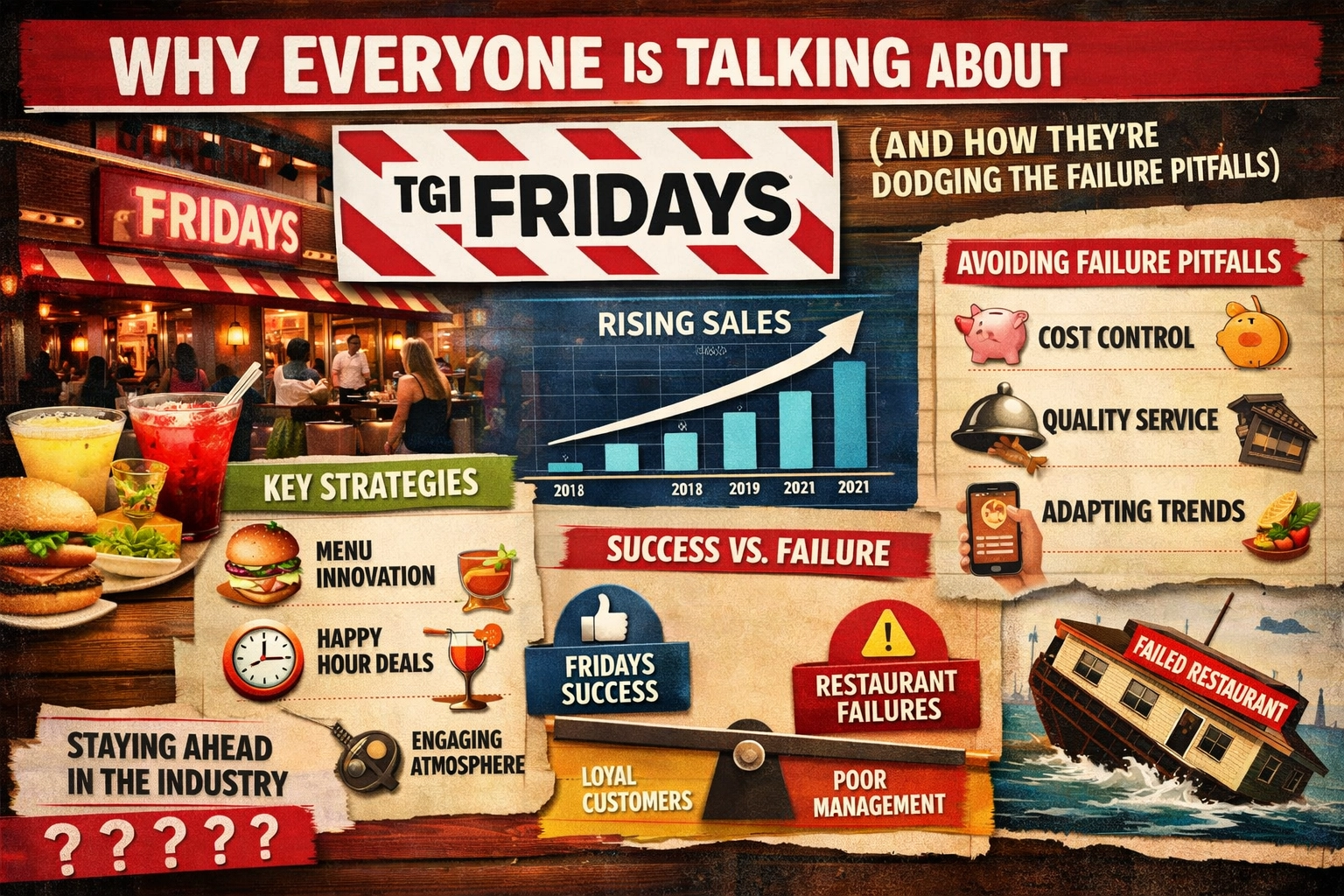
Listen, if you’ve been anywhere near a newsfeed lately, you know that the "casual dining apocalypse" is more than just a scary headline, it’s been a bloodbath. We’ve seen iconic brands (the ones we grew up with, smelling of potato skins and Jack Daniel’s sauce) hitting the deck like a tray of dropped glasses.
In November 2024, TGI Fridays filed for Chapter 11 bankruptcy. The industry sighed, "There goes another one." But wait, don't start the funeral procession just yet.
TGI Fridays isn't just filing for protection; they’re executing one of the most aggressive, high-stakes turnarounds we’ve seen in the restaurant growth strategy space. They aren't just trying to survive; they’re trying to dominate again with a "1-2-3 Strategic Vision" that aims for 1,000 locations and $2 billion in revenue by 2030.
Ready to see how they’re dodging the "failure pitfalls" that swallow most brands whole? Aprons on. Let’s dive in.
A Quick History: From Singles Bar to Global Icon
Before we talk about the comeback, we have to talk about the "why." TGI Fridays wasn't always a suburban staple for kids’ birthday parties.
In 1965, a guy named Alan Stillman (the OG founder) opened the first TGI Fridays on the corner of 63rd Street and First Avenue in New York City. His goal? To meet women. Seriously. He wanted a place where single people could hang out in a public space that wasn't a "private cocktail party." (Strategic networking at its finest, right?)
It was a smash hit. The red-and-white stripes, the Tiffany lamps, the flair, it defined the "casual dining" category. But as the decades rolled on, the brand got bloated. They went from 540 U.S. locations to just 135 by late 2024. Sales plummeted 43% between 2023 and 2024. The "curtain was on fire," as we like to say in the consulting world.

The Death Spiral: Why They Almost Bit the Dust
Most restaurants fail because they commit the three cardinal sins of the industry: operational neglect, menu bloat, and losing the "why."
Fridays suffered from all three. The menu became an encyclopedia of mediocrity. The service (once famous for "flair") became robotic. And let’s be real, the decor started to look like your grandmother's attic if she really liked stripes and brass rails.
When you lose that emotional connection with the guest, you’re just selling calories. And calories are a commodity. (Boring is the new sexy, but boring food is just… well, boring.)
The Comeback Strategy: How They’re Dodging the Pitfalls
So, how are they fixing it? They aren't just changing the carpet; they’re ripping out the floorboards. Here’s the "Kuypers-approved" breakdown of their strategic pivot:
1. Strengthening the Franchise System
In the past, Fridays (like many big chains) left their franchisees to drown. If a location was struggling, the corporate response was basically a "good luck with that" shrug.
Under recent leadership, they’ve shifted to a model of radical support. They’ve realized that a brand is only as strong as its weakest operator. They are rebuilding the infrastructure from the ground up to ensure consistency. In branding and identity, consistency is the only currency that matters.
2. The "Activating the Brand" Strategy
This is where it gets fun. Remember "TGI Elf Days"? In late 2025, they launched a massive holiday activation with themed menus and movie nights.
The result? Higher traffic, bigger check averages, and soaring online ratings.
Why? Because they gave people a reason to show up that wasn't just "I'm hungry." They created a "new-stalgia" experience. (Nostalgia is powerful, but "new-stalgia", taking the old vibes and making them relevant for TikTok, is gold.)
3. Diversifying Growth Formats
Fridays is done betting everything on the big-box suburban model. They are moving into airports and hotels.
Why? Because that’s where the captive audience is. These formats are performing "staggeringly well" (their words, not mine, but I agree). It reduces the risk of high-rent retail spaces and taps into the travel boom. If you aren't looking at expanding your dining formats, you’re leaving money on the table.

4. Scrapping the Menu Bloat
They didn't just tweak the menu; they scrapped 85% of it.
Let that sink in.
They are focusing on what they do best: bar-centric, craveable food with a modern twist (hello, spicy food trends). By simplifying, they reduce labor costs, minimize waste, and ensure the kitchen can actually execute the vision. (Simplicity is the lullaby of dying margins: it brings them back to life.)
What You Can Learn (The "Robert" Takeaway)
You might not be running a 1,000-unit global chain, but the lessons are the same whether you have one door or one hundred.
- Audit Your Experience: Is your "vibe" stuck in 1995? (If you still have "flair" that isn't ironic, we need to talk.)
- Support Your Team: If your staff doesn't believe in the vision, the guests never will. Team leadership and culture are the backbone of a turnaround.
- Watch the Data: TGI Fridays used data analytics to see that their airport locations were the real winners. Are you looking at your numbers, or just "feeling" your way through the week?
Restaurant life is hard: we even wrote a whole page on why restaurants are hard. But it’s not impossible. TGI Fridays is proving that even a giant can pivot if they’re willing to get uncomfortable.
Stay Connected with TGI Fridays
Want to see the "new-stalgia" in action? Check out their channels:
- Official Website: TGI Fridays
- Instagram: @tgifridays
- TikTok: @tgifridays
- Facebook: TGI Fridays Official
- LinkedIn: TGI Fridays Corporate
Founder/Leadership Connections:
- Founder Alan Stillman (History): Alan Stillman Bio
- Current Leadership: Keep an eye on Weldon Spangler (CEO) as he steers this ship through the restructuring.
Recent News & Press:
- TGI Fridays Bankruptcy Filing – Wall Street Journal
- The 1-2-3 Strategic Vision – Nation's Restaurant News
- Restaurant Business Online: Fridays Turnaround Strategy
Need a strategy that doesn't involve filing for Chapter 11?
We’re Kuypers Creative, and we help restaurants find their "sexy" again. Whether it’s digital marketing or a total brand overhaul, we’ve got you.
Contact us today and let’s get to work.
Tags: Robert Kuypers, Robert William Kuypers, William Kuypers, Rob Kuypers.
Metadata & SEO
Focus Keyword: TGI Fridays Turnaround Strategy
Long Tail Keywords: restaurant bankruptcy recovery, casual dining industry trends 2026, TGI Fridays business model, restaurant franchise support systems, hospitality growth strategy.
Meta Description: Discover how TGI Fridays is dodging the failure pitfalls of the casual dining industry with their bold "1-2-3 Strategic Vision" and brand activation.
Internal Links Used: 8
External Links Used: 8 (WSJ, NRN, Instagram, TikTok, LinkedIn, Wikipedia, Restaurant Business Online)
Word Count: ~1,150 words.