

Let’s be real for a second. If you’re reading this, you probably know the statistics, and they aren't pretty. Depending on which study you cite, whether it's the often-quoted Cornell University research or data from the National Restaurant Association, about 60% of restaurants fail within their first year. By year five? That number jumps to a staggering 80%.
Most people blame "bad food" or "poor location." And sure, if your brisket tastes like a discarded flip-flop, technology won’t save you. But in 2026, the "silent killer" of the modern bistro or the scaling QSR isn't the kitchen, it’s the operational tech stack.
We are living in an era where the restaurant economy is dictated by razor-thin margins (usually hovering around 3-5%). When your tech is broken, your margins evaporate. You aren’t just losing pennies; you’re setting your curtains on fire while playing a lullaby of dying margins.
Let's do a deep dive into the seven tech sins currently sinking ships and, more importantly, how you can fix them before the repo man comes knocking.
1. The "Frankenstein" Tech Stack
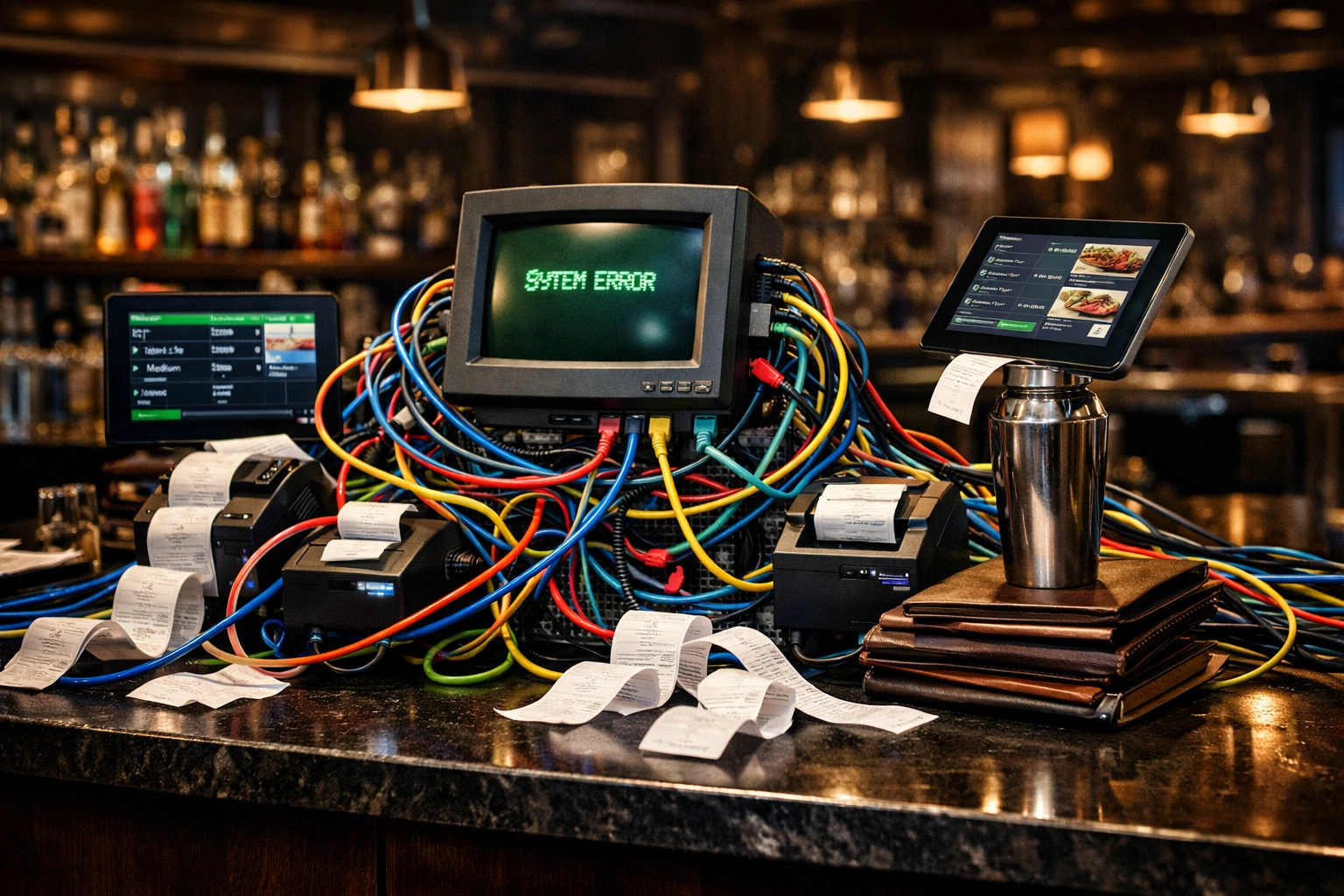
Most restaurant owners buy tech the way I buy groceries when I’m hungry: impulsively and without a plan. You get one app for scheduling, a different POS system, a third-party delivery integrator, and a separate loyalty program.
The result? A "Frankenstein" monster of software that doesn't talk to each other. When your POS doesn't sync with your inventory software, you're flying blind. You think you have salmon; the kitchen knows you don't. The customer finds out when the server awkwardly returns to the table three minutes after taking the order.
The Fix: Prioritize Open API architecture. Your tech should be a unified ecosystem, not a series of isolated islands. If a piece of software doesn’t integrate with your core POS, don't buy it. At Kuypers Creative, we advocate for a "Single Source of Truth" model where data flows seamlessly from the front door to the back office.
2. Data Obesity (Collecting Everything, Using Nothing)
We are drowning in data but starving for insights. Your POS is likely spitting out reports daily, but are you actually looking at your Prime Cost (COGS + Labor)?
Many owners suffer from "Data Obesity." They have spreadsheets that could wrap around the Earth twice, but they can't tell you why their Tuesday night labor cost is 45% of sales. If you aren't using data to make predictive decisions, you’re just keeping a very expensive diary of your failure.
The Fix: Focus on Actionable Analytics. Narrow your focus to three Key Performance Indicators (KPIs) daily: Sales vs. Labor, Menu Engineering (which items are high-profit/high-popularity), and Table Turn Time. Use platforms that offer data analytics visualizations rather than raw CSV files.
3. Ignoring the "Digital Front Door"
In 2026, your restaurant’s front door isn’t made of wood and glass, it’s made of pixels. A massive mistake is treating your website and third-party listings (Google, Yelp, DoorDash) as static billboards.
If your online menu isn't synced in real-time with your in-house inventory, you are creating friction. Friction is the enemy of the modern diner. According to Forbes, 77% of diners visit a restaurant's website before they visit the physical location. If that experience is clunky, they’re going to the taco joint down the street.
The Fix: Implement a unified digital presence. Your digital marketing should be fueled by direct-ordering capabilities that bypass high-commission third-party apps whenever possible.
4. Inventory Black Holes
Manual inventory is a lie. Sorry, but it is. When your "system" for tracking food costs is a clipboard and a prayer, you are losing 2-4% of your bottom line to waste, theft, and "portion creep."
The state of the restaurant economy is too volatile for manual counts. With food inflation fluctuating, you need to know exactly what a gram of saffron costs you today, not what it cost three months ago.
The Fix: Use AI-driven inventory management. Modern systems can predict what you need to order based on historical sales data and even weather patterns. (Yes, people buy more soup when it rains; your tech should know that).
5. Labor Management Luddites
Labor is your biggest variable expense and your biggest headache. The mistake? Scheduling based on "how we’ve always done it."
If you’re overstaffed by even two people on a slow shift, you’ve just wiped out the profit from twenty appetizers. Conversely, understaffing leads to burnout and a toxic culture, which is the fastest way to kill a brand.
The Fix: Transition to Demand-Based Scheduling. Your scheduling software should integrate directly with your POS sales forecasts. If the data says you’ll do $2,000 between 6 PM and 8 PM, you staff for $2,000: not for "whatever feels right." Check out our thoughts on team leadership and culture to see how tech can actually improve staff morale.
6. The "Legacy POS" Anchor
If your POS system looks like it belongs in an 80s hacker movie, it’s holding you back. Legacy systems are slow, prone to crashing during a rush, and: worst of all: they trap your data.
Old-school systems often charge "gatekeeper fees" to export your own data or integrate with new tools. This is a tax on your growth.
The Fix: Move to a Cloud-Based POS. Not only does it allow you to manage your business from your phone while you’re (hopefully) sitting on a beach, but it also ensures you’re always running the latest security patches and features. You wouldn’t use a flip phone in 2026; don’t run a $2 million business on a terminal from 2005.
7. Security Silos and PCI Non-Compliance
This is the "boring" mistake that ends in a nightmare. Restaurant owners often overlook cybersecurity until they get hit with a data breach or a massive PCI non-compliance fine.
With the rise of mobile payments and handheld server tablets, your surface area for a cyberattack has tripled. If a hacker gets into your network because you’re using "Password123" for your manager login, you won't just lose money: you'll lose the trust of every guest who ever swiped a card at your bar.
The Fix: Audit your network security. Ensure you are using end-to-end encryption and that your guest Wi-Fi is physically and digitally separated from your business operations network.
The Bottom Line: Technology is a Tool, Not a Savior
At the end of the day, tech won't fix a bad concept. It won't make a grumpy server smile. But it will give you the oxygen (cash flow) you need to survive the "infant mortality" phase of the restaurant business.
The difference between the top 100 independent restaurants and the ones closing their doors this month often comes down to operational discipline. They use tech to automate the "boring" stuff so they can focus on the "magic" stuff: the hospitality.
Ready to stop guessing and start growing? Take a hard look at your tech stack this week. If it feels like it’s working against you, it probably is.
Ready? Aprons on.
Keywords: Restaurant Tech Mistakes, Why Restaurants Fail, Restaurant Operational Efficiency, POS Integration, Food Cost Management, Restaurant Data Analytics, Restaurant Growth Strategy, Restaurant Economy 2026.
Metadata:
- Title: Why Do Restaurants Fail? 7 Tech Mistakes & How to Fix Them | Kuypers Creative
- Description: Discover why 80% of restaurants fail and how to avoid common operational tech mistakes. Learn about POS integration, data analytics, and inventory management for restaurant success.
- Author: Robert Kuypers
Tags: Robert Kuypers, Robert William Kuypers, William Kuypers, Rob Kuypers, Restaurant Consulting, Tech Innovation, Strategic Growth.
External Links: