

Welcome to 2026. The year where your POS knows more about your regulars than your head server, where "tech stack" and "tech sauté" finally mean the same thing, and where the restaurant industry officially split into two parallel universes.
Grab your coffee (or wine, depending on which side of the K you're on). This is your Saturday deep-dive into why restaurants are now tech companies that happen to serve food, and the mountains of data that prove it's not hype anymore. It's survival.
The 2026 Restaurant Pulse: Reading the Economic Thermometer
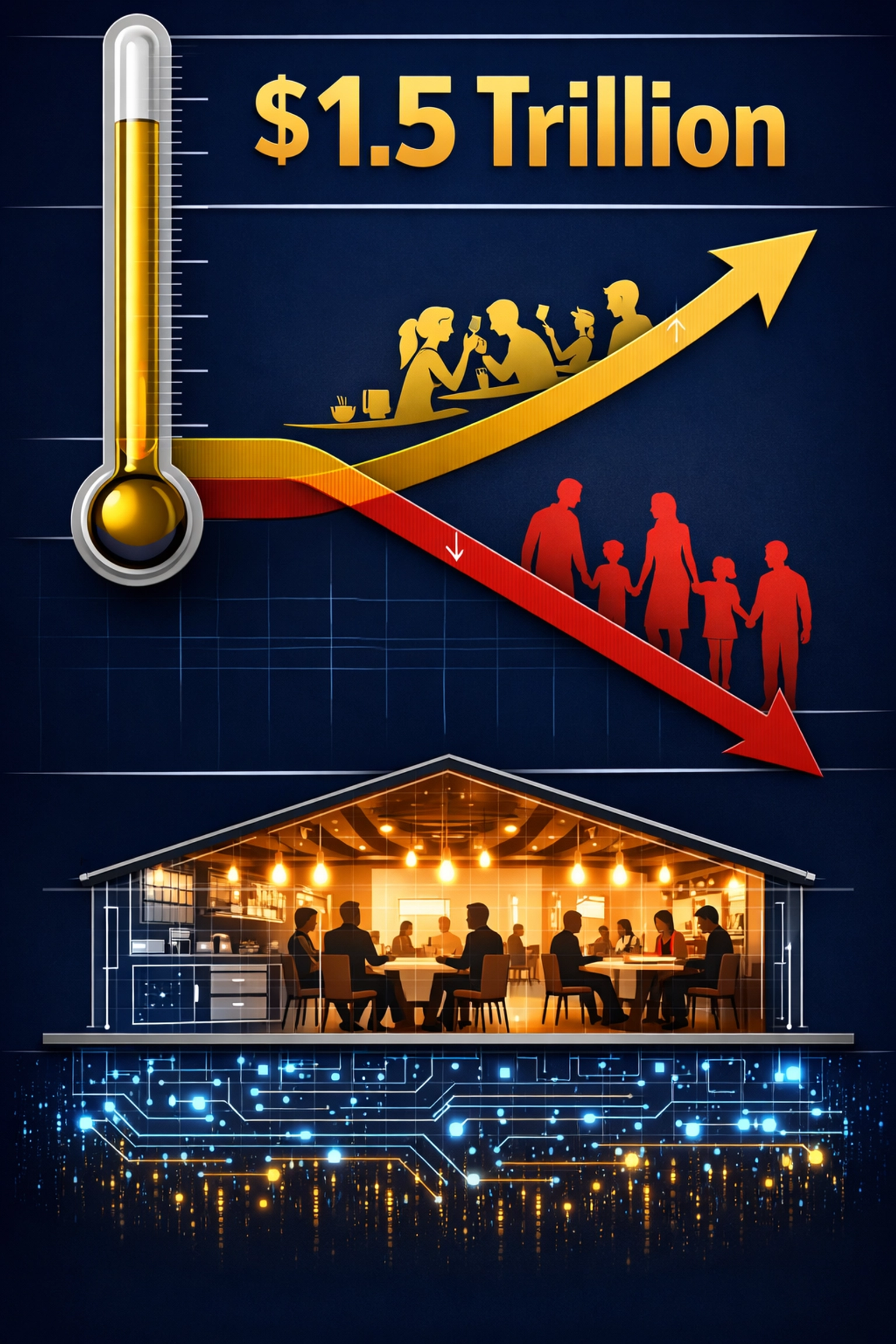
Let's start with the big number: $1.5 trillion in projected sales for 2026, according to Bank of America's State of the Industry report. That sounds incredible, right? A champagne-popping, confetti-cannon moment?
Hold the confetti.
Because when you adjust for inflation and look at the real growth rate from Technomic, we're talking about 1.2% to 2.1% actual growth. That's not a rocket ship. That's a crawl. A very expensive, labor-intensive, tech-dependent crawl through a bifurcated economy that's rewarding winners and punishing everyone else.
The thermometer isn't broken. The industry just has a fever, and the only prescription is more integration.
The K-Shaped Recovery: Two Industries, One Survival Manual
Here's where it gets weird (and a little dystopian). 2026 isn't one restaurant industry. It's two.
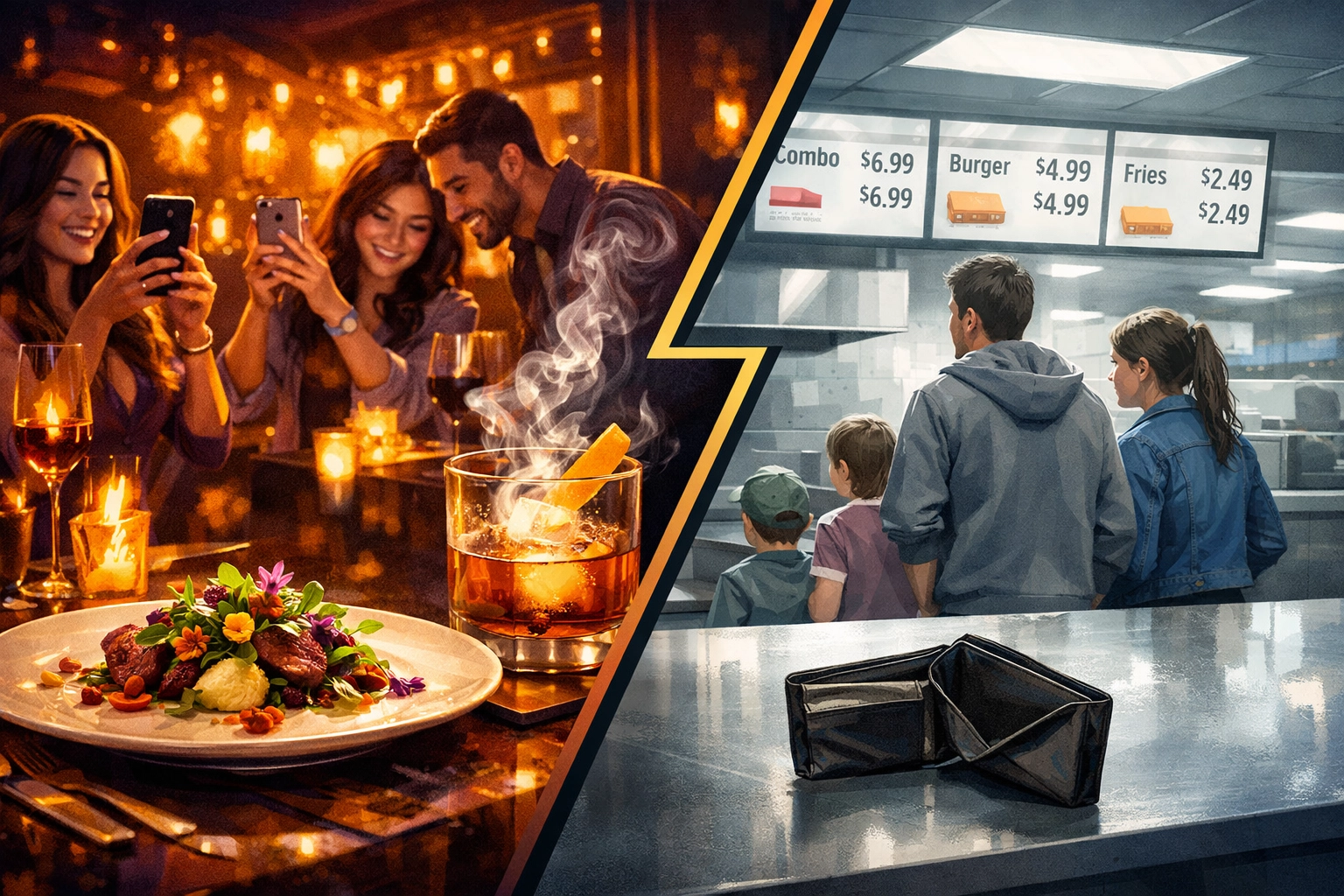
On the top branch of the K, you've got high-income households dropping serious cash on full-service dining, casual luxury, and experiential meals. These are the "Social Socialites", Gen Z and Millennials who want Instagrammable plating, chef storytelling, and a vibe that justifies the $22 cocktail. According to McKinsey's consumer research, this segment is spending more on dining out than ever before, with an emphasis on personalization and premium experiences.
On the bottom branch? Value exhaustion. Low-income households are getting squeezed by QSR price hikes (up 4% in 2026) and shrinking discretionary budgets. They're not going out less because they want to, they're going out less because a family meal at a fast-casual joint now costs what a sit-down dinner used to. The "value seekers" aren't finding value anymore, and that's creating a massive gap in traffic and guest loyalty.
The brutal truth? If you're stuck in the middle, not premium enough to justify pricing, not efficient enough to compete on value, you're the squeezed middle. And the squeezed middle doesn't survive K-shaped economies.
The Full-Stack Restaurant: You're Not Just Serving Food Anymore
So what's a "full-stack" restaurant? Glad you asked, because this is where the engineering brain meets the executive instinct.
A full-stack restaurant integrates every operational layer into a unified tech ecosystem:
- Unified POS systems that connect on-premises, delivery, kiosks, and mobile ordering in real-time
- Kitchen Display Systems (KDS) with color-coded workflows and automated ticket routing
- Inventory management that syncs with your suppliers and predicts ordering needs
- Labor optimization platforms that forecast demand and auto-schedule based on traffic patterns
- Guest data platforms that centralize order history, preferences, and personalized offers across all channels
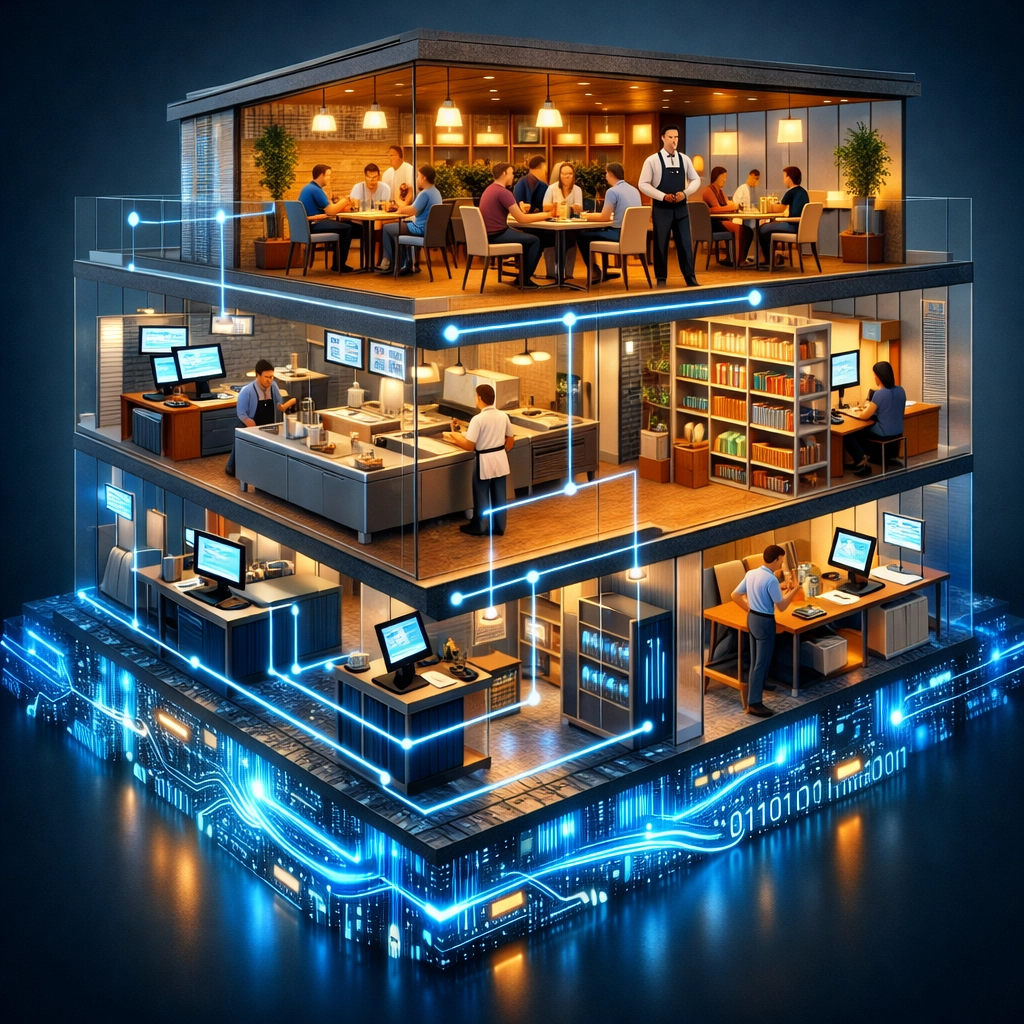
Think of it like building a house. For years, restaurants bought a POS from one vendor, a scheduling app from another, a delivery integration from a third party, and then duct-taped it all together with spreadsheets and prayers. The foundation was data chaos. The walls were integration nightmares. And the roof, the guest experience, leaked every time it rained.
Full-stack restaurants build their house on a data foundation, where every system talks to every other system, and decisions are made with real-time information, not yesterday's reports. According to industry research, 50% of restaurant executives now identify centralized, real-time data as critical for improving performance. That's not a nice-to-have. That's the new table stakes.
And here's the kicker: integration now trumps innovation. Operators are choosing platforms that play nicely with Toast, Square, or Olo over shiny new features that don't connect. Because a brilliant feature that lives on an island is just expensive decoration.
The Data Breakdown: Why This Isn't Just Tech Buzzword Bingo
Let's talk numbers, because this is a bathroom read and you deserve the receipts.
Pricing Pressure:
- QSRs increased prices by 4% in 2026 (Technomic/NRN)
- Casual dining went up 2-3%, trying to balance value perception with margin protection
- Fine dining? They're playing a different game entirely, with experiential pricing that customers expect to be premium
Labor & The "Me-Me-Me" Economy:
According to Harri (a leading restaurant HR platform), 2026 is the year of hyper-personalization in everything, including how employees want to work. The data shows:
- Workers demand flexible scheduling and instant-access payroll
- Turnover is highest in operations that still use paper schedules and manual time tracking
- Retention improves 35% in restaurants using AI-powered labor optimization (yes, really)
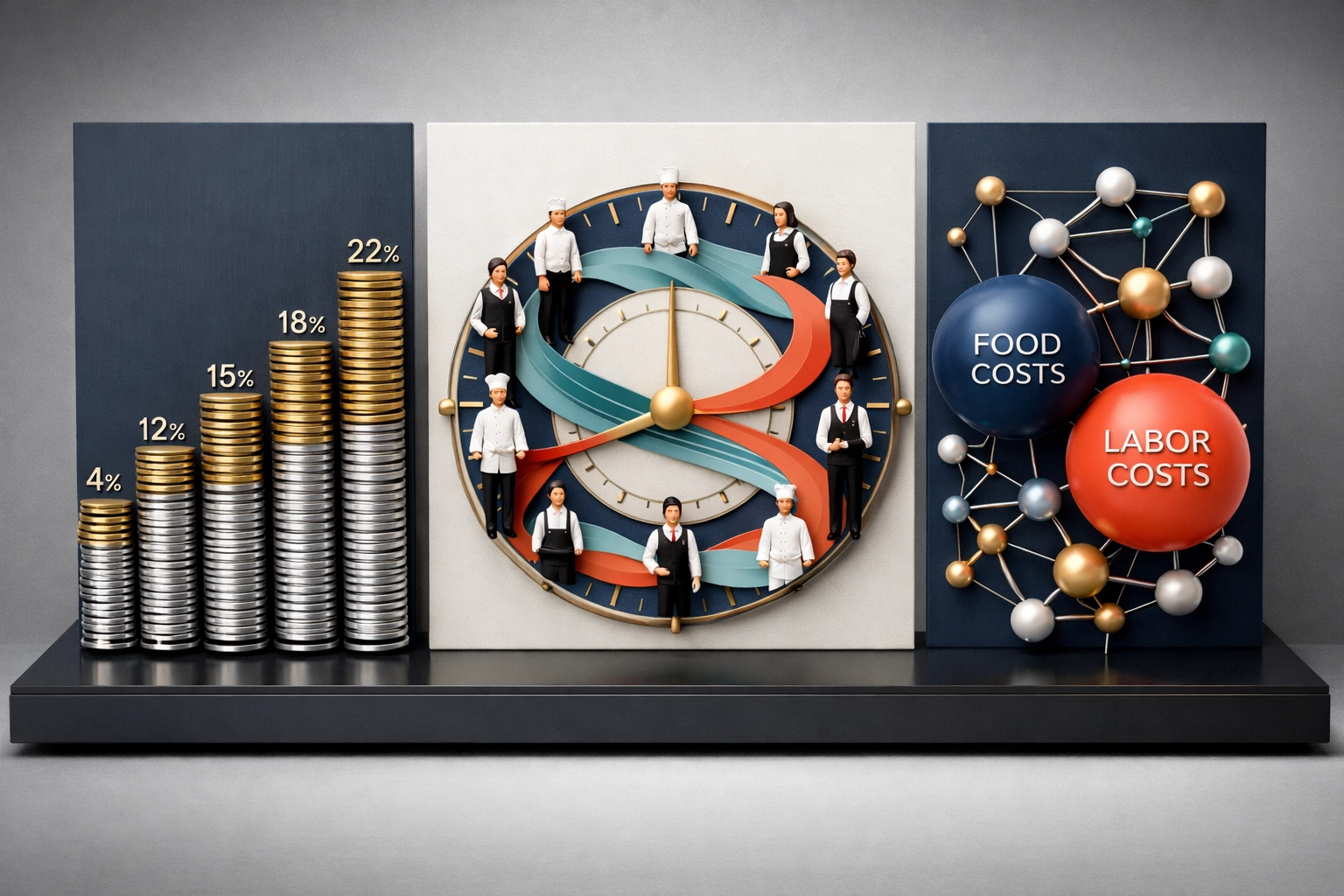
The Bank of America report nails it: food and labor costs remain the two most influential operational factors across the entire industry. You can't magic away food costs (suppliers know what they're worth), but you can engineer labor efficiency through intelligent forecasting and tech-enabled scheduling.
Guest Expectations Have Evolved:
It's not about "convenience" anymore. Guests expect to be in a "known state" every time they interact with your brand:
- Complete order history at their fingertips
- Frictionless reordering (yes, the same weird sub they ordered at 2 AM last Thursday)
- Recommendations that actually make sense (not random upsells)
This level of personalization requires centralized data architecture. You can't fake it with disconnected systems.
AI, Automation, and Why Robots Aren't Stealing Jobs (Yet)
Let's address the robot in the room. Gen AI and automation are exploding in 2026, but not in the "Terminator takes your shift" way the headlines suggest.
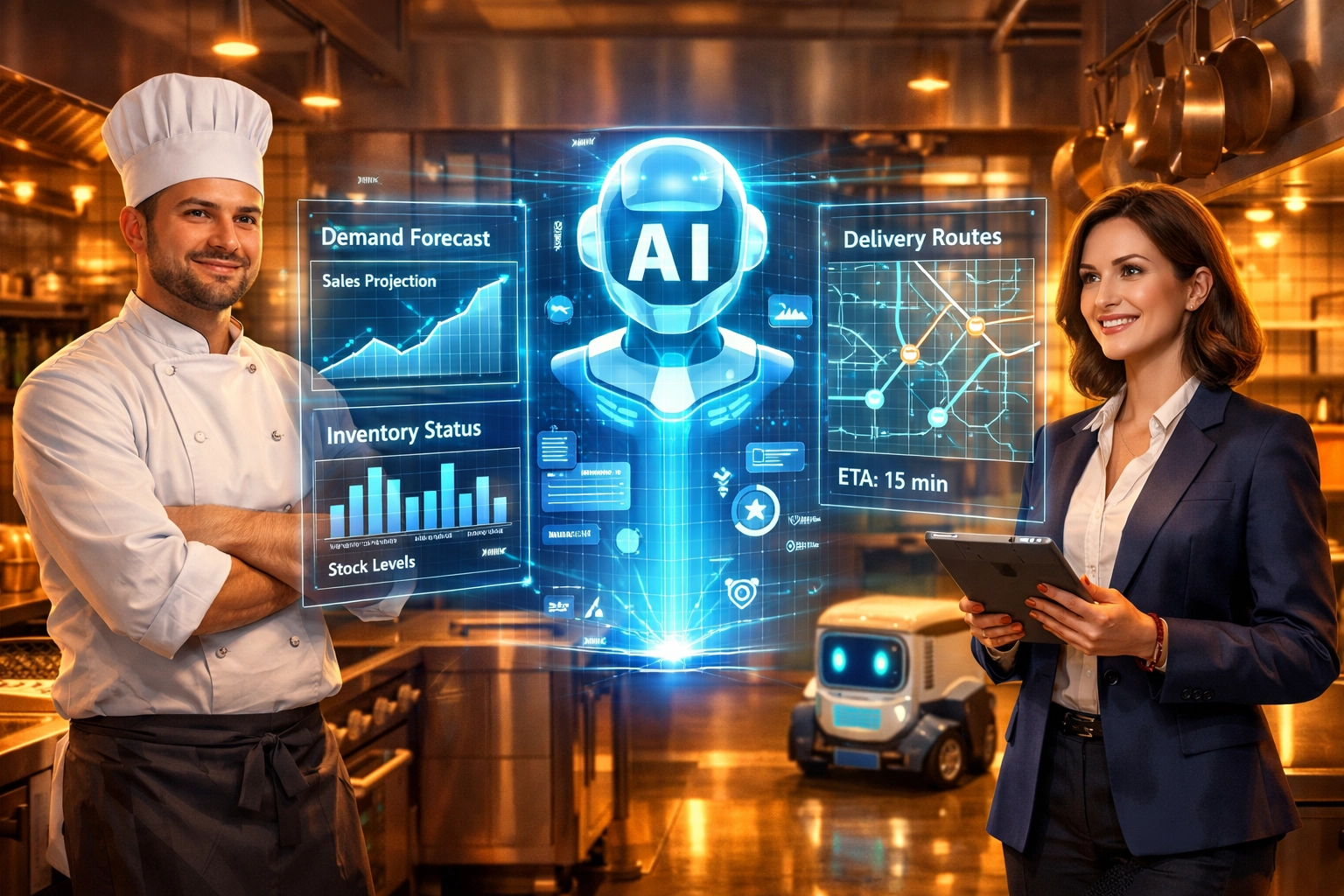
Smart operators are using AI for:
- Demand forecasting that adjusts labor hours before the rush (or lack of rush) hits
- Inventory prediction that eliminates both food waste and "86'd" embarrassments
- Dispatch optimization for delivery, routing short-radius orders to robots while keeping branded drivers on high-value, relationship-building runs
The goal isn't to replace humans. It's to free humans from administrative chaos so they can focus on hospitality. Your line cook shouldn't be manually counting inventory at 11 PM. Your floor manager shouldn't be building next week's schedule on a spreadsheet at midnight. That's what tech is for.
As one industry report put it perfectly: "Rather than replacing human workers, forward-thinking operators are using AI to handle the predictable, freeing staff to handle the memorable."
The Actionable Strategy: Bridging the Engineering/Executive Gap
Okay, enough with the doom and data. What do you actually do with all this?
Step 1: Audit Your Current Stack
List every piece of software you're using. POS, KDS, scheduling, inventory, guest engagement, delivery integrations. Now map out where the data gaps are. Where are you manually transferring information? Where are decisions being made on outdated reports? Those gaps are costing you money.
Step 2: Choose Integration Over Innovation
Before buying the next shiny app, ask: "Does this integrate with what we already have?" If the answer is "sort of" or "we can export a CSV," run. You need native integrations or robust APIs. Period.
Step 3: Build a Data Culture, Not Just a Data Warehouse
Centralized data means nothing if nobody looks at it. Train your managers to use real-time dashboards. Make data literacy a core competency. The best tech in the world won't save you if your team still makes decisions on gut feel alone.
Step 4: Don't Just Buy Software: Build a Platform
This is the executive mindset shift. You're not buying tools. You're building an operational platform that will evolve with your business. Think like a product manager, not just a restaurant operator. What do you need today? What will you need in 12 months? Choose partners who grow with you.
Step 5: Invest in Your People's Tech Fluency
The "Me-Me-Me" economy isn't going away. Employees: especially Gen Z: expect intuitive tech, instant feedback, and control over their schedules. Investing in employee-facing platforms (self-service scheduling, instant tip payouts, mobile communication) isn't just nice. It's competitive advantage in a tight labor market.
Need more context on the labor challenges? Check out our deep-dive on the 2026 labor paradox.
The Bottom Line: Full-Stack or Get Stacked Against
2026 is the year of the "Great Hospitality Resync": where technology modernization became the highest-priority investment for restaurant operators. Not because it's trendy. Because fragmented systems create competitive disadvantage, and the K-shaped economy rewards efficiency and experience while punishing the middle.
The restaurants winning right now? They've stopped thinking like restaurants and started thinking like tech companies that happen to serve incredible food. They've unified their stacks, centralized their data, and empowered their teams with real-time intelligence.
The restaurants struggling? They're still operating like it's 2019, hoping vibes and hustle will carry them through.
Your blueprint is data. Your foundation is integration. Your competitive moat is the speed at which you can make intelligent decisions.
The full-stack restaurant isn't the future. It's the present. And the thermometer doesn't lie.
Want help building your full-stack operation? That's literally what we do. Let's talk strategy.
#RestaurantEconomy2026 #HospitalityData #FullStackRestaurant #KuypersCreative #RestaurantTrends #TechIntegration #DataDrivenDining