
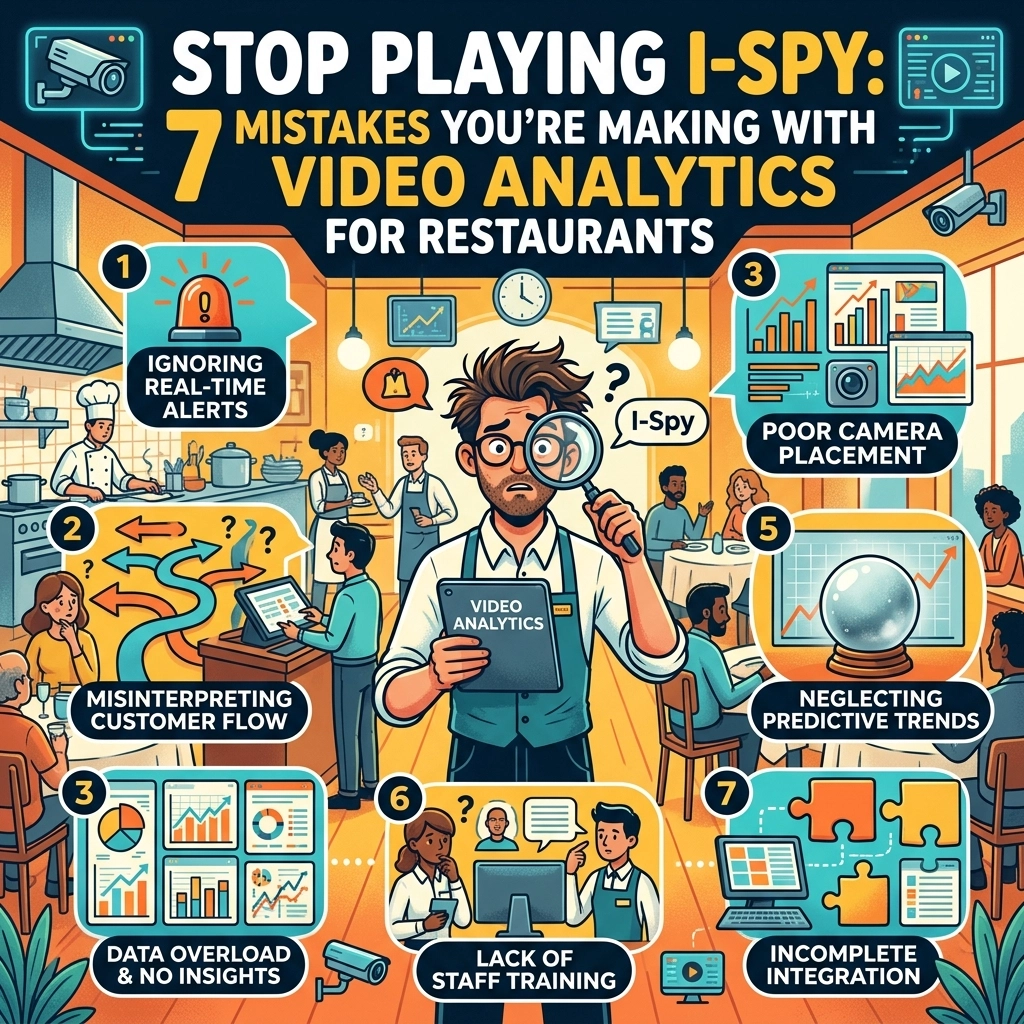
Let’s be real: most restaurant owners treat their security cameras like a digital version of I-Spy. You log in from your phone while you’re supposed to be at dinner with your spouse (sorry, honey!), squint at a grainy feed of the kitchen, and try to spot if the line cook is wearing a hat or if that one server is leaning on the host stand again.
If that’s how you’re using video, you’re essentially using a Ferrari to drive to the mailbox. You’ve got a high-powered data engine sitting in your ceiling, and you're using it to play detective for five-dollar infractions.
In the world of modern restaurant tech innovation, video analytics has evolved from "Who stole the brisket?" to "Why did Table 4 wait twelve minutes for water?" It is the bridge between the "vibes" of your shift and the hard, cold reality of your P&L statement.
But, as with any shiny new toy, operators are tripping over their own feet. If you want to stop the lullaby of dying margins and start actually scaling, you need to stop these seven mistakes. Ready? Aprons on.
1. Treating it Like a Security Guard, Not a Strategist
The biggest mistake? Thinking video analytics is just "better CCTV." CCTV is reactive; video analytics is proactive. If you only look at the footage after something goes wrong, a slip and fall, a drawer short, or a literal fire, you’re missing 90% of the value.
Strategic operators use video to track Table Turn Times. If your POS says a table was occupied for 90 minutes, but the video shows the guests finished eating at 60 minutes and spent 30 minutes waiting for a check, you don't have a slow-eating problem; you have a service friction problem.
The Fix: Use your analytics to track "Dead Air" at tables. That’s the gap between the last bite and the check drop. Closing that gap by just five minutes across 40 tables can add a whole extra seating per night. (Boring wins. Boring pays. Boring is the new sexy.)
2. Managing by "Vibes" Instead of Actionable Dashboards
"I feel like the lunch rush was a bit slow today."
"I feel like we need more people on the floor on Fridays."
Stop it. "Feeling" is for poets and people who want to go bankrupt. Data analytics is for winners. One of the most common pitfalls is ignoring the dashboard provided by your video analytics software in favor of "gut checks."
When you see a heat map of your dining room, it might show that your staff is clustering near the POS station instead of circulating the floor. You can’t "feel" a cluster; you can only see it in the data.

Caption: A visual representation of restaurant heat mapping showing staff clustering vs. guest distribution.
The Fix: Set three KPIs for your video data every week. For example: Average Queue Length at the host stand, Kitchen Ticket-to-Window time, and Table Reset speed. If the data doesn't match your "vibe," trust the data. Every. Single. Time.
3. The "Big Brother" Culture Killer
If you walk into your pre-shift meeting and say, "I saw on the cameras that you guys were standing around at 3:00 PM," you are going to have a mutiny on your hands. Or, at the very least, you’ll be the guy everyone hates. (And nobody works hard for the guy they hate).
Using video analytics as a "gotcha" tool creates a culture of fear. When people feel watched, they stop being hospitable and start being robotic. They spend more time looking at the camera than the customer.
The Fix: Frame video analytics as a coaching tool, not a policing tool. Share the data with the team. "Hey guys, the analytics showed our average ticket time went up by 4 minutes during the rush yesterday. Let’s look at the flow and see where the bottleneck was." Make them part of the solution. As Robert Kuypers often mentions on LinkedIn, leadership is about culture, not surveillance.
4. Ignoring the "Heat" (Heat Mapping)
Most restaurant owners look at their floor plan and think it’s perfect. It’s not. It’s almost never perfect. Video analytics can provide heat maps: visual representations of where people (both staff and guests) spend the most time.
Are your servers constantly bumping into each other at a specific corner? Is there a "dead zone" in your dining room where guests always look unhappy? Maybe that table is under an AC vent, or the lighting is weird. You won't know by looking at a spreadsheet; you'll only know by seeing the dwell time in a heat map.
The Fix: Review your heat maps monthly. If your host stand is constantly a "red zone" of high density, you might need to rethink your reservation flow or move the stand entirely.
5. Siloed Data (The Island of Misfit Tech)
Your video analytics should not live on an island. If your video data isn't talking to your POS system, you’re only getting half the story.
For example, your video shows a line out the door (Great!). But your POS shows sales are flat (Wait, what?). This integration allows you to see "Abandonment Rates." People are seeing the line and walking away. Without the integration, you might just think it was a "weirdly quiet" Tuesday.
The Fix: Ensure your tech stack is integrated. You want to be able to click on a "Void" or a "Comp" in your POS and have the corresponding video clip pop up immediately. This isn't just about theft: it’s about understanding why that steak was sent back. Was it overcooked, or did it sit under the heat lamp for ten minutes?

Caption: Integrating POS data with video overlays to identify operational bottlenecks.
6. Failing to Monitor the "Back of House" Flow
Everyone focuses on the dining room because that’s where the money changes hands. But the kitchen is where the money is lost.
Mistake #6 is neglecting video analytics in the kitchen and prep areas. Are your prep cooks spending 20 minutes a day walking back and forth to a distant walk-in because the layout is inefficient? That’s labor cost walking right out the door.
According to reports from National Restaurant Association, labor costs are one of the primary pressures on margins in 2026. If you aren't using video to optimize the "steps" your team takes, you’re burning cash.
The Fix: Conduct a "Step Audit" using your analytics. Watch a single station for an hour. If the cook has to leave the station more than three times, move whatever they are reaching for closer to them. Shaving 30 seconds off a task performed 100 times a day is a massive win.
7. Setting it and Forgetting it
Technology is not a "crock-pot" solution. You can't just buy the most expensive video analytics package and expect your restaurant growth strategy to fix itself.
The biggest mistake is the lack of a "Feedback Loop." You get the data, you see the problem, but you don't change the behavior. If the analytics show that your drive-thru window is bottlenecking at the payment step, but you don't retrain the cashier or change the tech, the analytics are just an expensive way to watch yourself fail.
The Fix: Create a weekly "Action Report."
- Observation: (e.g., Table reset times are averaging 8 minutes).
- Hypothesis: (e.g., Busser is overwhelmed because they are also running glass racks).
- Action: (e.g., Assign a dedicated glass runner during peak).
- Result: (e.g., Check the analytics next week to see if reset time dropped).
The Bottom Line: Stop Playing, Start Winning
Video analytics is the closest thing to a superpower a restaurant operator can have. It allows you to be everywhere at once without actually having to be everywhere at once. But if you keep playing I-Spy and looking for tiny mistakes instead of looking at the big strategic picture, you’re wasting the most valuable tool in your arsenal.
Stop guessing. Stop "feeling." Start watching the data and acting on the insights. Your margins will thank you, your staff will be better trained, and you might finally be able to finish that dinner with your spouse without checking your phone.
Ready to level up your tech stack and stop the "lullaby of dying margins"? Let’s talk. At Kuypers Creative, we specialize in turning chaotic operations into strategic powerhouses. Check out our Digital Marketing and Tech services to get started.
: Robert
Keywords & Metadata
Keywords: Restaurant video analytics, restaurant technology trends 2026, operational efficiency, POS integration, heat mapping for restaurants, restaurant management mistakes, Robert Kuypers, restaurant consulting.
Long-tail Keywords: How to use video analytics to improve restaurant table turns, reducing labor costs with kitchen video data, integrating security cameras with restaurant POS systems, restaurant leadership and technology adoption.
Metadata Description: Stop using your restaurant cameras for just security. Discover the 7 common mistakes operators make with video analytics and how to use data to drive growth and efficiency.
Tags: Robert Kuypers, Robert William Kuypers, William Kuypers, Rob Kuypers, Restaurant Tech, Data Analytics, Restaurant Leadership, Operational Excellence.