
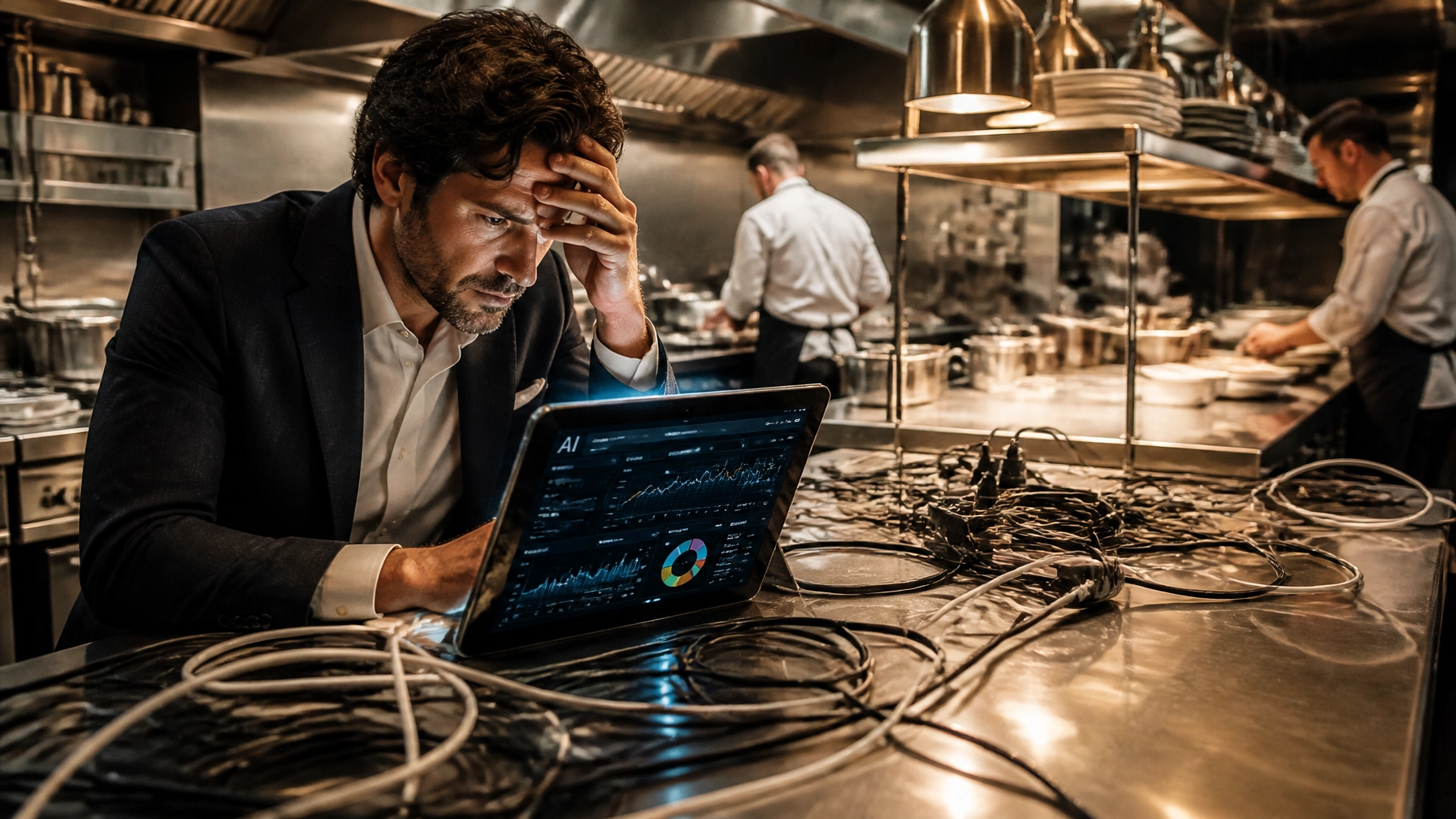
Grab your favorite cup of cold brew (or whatever industrial-strength stimulant is currently keeping your multi-unit operation afloat), lock the bathroom door, and let’s talk about the elephant in the walk-in cooler.
We are living in the golden age of restaurant tech hype. Every week, a venture-backed SaaS startup emerges from the ether promising that their proprietary generative AI model will magically fix your labor shortage, optimize your fry-station grease cycles, and write sonnets to your loyal Tuesday night regulars.
The numbers floating around the industry right now are dizzying. According to landmark benchmarks from industry leaders like Qu’s 2026 Restaurant Technology Benchmark, 73% of restaurant brands are actively investing in AI. Sounds like a revolution, right? We are boldly marching into the future on a titanium-reinforced cloud of cutting-edge innovation.
Except there is one tiny, catastrophic catch: only 9% of those brands are reporting meaningful, tangible impact on their P&L.
(Let that sink in while you check your phone. Seventy-three percent of operators are swiping their corporate cards for AI, while only nine out of a hundred can actually point to a higher operating margin or a happier general manager as proof it worked.)
Welcome to the 2026 Restaurant Execution Gap. It’s the expensive chasm where bright shiny object syndrome goes to die, and it’s costing our industry billions in unintegrated software subscriptions that nobody asked for and nobody knows how to use.
The Anatomy of the Tech Graveyard (Or: Why Your POS and Loyalty Program Are Breaking Up)
Let’s be brutally honest for a second. (Tough love time: your tech stack looks like Frankenstein’s monster after a three-day bender.)
Over the past five years, restaurant operators have fallen into the trap of point-solution promiscuity. You needed online ordering during the pandemic, so you bolted on Brand A. Then your front-of-house staff complained about the tablet clutter, so you added Brand B to "bridge the gap." Then marketing insisted on a new gamified loyalty app (Brand C), which stubbornly refuses to talk to your kitchen display system (Brand D), which in turn gets its inventory updates from a spreadsheet duct-taped together by an exhausted sous chef named Dave.

When you try to drop artificial intelligence on top of a data architecture that resembles a bowl of cold spaghetti, you don't get operational efficiency. You get a very expensive, very sophisticated random number generator.
As highlighted in recent analyses by Restaurant Technology News, the core barrier isn't the sophistication of the AI models. It’s fragmented systems and data silos. When your POS, KDS, inventory, and loyalty platforms operate as sovereign city-states with zero diplomatic relations, your AI agent is essentially trying to navigate a maze blindfolded while someone keeps moving the cheese.
The Great Tech Consolidation Imperative
The era of collecting point solutions like trading cards is officially over. The winners of 2026 and beyond are doing something profoundly unglamorous: consolidation and synchronization.
If your tech vendors aren't playing nice in the sandbox, you need to evict them. You need a unified ecosystem where guest data flows seamlessly from the moment a diner clicks your mobile app to the exact second the line cook plates their ribeye.
Webhooks vs. Polling: Why Your Kitchen Is Still Waiting for Orders
Let’s get slightly technical for a moment, because this is where billions of dollars in restaurant efficiency are won or lost in the background. If you’ve ever wondered why an online order gets stuck in digital purgatory while your expo line stands around tapping their feet, blame your data architecture.
For years, many legacy and mid-tier restaurant systems relied on polling. Think of polling like an impatient toddler in the back seat asking, "Are we there yet? Are we there yet? Are we there yet?" every five seconds. Your POS asks the third-party delivery app every ten seconds if there’s a new order. If there’s network congestion or latency, orders get dropped, kitchen timing gets skewed, and guests leave furious one-star reviews about cold fries.

Modern, high-performance tech stacks use webhooks.
A webhook is an instant notification. The moment an event happens, a guest places an order, modifies a modifier, or redepts a loyalty reward, the source system instantly screams, "Hey! Look over here! Something happened!" to the receiving system.
• Polling creates unnecessary server load, introduces latency, and drops data when networks hiccup.
• Webhooks create event-driven, real-time synchronization that keeps your KDS, inventory deduction, and labor forecasting tightly locked in step.
If your software providers are still architecting their integrations on sluggish polling mechanisms, you are running a Ferrari engine with bicycle brakes.
The Unglamorous ROI of Boring Operations
Here is the secret that consulting boardrooms whisper when the venture capitalists leave the room: Boring wins. Boring pays. Boring is the new sexy.
Everyone wants to talk about generative AI avatars taking drive-thru orders or autonomous drone delivery. But the 9% of brands seeing massive, measurable impact aren't winning because they have the flashiest robot on the block. They are winning because they nailed the unglamorous blocking and tackling of operational execution.
At Kuypers Creative, when we work with multi-unit operators and C-level executives, our first question isn't "What’s your AI strategy?" It’s "Is your baseline data clean?"
Consider what true operational ROI looks like when you fix the foundation:
- Automated Prep Forecasting: Instead of your kitchen manager guessing how many pounds of brisket to smoke based on a hunch and a prayer, integrated predictive forecasting models look at historical sales, local weather, upcoming neighborhood events, and real-time inventory to generate exact prep lists down to the ounce.
- Labor Optimization: Seamlessly syncing time-clock data with POS sales velocity so that managers get instant alerts when labor percentages creep past target thresholds, before the shift is over and the damage to labor margins is already done.
- Frictionless Loyalty Redemption: Ensuring that when a VIP guest walks through the door, the host stand and the POS recognize them instantly without requiring the server to ask for a QR code scan that fails half the time.
As leading macroeconomic and hospitality advisory reports from firms like McKinsey & Company frequently emphasize, digital transformation in hospitality fails not at the whiteboard, but on the floor during a Friday night dinner rush. If the crew can't use it in thirty seconds under pressure, the technology is worthless.
How to Bridge the 2026 Execution Gap
Ready to stop wasting budget on software shelf-ware and actually make your tech stack work for your P&L? Here is your battle-tested roadmap:

1. Conduct a Brutal Tech Audit
List every single software subscription, app, and hardware terminal your restaurants pay for monthly. If a tool doesn't directly drive guest conversion, labor efficiency, or food cost reduction, and if it doesn't integrate natively via robust APIs, cut it.
2. Demand Event-Driven Architecture (Webhooks)
When evaluating new vendors or upgrading your POS, stop asking about shiny user interfaces and start asking technical questions: “Do you use webhooks for real-time order and inventory syncing, or are you still relying on legacy polling?” If they stumble, keep walking.
3. Focus on Workflow Adoption Over Feature Lists
Your staff hates new software because corporate keeps dropping apps on them without training or workflow alignment. Involve your general managers, shift supervisors, and line cooks in tech selection. If the people wearing the aprons don't love the tool, the guest won't either.
4. Partner with Experts Who Speak Both Code and Kitchen
Bridging the gap between software engineering and executive restaurant vision isn't easy. It requires multidisciplinary expertise that understands both database schemas and the raw, chaotic reality of a Saturday night dinner rush. That’s precisely why forward-thinking brands partner with specialized advisory teams to architect scalable growth without missing a single margin goal.
Final Thoughts (Before You Flush and Get Back on the Line)
The 2026 execution gap isn't a permanent curse; it’s a massive competitive advantage for operators willing to do the hard, disciplined work of cleaning up their tech stacks.
Stop buying tech just to put it in a pitch deck. Build an ecosystem that works together, synchronize your data in real-time, and let your competitors waste their millions on flashy AI gimmicks while you quietly capture all the margin.
Now wash your hands, step back out onto the floor, and go make some money.
(Ready to close your execution gap? Explore our strategic restaurant consulting and tech integration services at Kuypers Creative.)
SEO Metadata & Keywords
- Primary Keyword: restaurant technology integration 2026
- Secondary Keywords: AI execution gap in restaurants, restaurant POS KDS consolidation, webhook synchronization vs polling, unglamorous operational ROI, Qu restaurant technology benchmark
- Tags: Robert Kuypers, Robert William Kuypers, William Kuypers, Rob Kuypers