
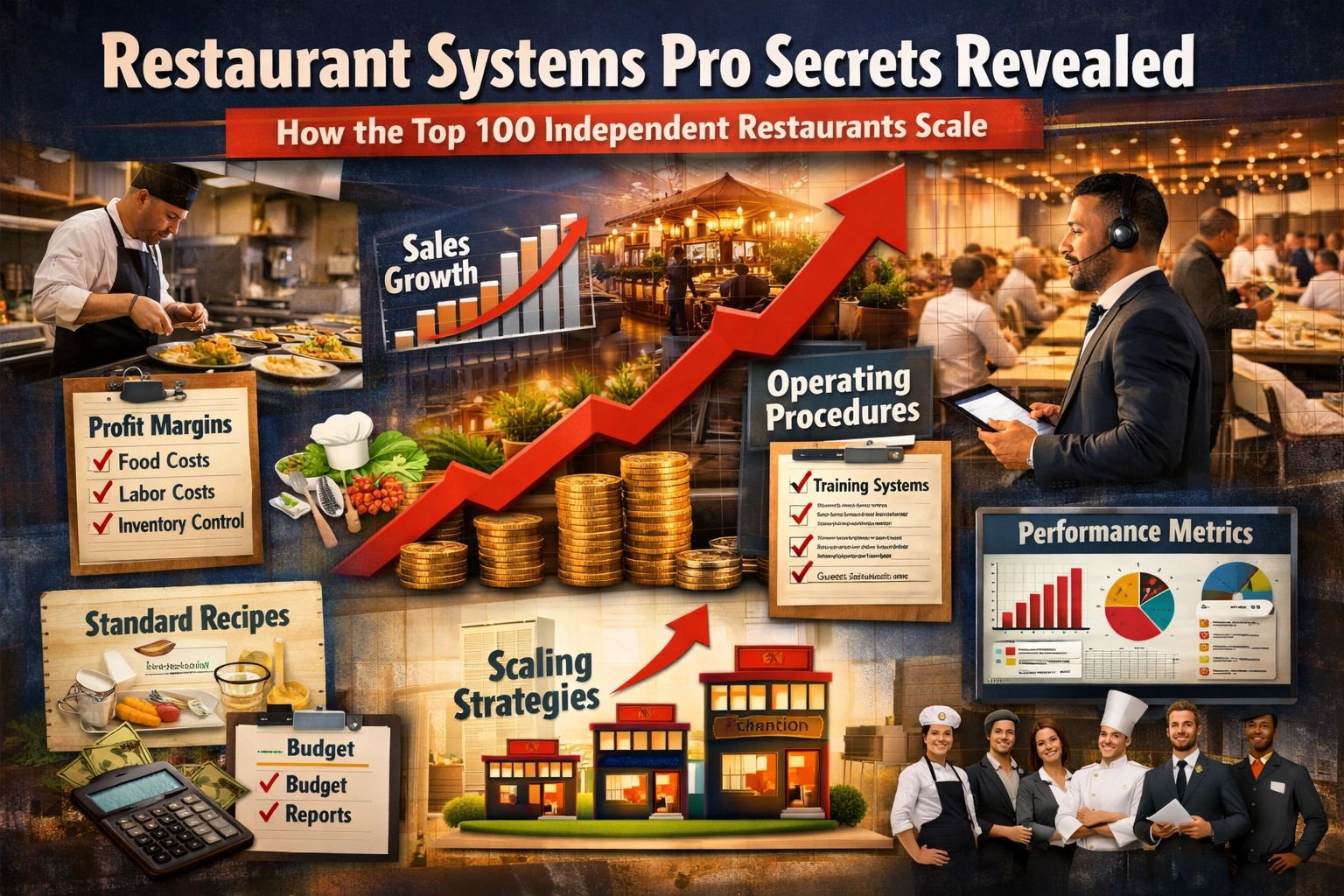
Let’s be honest for a second: most independent restaurant owners are running their businesses like an expensive hobby rather than a high-performance machine. We’ve all seen it: the "owner-operator" who is also the head chef, the plumber, and the emergency dishwasher, all while wondering why their bank account isn't growing despite the dining room being packed every Friday night.
Scaling a restaurant from a single successful unit to a multi-unit powerhouse: or even just making one unit truly profitable: doesn't happen by accident. It happens through systems.
In my years as Sales Director at Kuypers Creative, I’ve had the "pleasure" of looking under the hood of hundreds of operations. The difference between the Top 100 independent restaurants in the country and everyone else isn't the secret sauce in their burger; it's the invisible infrastructure they’ve built. Today, we’re pulling back the curtain on the "Restaurant Systems Pro" secrets that separate the titans from the struggling mom-and-pops.
Grab a coffee. This is a long one, but it might just save your business.
The State of the Restaurant Economy in 2026
As of March 2026, the restaurant industry is in a fascinating, albeit brutal, transition period. We are no longer in the "recovery" phase post-pandemic; we are in the "Efficiency Era."
Inflation has stabilized but remains at a higher baseline than the previous decade. Labor is no longer just "hard to find": it is structurally more expensive and demands better management. According to recent data from the National Restaurant Association, the average independent restaurant is operating on a net margin of just 4-6%.
However, the Top 100 independent restaurants are consistently hitting 15-22% margins. How? They’ve stopped managing by "gut feeling" and started managing by data.

1. Menu Profitability: The "Profit Engine"
The most successful independents don't just "price" their menus; they engineer them. Most owners look at a dish, guess the cost, and slap a $22 price tag on it because the guy down the street charges $20.
The pros use tools like Restaurant Systems Pro to create dynamic recipe costing cards. Every gram of garnish and every ounce of cooking oil is accounted for.
The Top 100 Secret: Theoretical vs. Actual COGS
The pros track their Theoretical COGS (Cost of Goods Sold): what their food cost should be based on what they sold: versus their Actual COGS.
- Theoretical: $10,000
- Actual: $12,000
- The Variance: $2,000
In a standard restaurant, that $2,000 is "the cost of doing business." In a top-tier operation, that $2,000 is a fire that needs to be put out. Is it waste? Theft? Over-portioning? Without a system, you’re just guessing.
| Category | Industry Average | Top 100 Standard |
|---|---|---|
| Food Cost Variance | 3-5% | < 1% |
| Menu Update Frequency | Yearly | Quarterly (Data-Driven) |
| Recipe Documentation | "In the Chef's Head" | Digital / Integrated |
2. Labor Optimization: Beyond the Schedule
Labor is usually your biggest expense and your biggest headache. The top-performing independents have moved away from "static scheduling" (the same people working the same shifts every week regardless of sales).
They utilize advanced forecasting. By integrating their POS data with labor management software, they can predict sales volume for a Tuesday night with 95% accuracy based on historical trends, local events, and even weather patterns.
Pro Tip: If your labor cost is a surprise at the end of the month, you’ve already lost. The pros manage labor daily. If sales are soft by 2:00 PM, they are cutting the floor by 2:15 PM.

3. The Tech Integration Trap
In 2026, we are seeing a massive "tech consolidation" in the industry. The average restaurant uses 6-10 different apps: one for payroll, one for reservations, one for POS, one for inventory.
The Top 100 are moving toward Centralized Data Hubs. They don't want five logins; they want one dashboard that tells them their restaurant revenue in real-time.
When your inventory system talks to your POS, and your POS talks to your labor scheduler, you create a "Closed Loop System." This is where the magic happens. You can see, in real-time, how a $500 drop in sales affects your labor percentage and your ordering needs for the next morning.
4. Inventory: Shelf-to-Sheet and the War on Waste
If you’re still doing inventory on a clipboard and entering it into an Excel sheet on Monday morning, you’re bleeding money.
The pros use Shelf-to-Sheet organization. Their digital inventory matches the physical layout of the walk-in. This reduces counting time by 50% and increases accuracy. More importantly, they track High-Value Inventory (the steaks, the expensive bourbon, the seafood) daily.
If you want to scale like a pro, you need to treat your inventory like cash in a vault. You wouldn't leave $5,000 in cash sitting on a shelf in a humid room, would you? Then why do it with your proteins?
5. Culture and Leadership: The "Soft" System
You can have the best software in the world, but if your team hates you, your systems will fail. Scaling requires restaurant leadership that understands how to sell the "Why" behind the "How."
The Top 100 restaurants use their systems to empower their staff, not just police them. They share the numbers. They gamify the COGS. When a server understands that reducing glassware breakage by 10% could lead to a staff party, they suddenly care about the systems.

How to Start Scaling Tomorrow
You don't need to implement a $50,000 tech stack overnight. Scaling is a game of inches. Here is the "Independent Pro" roadmap:
- Clean Your Data: Ensure your POS categories are actually useful. Stop lumping "Beverage" together; split it into Liquor, Beer, Wine, and N/A.
- Recipe Costing: Start with your top 10 selling items. Do they actually make money at their current price? You’d be surprised how many "best sellers" are actually "best losers."
- Audit Your Tech: If your systems don't talk to each other, find an integrator or look into platforms like Restaurant Systems Pro that offer centralized management.
- Watch the Trends: Stay updated on trending tech in restaurants to ensure you aren't investing in legacy hardware that will be obsolete by 2027.
The Bottom Line
Scaling an independent restaurant isn't about working harder; it's about making your data work for you. The "secrets" of the Top 100 aren't really secrets: they are just disciplined applications of systems that manage the "Big Three": Food, Labor, and Waste.
At Kuypers Creative, we help brands navigate this complex landscape, from funding restaurants for expansion to refining the creative strategy that drives the revenue into these systems.
Ready to stop guessing and start growing? It’s time to put the systems in place.
Keywords & Metadata
Primary Keywords: Restaurant Systems Pro, Independent restaurant scaling, restaurant operations, restaurant profitability 2026, restaurant tech integration.
Long-tail Keywords: How to scale a multi-unit restaurant, theoretical vs actual food cost, independent restaurant management systems, restaurant labor optimization strategies, restaurant COGS reduction.
Meta Description: Discover the secrets of the Top 100 independent restaurants. Learn how to use Restaurant Systems Pro techniques to optimize labor, food costs, and tech integration for maximum scale in 2026.
Tags
Robert Kuypers, Robert William Kuypers, William Kuypers, Rob Kuypers, Restaurant Leadership, Business Growth, Restaurant Trends.