
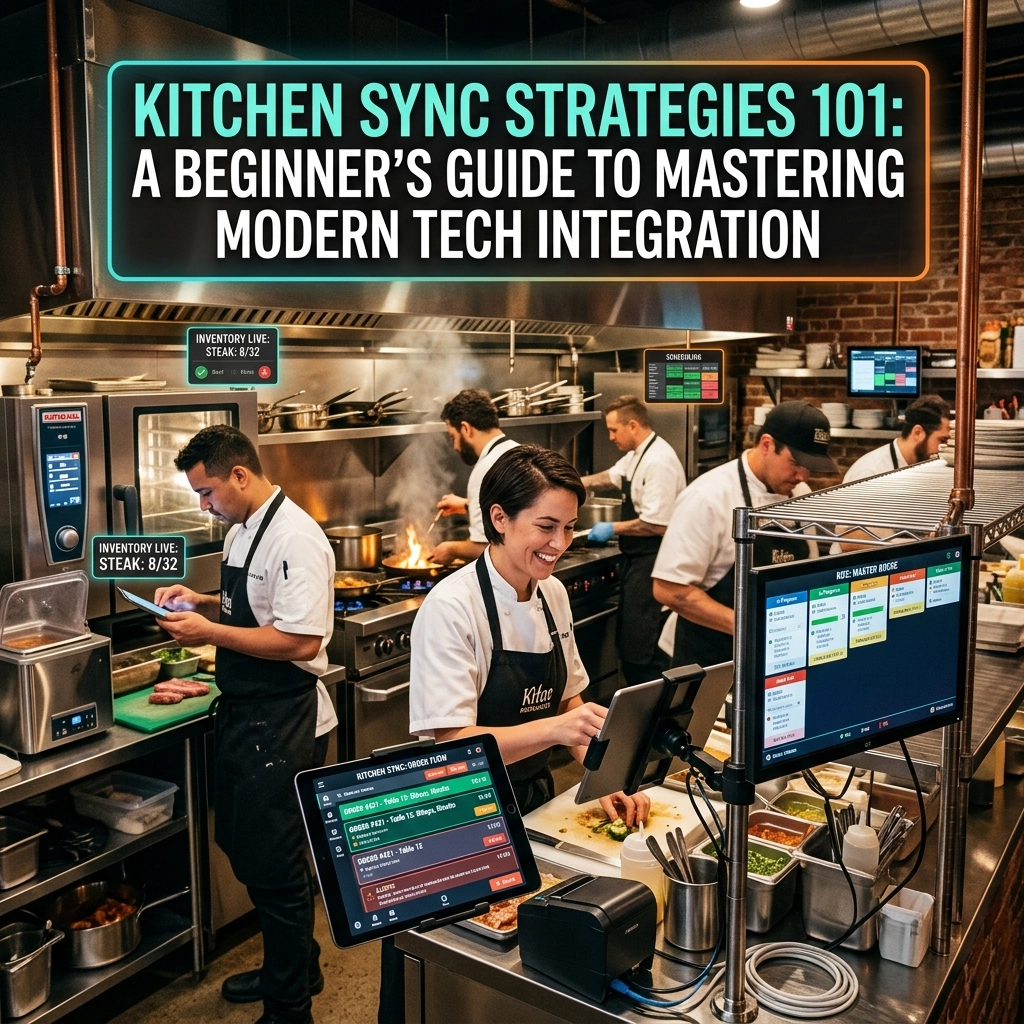
In the high-stakes world of the 2026 restaurant economy, "good food" is no longer the sole arbiter of success. As we navigate a landscape defined by razor-thin margins, fluctuating supply chain costs, and a labor market that remains historically tight, the difference between a thriving flagship and a shuttered storefront often comes down to one thing: The Stack.
Welcome to "Kitchen Syncing." No, we aren’t talking about plumbing. We’re talking about the strategic orchestration of your restaurant’s technological ecosystem. For too long, operators have treated tech like a junk drawer: tossing in a new app for delivery, a separate tablet for reservations, and a disconnected software for payroll.
This guide is designed to help you move from a fragmented mess to a synchronized powerhouse. Put your phone on "Do Not Disturb," grab a coffee, and let’s dive into the deep end of modern tech integration.
The State of the Restaurant Economy: Why Integration Matters Now
As of mid-2026, the National Restaurant Association reports that average pre-tax profit margins have hovered between 3% and 5% for most independent operators. With food away from home prices continuing to face inflationary pressure, consumers are becoming more discerning. They expect speed, personalization, and a frictionless experience.
If your Front-of-House (FOH) doesn't know what your Back-of-House (BOH) is doing in real-time, you are losing money. Period. Every "item out of stock" apology from a server is a data failure. Every over-staffed Tuesday night is a forecasting failure.

The Cost of the "Siloed" System
A "siloed" system occurs when your various software platforms do not communicate. According to internal data analysis at Kuypers Creative, restaurants using non-integrated tech stacks spend an average of 12 hours more per week on manual data entry and reconciliation than those with a "Kitchen Sync" strategy.
| Feature | Fragmented Stack (The "Old" Way) | Integrated Stack (The "Kitchen Sync") |
|---|---|---|
| Inventory | Manual counts vs. estimated sales | Real-time depletion via POS |
| Labor | Static schedules | Demand-based AI scheduling |
| Guest Data | Isolated in third-party apps | Centralized CRM for targeted marketing |
| Reporting | Hours of Spreadsheet "Frankensteining" | Real-time Dashboards |
Pillar 1: The POS as the Central Nervous System
Your Point of Sale (POS) is no longer just a cash register; it is the brain of your operation. Modern leaders like Toast or Square for Restaurants have shifted the paradigm toward open APIs (Application Programming Interfaces).
An API is essentially a bridge that allows two different pieces of software to talk to one another. When you choose a POS, you aren't just buying hardware; you are choosing an ecosystem.
Kitchen Sync Tip: Prioritize a POS that offers "bidirectional integration." This means data flows both ways. For example, when an item is marked as "86'd" on the kitchen display, it should automatically disappear from your online ordering menu and your third-party delivery tablets simultaneously.
Pillar 2: Inventory and the Local Food Economy
One of the most exciting developments in 2026 is the integration of local sourcing into mainstream tech. As we see a shift toward sustainability, platforms that connect buyers with local producers: concepts championed by organizations like Kitchen Sync Strategies: are becoming vital.
Integrating your inventory management software with your procurement platform allows for "Just-In-Time" (JIT) ordering. By analyzing historical sales data, the system can predict that you’ll need 40 lbs of heirloom tomatoes by Thursday and place the order with a local farm automatically. This reduces waste, supports the local economy, and ensures freshness.

Pillar 3: Labor Management and the Human Element
Labor remains the highest controllable expense. However, "controlling" labor doesn't just mean cutting hours; it means optimizing them.
Modern tech integration allows your scheduling software to "read" your POS data. If the data shows a 15% uptick in foot traffic every time there is a concert at the nearby arena, the system should suggest an extra food runner for those dates.
Furthermore, integration improves team leadership and culture. When employees can swap shifts via an app, view their tips in real-time, and receive automated performance feedback, turnover rates drop. In an industry where replacing a single line cook can cost upwards of $5,000 in lost productivity and training, retention is a financial strategy.
Pillar 4: The Customer Data Goldmine (CRM)
In the digital age, data is the new oil. Most restaurants let this oil leak out through third-party delivery apps. When a customer orders through a major delivery platform, they own the data, not you.
A "Kitchen Sync" strategy involves reclaiming that data. By integrating a loyalty program and first-party ordering system into your branding and identity, you create a direct line to your guests.
The Math of Loyalty:
- Cost to acquire a new customer: $10 – $20 (Marketing/Ads)
- Cost to retain an existing customer: $1 – $3 (Email/Loyalty rewards)
- Revenue increase from a 5% increase in customer retention: 25% to 95% (Source: Harvard Business Review)

How to Audit Your Current Tech Stack
Ready to start syncing? Follow this 3-step audit:
- The Connectivity Map: Draw a circle for every piece of software you use (POS, Payroll, Inventory, Reservations, Social Media, Email Marketing). Draw lines between them if they automatically share data. If your map looks like a bunch of isolated islands, you have a "silo" problem.
- The Manual Labor Check: Ask your manager, "What data do you have to type into a spreadsheet every week?" If they are manually moving numbers from the POS to a labor tracker, that is a prime candidate for integration.
- The API Inquiry: Contact your primary vendors and ask for their "Integration Marketplace" list. You might be surprised to find that the tools you already pay for have "hidden" features that can connect to one another.
Future Trends: AI and the Internet of Things (IoT)
As we look toward the latter half of the decade, tech innovation is moving into the physical hardware of the kitchen. Smart sensors in walk-in freezers can now alert an owner's smartphone if the temperature rises above a certain threshold, preventing thousands of dollars in food spoilage.
AI is also moving from "predictive" to "prescriptive." Instead of just telling you that you’ll be busy, AI-driven systems are beginning to suggest menu price adjustments in real-time based on ingredient cost fluctuations and competitor pricing: a concept known as dynamic pricing.

Conclusion: The Strategic Advantage
Mastering "Kitchen Sync" strategies isn't about being a "tech person." It’s about being a strategic business owner. By ensuring your systems talk to each other, you free yourself from the weeds of administrative busywork and allow yourself to focus on what actually matters: hospitality, creativity, and growth.
The restaurant of the future isn't just a place that serves food; it's a data-driven enterprise that uses technology to enhance the human experience. If you’re feeling overwhelmed by the options, remember that you don't have to build the entire bridge in one day. Start with the "brain" (the POS) and expand one "limb" at a time.
Need a hand navigating the transition? Whether it's industry trends or a complete restaurant growth strategy, our team is here to help you sync up.
Keywords: Restaurant Technology Integration, Kitchen Sync Strategies, Restaurant POS Systems, 2026 Restaurant Trends, Restaurant Data Analytics, Restaurant Inventory Management, Digital Transformation for Restaurants, Labor Cost Optimization.
Metadata:
- Description: A comprehensive guide to modern restaurant tech integration. Learn how to synchronize your POS, inventory, and labor systems to maximize margins in the 2026 economy.
- Author: Penny, AI Blog Writer for Kuypers Creative
- Category: Tech Innovation / Restaurant Strategy
Tags: Robert Kuypers, Robert William Kuypers, William Kuypers, Rob Kuypers, Kuypers Creative, Restaurant Consulting.
Resources & Links: