
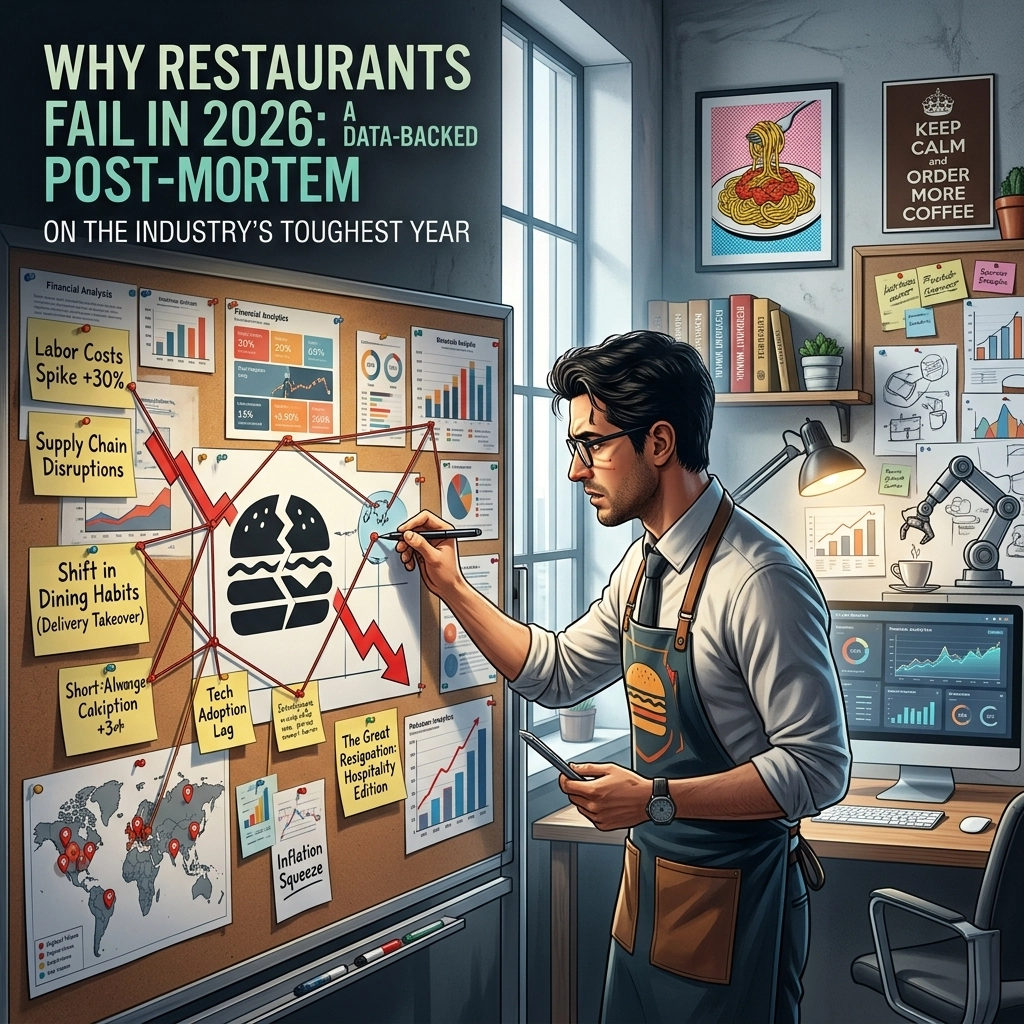
Pour yourself a double espresso and pull up a chair. If you’re reading this in a bathroom stall or during a rare five-minute break between shifts, you’re in the right place. We need to talk about why the "Year of the Purge", as 2026 is already being called in the boardroom, is claiming so many victims.
It’s been a brutal ride. While the pundits on news networks talk about "stabilizing markets," those of us on the ground know the truth: the restaurant industry is currently undergoing a massive, painful restructuring. We aren’t just seeing a "dip"; we’re seeing a total evolutionary shift. Some brands are adapting, but many are simply being left in the dust (usually with a "For Lease" sign in the window and a kitchen full of unpaid-for equipment).
At Kuypers Creative, we’ve been digging into the data to figure out why 2026 became the tipping point. Why did brands that survived the pandemic finally fold this year? Let's perform a post-mortem on the industry’s toughest year yet.
The Margin Massacre: The 30% Danger Zone
The most chilling statistic from the first half of 2026 is this: 9% of full-service restaurants are currently at high risk for closure. These aren't just "struggling" spots; these are units that have lost 30% or more of their peak sales compared to 2025.
Once a restaurant hits that 30% sales decline, the math becomes a horror movie. Why? Because cumulative inflation since 2019 has driven up operational costs by nearly a third. (Yes, you read that right. Your labor, your brisket, and even your paper napkins are 30% more expensive than they were a few years ago). When your sales drop by 30% but your fixed costs are 30% higher, the "break-even" point isn't just out of reach: it’s in another zip code.

In 2025, 42% of operators reported they weren't profitable. By the time we hit May 2026, those who couldn’t find a way to balance the books were forced to pull the plug. We’re seeing this play out in the full-service segment most aggressively, where 9% of units are at risk compared to only 4% in the limited-service space.
The "Value Trap" and the Death of the $25 Burger
For the last two years, many brands tried to "price their way out of a problem." They raised menu prices, shrunk portions (hello, shrinkflation), and hoped the consumer wouldn't notice.
Spoiler alert: They noticed.
The 2026 consumer is smarter and more "value-sensitive" than ever. We’ve reached a point of diminishing returns. When a casual dining meal for two hits $80 with tip and tax: and the service is mediocre because the staff is overworked: the customer decides to stay home and air-fry a bag of wings instead.
This breakdown in the Customer Value Crisis is why we’ve seen heavy hitters like Red Lobster and TGI Fridays shuttering locations. It wasn't just the "endless shrimp" (though that didn't help); it was a fundamental failure to provide a value proposition that justified the cost.
If you want to dive deeper into how to fix this, check out our Restaurant Growth Strategy section. Boring, consistent value is the new "sexy" in 2026.
Casual Dining vs. The Quick-Service Juggernaut
The data shows a massive divide in how different segments are handling the pressure.
- Casual Dining: Net unit growth has declined by 3.3% since 2022.
- Quick-Service (QSR): Growth is up 5.8%.
- Fast Casual: The clear winner, with a 15.5% growth rate.
People still want to eat out, but they’ve traded "the experience" for "the efficiency." The brands failing in 2026 are often stuck in the "mushy middle": not fast enough to be a convenience play, and not special enough to be a destination.

Independent restaurants have been hit even harder, with the sector shrinking by 2.3% this year. Meanwhile, chains: leveraging their Data Analytics and massive buying power: have managed a tiny 1.4% increase. The lesson? Scale matters, but so does your tech stack.
Tech Integration: The Silent Killer (or Savior)
In 2026, tech is no longer "nice to have." It’s the difference between a functional P&L and a bankruptcy filing. However, the wrong tech is just as dangerous.
Many of the restaurants that failed this year were buried under "Tech Debt." They bought expensive, fragmented systems that didn't talk to each other. They had one tablet for delivery, another for the POS, and a third for the loyalty program. (It’s enough to make any manager want to walk into the walk-in and scream).
The winners are focusing on Tech Innovation that actually saves labor. We’re talking about integrated AI for phone orders, smart kitchen display systems (KDS) that optimize ticket times, and data-driven inventory management. According to industry reports from Nation's Restaurant News, operators who integrated their tech stack saw an average 12% reduction in food waste: a number that literally saves the bottom line in this economy.
The Debt Burden: Why Private Equity-Backed Brands are Shaking
We have to talk about the elephant in the room: Debt.
Many of the large-scale closures we’re seeing: like the 40+ locations of Tijuana Flats or the bankruptcy filings from various Popeyes and Pizza Hut franchisees: are the result of unsustainable debt loads.
In a low-interest-rate environment, carrying massive debt was a strategy. In 2026, it's an anchor. When sales soften even slightly, the debt service becomes impossible to manage. This is why we're seeing a shift toward Funding & Investment models that prioritize cash flow over aggressive, debt-fueled expansion.

Survival Checklist: How to Avoid the Post-Mortem
If you’re still standing in 2026, congratulations. You’ve survived the toughest gauntlet the industry has ever seen. But "surviving" isn't the goal: thriving is. Here is what the data tells us about the restaurants that are winning:
- Ruthless Menu Engineering: They’ve cut the bottom 20% of low-margin, low-popularity items. (Kill your darlings, people. If that octopus appetizer isn't moving, get it off the menu).
- Labor Efficiency: They aren't just "cutting hours"; they are using tech to automate the boring stuff so their staff can actually focus on hospitality.
- Brand Identity: They know exactly who they are. They aren't trying to be everything to everyone. Check out our thoughts on Branding & Identity to see why focus is your best friend.
- Data-First Decisions: They don't guess what the customer wants; they look at the data. They track customer lifetime value (CLV) like their life depends on it. Because it does.
Final Thoughts: The Industry Isn't Dying, It's Regenerating
It’s easy to look at the closures and the "For Lease" signs and get discouraged. But for every brand that fails because it was stuck in 2019, a new, leaner, more innovative concept is taking its place.
The "Post-Mortem" of 2026 shows us that the old ways: bloated menus, high debt, and ignoring tech: are officially dead. The future belongs to the strategic, the data-driven, and the bold.
Ready to make sure your restaurant isn't the subject of next year's post-mortem? Let’s get to work. Aprons on.
Keywords: Restaurant industry trends 2026, why restaurants fail, restaurant economy, restaurant data analytics, casual dining decline, restaurant tech integration, Kuypers Creative consulting, food service inflation 2026.
Metadata:
- Description: An in-depth analysis of the 2026 restaurant industry crisis. Explore data-backed reasons for closures, the impact of inflation, and how tech integration is separating winners from losers.
- Author: Robert Kuypers
- Category: Industry Trends, Restaurant Growth Strategy
Outbound Links:
- National Restaurant Association – 2026 State of the Industry
- Nation's Restaurant News – Chains Closing Locations
- Forbes – The Future of Food Tech
Tags: Robert Kuypers, Robert William Kuypers, William Kuypers, Rob Kuypers, Restaurant Leadership, Restaurant Investment, Industry Trends.