
Scaling a restaurant brand is usually the point where most owners lose their minds: and their margins. You start with one successful spot, think you've caught lightning in a bottle, and then try to replicate it ten times only to find out that lightning doesn't like being told what to do.
But here is the secret: you don’t need 500 locations to make "real" money. In fact, some of the most profitable, most efficient, and most legendary businesses in our industry are the ones that stayed small enough to keep their soul but grew big enough to dominate their market. I’m talking about the Top 100 Independent Restaurants.
These aren't just "mom and pop" shops. These are high-performance machines that out-earn most franchised units by a factor of ten. If you want to scale your revenue without necessarily scaling your footprint until it breaks, you need to understand how these giants play the game.
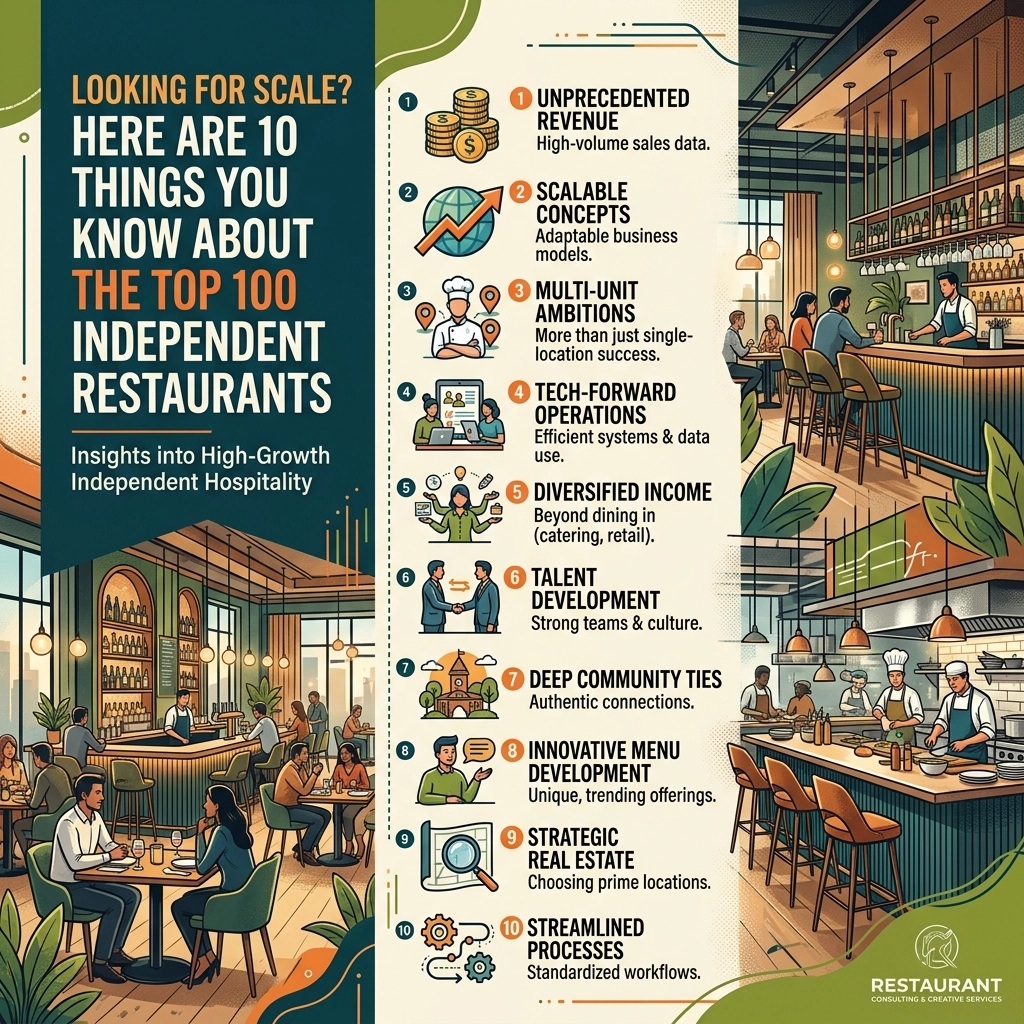
Ready? Aprons on. Here are 10 things you need to know about the Top 100 Independent Restaurants.
1. The "Rule of Five" is the Line in the Sand
In the world of industry rankings (like the ones put out by Restaurant Business Online), an "independent" isn't just one guy with one grill. The technical cutoff is usually five locations or fewer. Once you hit six, you’re officially a "chain" in the eyes of the data nerds.
Why does this matter for you? Because it proves that you can reach world-class revenue levels (we’re talking $20M+ per unit) without the massive overhead of a corporate franchise structure. (It’s also much easier to keep the "vibe" alive when you aren't managing 50 regional directors who have never flipped a burger.)
2. They Are a $2 Billion Collective
The Top 100 independents aren't just surviving; they are a powerhouse. Collectively, these 100 businesses generated nearly $2 billion in sales in 2023. That is a staggering amount of money for only 100 addresses.
When you look at the sheer scale, it becomes clear that these aren't just restaurants; they are destinations. They have figured out how to move people through the doors with surgical precision. If your current strategy is "hope people find us on Yelp," you’re playing in the sandbox while these guys are building skyscrapers.
3. Steakhouses Still Hold the Crown
If you want to know where the big money lives, follow the sound of a sizzling ribeye. Steakhouses consistently dominate the rankings, accounting for roughly 40% of the top-growing restaurants on the list.
Why? High check averages and a predictable, high-perceived-value product. People will complain about a $22 burger, but they will happily drop $85 on a steak and another $100 on a bottle of wine because "it’s an experience." (Steakhouses are essentially the "safe bet" for luxury spending, and the Top 100 list proves it.)

4. Stability is the Secret Sauce
You’d think a list of independent restaurants would change every year as trends fade, but the opposite is true. About 63% of the restaurants that were on the list a decade ago are still there.
Boring wins. Consistency pays. While the "viral" TikTok cafes are burning out after six months, the legends are focusing on the same high-quality service they provided in 1995. Scale isn't just about moving horizontally (more locations); it’s about moving vertically (more years of sustained excellence).
5. Unit Volume is the Only Metric That Matters
While a Taco Bell might do $2 million or $3 million a year, the top independents are operating on a different planet. The #1 spot (historically Joe’s Stone Crab) has pulled in upwards of $47 million in a single year from one location.
Think about that for a second. To match that revenue with a standard casual dining concept, you’d need 15 to 20 locations. These independents prove that maximizing your Average Unit Volume (AUV) is often more profitable than expansion. (More locations = more leases, more managers, and more headaches. One high-AUV location = one very happy owner.)
6. The "American" Cuisine Dominance
While we all love a niche concept, the data shows that "American" and "Steakhouse" concepts account for 51% of the total sales on the Top 100 list. They generate more revenue than seafood, French, and Spanish cuisines combined.
If you are looking for scale, don't get so creative that you alienate the masses. The Top 100 shows us that you can be "independent" and "unique" while still serving the food people actually want to eat every week.
7. The Geographic "Golden Triangle"
If you want to hit the Top 100, it helps to be in New York, Las Vegas, Chicago, or Miami. These cities are geographic hotbeds for high-volume independents because they have the "perfect storm": high foot traffic, a culture of dining out, and tourist dollars that aren't price-sensitive.
If you aren't in those cities, don't worry. You just have to work twice as hard to become a "destination" restaurant. You have to give people a reason to drive 45 minutes to see you. (Hint: It’s usually not the food; it’s how you make them feel.)
8. Check Averages are All Over the Map
There is no "one way" to make $15 million a year. The list includes casual spots with a $24 check average and fine-dining temples where you won't get out for less than $200 per person.
The lesson? Pick a lane and dominate it. Don't try to be "upscale casual" (the lullaby of dying margins). Be a high-volume, high-efficiency casual spot, or be a high-margin, low-volume luxury spot. The "middle" is where restaurants go to die.
9. Systems Over "Soul"
People think independent restaurants succeed because of the "soul" of the founder. While that’s true at the start, the Top 100 stay there because they have better systems than the chains.
To do $20M out of one kitchen, your inventory management, labor scheduling, and floor control have to be flawless. You can't "vibe" your way to those numbers. You need data. (This is why we talk so much about tech innovation and data analytics at Kuypers Creative.)
10. They are the Ultimate Private Equity Targets
Finally, understand that the Top 100 independents are the "farm system" for Private Equity. When a single-unit independent starts doing $15M+, the big money starts circling. They want to buy that system and try to turn it into the next big chain.
Whether you want to sell or not, you should build your business as if you are going to. Clean books, documented processes, and a brand that exists independently of the owner. (Check out our thoughts on private equity in restaurants for more on that.)

Featured Brand of the Day: Joe’s Stone Crab
When you talk about the Top 100 Independents, you have to start with the king. Joe’s Stone Crab in Miami Beach isn't just a restaurant; it’s a landmark. It has topped the revenue charts for years, proving that a seasonal product and a commitment to tradition can create a financial juggernaut.
History of the Brand
Founded in 1913 by Joseph "Joe" Weiss, Joe’s started as a small lunch counter on Miami Beach: before Miami Beach was even a city. In 1921, a biologist brought Joe a strange crustacean: the stone crab. Joe threw them in boiling water, served them with hash browns and cole slaw, and the rest is history. Four generations later, the Sawitz family still runs the show, maintaining a "no reservations" policy that has seen everyone from Al Capone to Frank Sinatra wait for a table.
Connect with Joe’s Stone Crab
- Website: joesstonecrab.com
- Instagram: @joesstonecrab
- Facebook: Joe's Stone Crab
- Twitter/X: @JoesStoneCrab
The Visionaries
- Owner/Operator: Stephen Sawitz (Fourth Generation)
- LinkedIn: Stephen Sawitz
Recent Press & News
- Forbes: How Joe's Stone Crab Remains a Top-Grossing Independent
- Miami Herald: The Century-Long Legacy of Joe’s
The Bottom Line
Scaling doesn't always mean "more." Sometimes, it means "better." The Top 100 independent restaurants are proof that if you focus on your unit economics, nail your systems, and choose a concept with high demand, the sky is the limit.
If you’re struggling to find that next level of growth, maybe it’s time to stop looking at the 500-unit chains and start looking at the 1-unit legends.
Need help building those systems? That’s what we do.
Tags: Robert Kuypers, Robert William Kuypers, William Kuypers, Rob Kuypers.
Keywords: Top 100 Independent Restaurants, restaurant scaling strategy, Joe’s Stone Crab revenue, independent restaurant growth, high volume restaurant operations, restaurant unit economics, restaurant consulting services.
Metadata:
- Title: 10 Secrets of the Top 100 Independent Restaurants | Kuypers Creative
- Description: Discover how the top 100 independent restaurants generate $2 billion in collective sales. Learn the 10 key insights for scaling your restaurant brand.
- Author: Admin (Kuypers Creative)
- Category: Restaurant Growth Strategy