
It is Saturday, April 4th, 2026. You’re sitting in your office (or maybe a quiet corner of the bar before the brunch rush), and you’re looking at the numbers. They aren’t adding up. Again.
If you feel like you’re running a marathon in combat boots while trying to balance a tray of martinis, you aren't alone. The restaurant industry in 2026 is a different beast than it was even two years ago. We are currently seeing a massive "shakeout": a Darwinian moment where the restaurants that relied on "vibes" and "gut feelings" are being replaced by operators who treat their data like gold.
According to recent data, nearly 42% of restaurants weren't profitable last year, and 1 in 10 full-service establishments are at serious risk of closing their doors before the year is out. Why? Because the old playbook is on fire, and not in the "cool flambé" kind of way.
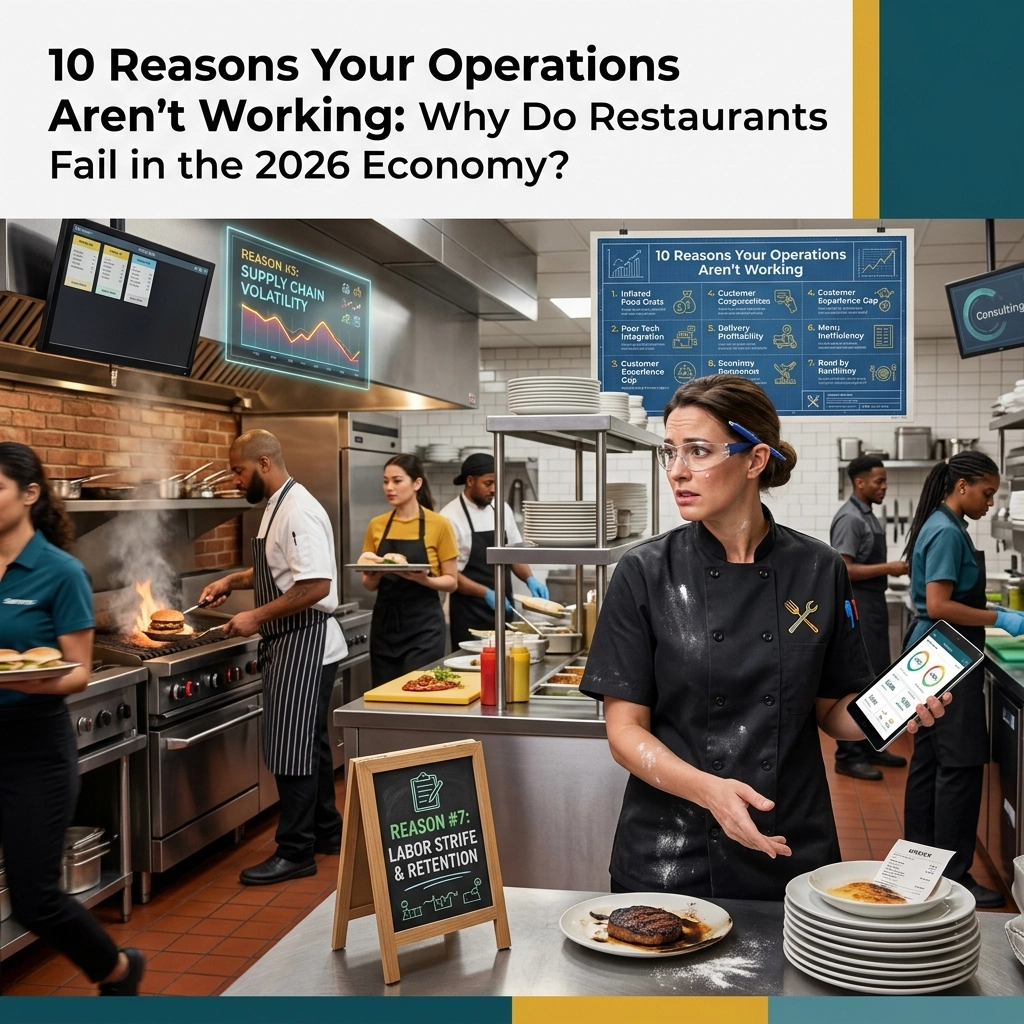
Here are the 10 reasons your operations aren't working in the 2026 economy, and how to stop the bleed.
1. The Inflation Hangover (35-39% Cost Spikes)
Let’s talk about the elephant in the walk-in. Since 2019, food and labor costs have climbed between 35% and 39%. That is not a typo. If your costs have gone up by nearly 40% and your menu prices have only moved 15%, you are literally paying your customers to eat at your restaurant.
The math is brutal. Many operators are trying to absorb these costs because they’re terrified of losing regulars. But "absorbing" is just a fancy word for "slowly going out of business." You need a Strategic Growth Strategy that looks at these numbers weekly, not quarterly.
2. The "Pricing Ceiling" is Real
You can’t just keep raising prices. We’ve hit a wall. According to the James Beard Foundation, establishments that raised prices by more than 10% in the last year were the most likely to see a drop in foot traffic and overall profit.
Eight in ten Americans report noticing significant price hikes, and their response is to share meals, skip the high-margin cocktails, or stay home entirely. When the guest feels "nickeled and dimed," the relationship is over.

3. Spreadsheet Sabotage: Manual Procurement
Are you still using a manual spreadsheet to track your food costs? Or worse, are you still calling in orders to your reps like it’s 1995?
Operating without data-backed visibility into spending patterns is professional suicide in 2026. Many restaurants are overpaying for supplies because they lack the transparency to catch price creeps or miss out on rebate opportunities. If you aren't using modern Tech Innovation to automate your procurement, you’re essentially leaving the back door open for your profits to walk out.
4. The Talent Tug-of-War (49% Staffing Shortage)
Almost half of all restaurant operators are reporting staffing shortages. It’s not just that people don’t want to work; it’s that the "talent" is being poached by industries that offer better Team Leadership & Culture.
High turnover doesn't just hurt morale: it degrades the guest experience. Every time a seasoned server leaves, you lose the ability to upsell that $80 bottle of wine or the $15 dessert. You aren't just hiring bodies; you're hiring brand ambassadors. If your operations rely on "whoever showed up today," your consistency is going to crater.
5. Creative Vanity vs. Menu Engineering
I’ve seen it a thousand times: a chef puts a beautiful, labor-intensive dish on the menu because it looks great on Instagram. But when you look at the contribution margin? It’s a loser.
Many menus are designed for creativity rather than profitability. Without analyzing plate costs down to the gram, you might be featuring low-margin items that are actively eroding your bank account. (Boring wins. Boring pays. Boring is the new sexy.) You need to audit your menu for "market fit" and margin, not just aesthetics.

6. Deferred Maintenance: The Ticking Time Bomb
When cash flow is tight, the first thing to go is the preventive maintenance schedule. You decide to skip the HVAC service or ignore the leak in the walk-in.
Big mistake. The cost of equipment breakdown claims has doubled between 2024 and 2025. Between supply chain delays for parts and a shortage of qualified contractors, a broken compressor in July could mean your restaurant is closed for a week. That’s a "lullaby of dying margins" you don't want to hear.
7. Supply Chain Fragility
Global trade changes and extreme weather events are no longer "rare." They are the new normal. If your entire menu relies on one specific type of Chilean sea bass or a very niche organic produce supplier, you are one storm away from a 404 error on your menu.
Successful 2026 operations prioritize supply chain agility. You need backup vendors and a menu that can pivot when your primary ingredient suddenly triples in price or disappears from the market.
8. The Quality-Price Disconnect
This is the most dangerous one. Because costs are high, some operators are tempted to "cheap out" on ingredients while still charging premium prices.
Customers aren't stupid. If they are paying $28 for a burger, it better be the best burger of their lives. When you serve lower-quality food at higher prices, you break the "value proposition." Once that trust is gone, no amount of Digital Marketing can bring them back.

9. AI Aversion (Leaving Money on the Table)
If you hear the word "AI" and think of robots serving soup, you’re missing the point. In 2026, AI is about Data Analytics. It’s about predicting how many steaks you’ll sell on a rainy Tuesday so you don't over-order. It’s about personalized loyalty programs that actually work.
Avoiding tech integration puts you at a massive competitive disadvantage. Your competitors are using AI to streamline their labor schedules and reduce friction in the ordering process. If you’re still doing it "the old way," you’re fighting a tank with a toothpick.
10. The One-Trick Pony Syndrome
Consumer preferences are shifting faster than ever. The brands that are failing are the ones built around a single, rigid category that refused to evolve.
Whether it's the rise of alcohol-free social spaces or the demand for high-protein, "bio-available" ingredients, you have to stay agile. If your operations aren't flexible enough to adapt to what the 2026 consumer actually wants, you’re just a dinosaur waiting for the asteroid.
How to Pivot (Before the "For Lease" Sign Goes Up)
Look, I’m not here to scare you; I’m here to wake you up. The restaurants that are thriving right now are the ones that have embraced the "New Math." They are lean, they are tech-forward, and they are obsessed with the guest experience.
Step 1: Audit your tech stack. Check out our 2025 Restaurant POS Buyers Guide to see if your systems are helping or hurting you.
Step 2: Tighten your procurement. No more "guessing" what things cost.
Step 3: Invest in your people. Culture is the only thing that survives a labor shortage.
Ready to fix the leaks? Let's get to work. Aprons on.
SEO Keywords
Targeted Keywords: Restaurant failure reasons 2026, restaurant operational efficiency, why restaurants fail, restaurant economy 2026, restaurant cost control.
Long Tail Keywords: How to increase restaurant profit margins in 2026, impact of food inflation on restaurants, restaurant technology integration strategies, reducing restaurant labor turnover, menu engineering for profitability.
Metadata
Title: 10 Reasons Your Operations Aren’t Working: Why Do Restaurants Fail in 2026?
Description: Discover why 42% of restaurants aren't profitable and how to fix your operations in the 2026 economy. From inflation to tech, we dive deep into the data.
Category: Restaurant Growth Strategy
Tags: Robert Kuypers, Robert William Kuypers, William Kuypers, Rob Kuypers, Restaurant Operations, Business Consulting, 2026 Economy.