
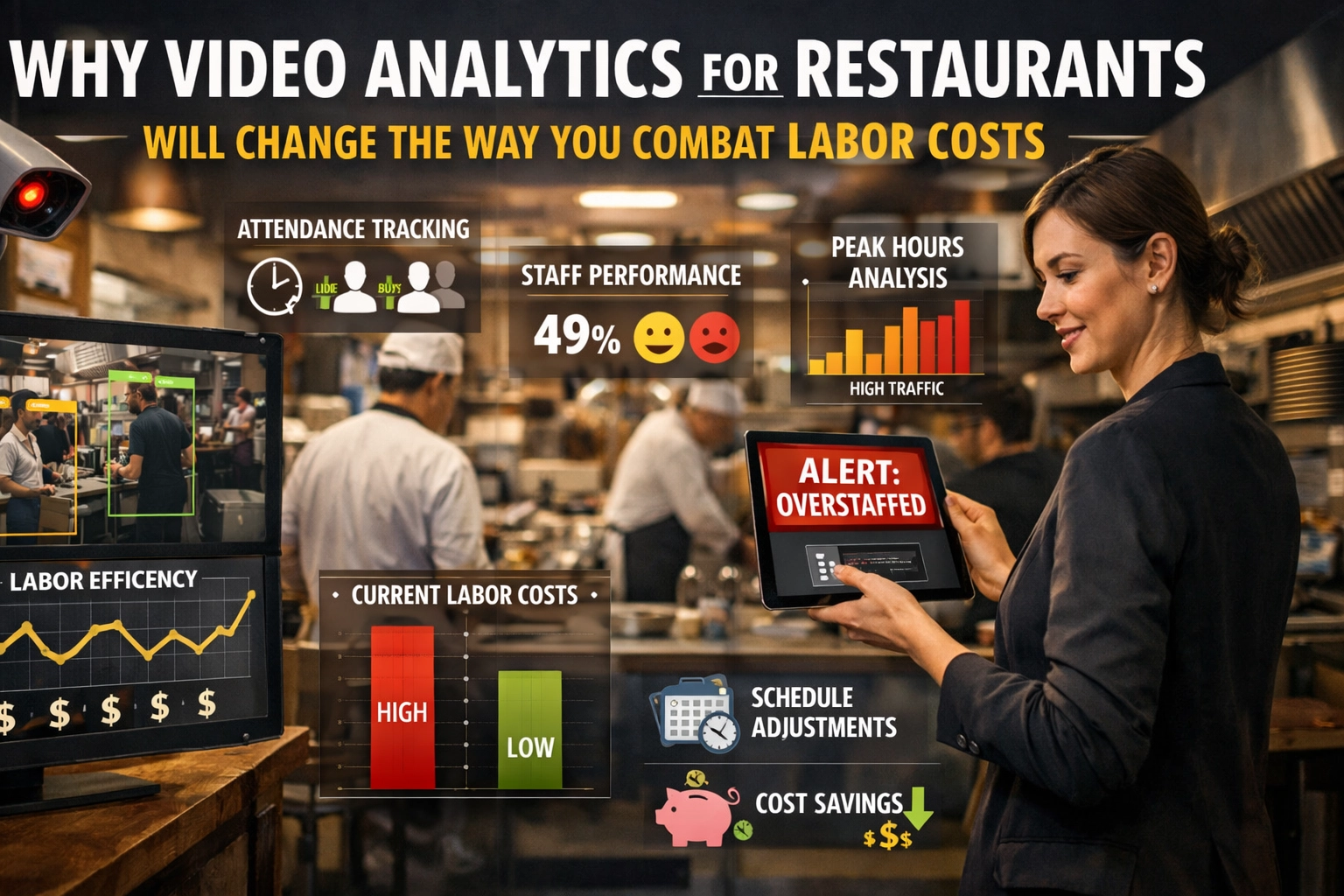
Listen, I’ve seen restaurant margins thinner than a slice of budget carpaccio. If you’re running a kitchen or managing a floor in 2026, you know that labor isn’t just a line item anymore, it’s a fire-breathing dragon trying to incinerate your bottom line. We’ve tried everything: cutting shifts, cross-training until the dishwasher can cook a soufflé, and praying to the gods of the "Average Check."
But here’s the cold, hard truth: you can’t manage what you can’t see. And unless you have twelve pairs of eyes and the ability to be in the walk-in, the dining room, and the loading dock simultaneously, you are missing the leaks.
Enter Video Analytics.
Now, before you roll your eyes and think, "Robert, I already have security cameras," let me stop you right there. We aren’t talking about graining footage of someone slipping on a banana peel. We’re talking about AI-powered "Computer Vision" that turns your video feed into a mountain of actionable data. It’s the difference between a VHS tape and a supercomputer.
Ready? Aprons on. Let’s dive into why this tech is the ultimate weapon against the lullaby of dying margins.
1. The Death of "Guess-timating" Your Staffing
We’ve all been there. You look at the schedule on a Tuesday morning, see the sun is out, and think, "Yeah, three servers should be enough." Then, a local soccer team shows up unannounced, the patio fills up, and suddenly your staff is drowning while your labor cost per hour spikes because of the chaos and slow turn times.

Video analytics takes the "vibes-based" scheduling and throws it in the trash. By using real-time occupancy tracking, these systems monitor exactly how many people are in your building and, more importantly, where they are.
According to recent industry reports on restaurant technology trends, AI systems can now send dynamic alerts to managers’ smartwatches or tablets.
- The Scenario: The AI detects the queue at the host stand has reached five groups, but only one server is on the floor.
- The Action: It pings you to pull someone from prep to the front before the Yelp reviews start complaining about the wait.
This isn’t just about adding people; it’s about cutting them, too. If the "rush" ends 30 minutes early, the data shows the drop-off in real-time, allowing you to send people home based on actual traffic patterns rather than "what we did last year."
2. Hunting the "Silent Killers": Bottlenecks and Ghost Stations
Inefficiency is a silent killer. It’s the extra 45 seconds a plate sits under the heat lamp because the runner is chatting at the bar. It’s the cashier station that stays empty while a line forms because someone "stepped away for a second."
Video analytics uses absence detection. It knows when a critical workstation, be it the fry station, the bar, or the POS, is left unattended during peak hours. (And yes, it tracks how long that station stayed empty.)

As I often say on LinkedIn, Boring wins. Boring pays. Having a person in the right spot at the right time is "boring" operational excellence, but it’s what keeps your labor percentage from creeping into the danger zone. When you identify that your kitchen bottleneck isn't "slow cooks" but actually "poorly timed ticket runners," you stop throwing money at the wrong problem.
3. Accountability Without the Micromanagement (The 24/7 Digital Manager)
Nobody likes a micromanager. I don't like being one, and your team definitely doesn't like working for one. But you still need to know: Are people showing up on time? Are they spending forty minutes of their shift scrolling through TikTok in the dry storage?
Video analytics provides 24/7 automated monitoring of labor discipline. It can track:
- Late arrivals and early departures.
- Time spent away from designated workstations.
- Compliance with safety protocols (like handwashing or wearing hats).
- Excessive "idle time" where staff are clustered together instead of cleaning or prepping.
This isn't about being Big Brother; it's about fairness. Your A-players hate it when the slackers get paid the same amount to do half the work. By using data-driven performance metrics, you can reward the hustlers and have "the talk" with the coasters based on cold, hard facts: not a "he-said, she-said" situation.
4. Syncing Production with Reality
One of the biggest hidden labor costs is over-production. We have people prepping 50 gallons of salsa because "that's what we always do on Wednesdays," only to throw half of it out or spend labor hours repurposing it.

By correlating video data (how many people actually came in) with your POS data (what they actually bought), AI helps you forecast production levels with scary accuracy. If the video analytics show a 20% decline in foot traffic on rainy Tuesdays, your prep list should reflect that. Less prep = fewer labor hours = more money in your pocket. It’s simple math, but doing it manually is a nightmare. Let the robots do it.
5. How to Implement Without Starting a Mutiny
I get it. Bringing in "AI Video Analytics" sounds like something out of a sci-fi movie that ends with the robots taking over the bistro. Your staff might be nervous.
Here’s the Robert Kuypers approach: Transparency is your best friend.
- Frame it as a support tool: Tell the team the system is there to ensure they aren't overwhelmed during unexpected rushes.
- Use it for training, not just "catching": Show the team the heatmaps. Show them where the bottlenecks are. When they see that the data helps them make more tips because service is smoother, they’ll buy in.
- Focus on the ROI: These systems aren't free, but neither is an extra $2,000 a month in wasted labor. Start with a pilot at one location and track the "Labor Cost vs. Sales" ratio like a hawk.

The Bottom Line: Data is the New Secret Sauce
The "old way" of managing a restaurant involved a lot of gut feeling and "walking the floor." While you should never stop walking the floor, you need to back your intuition with data. Video analytics is the bridge between the physical world of your dining room and the digital world of your P&L statement.
If you’re ready to stop guessing and start growing, it’s time to look at the lens. Your margins will thank you.
Ready to optimize? Let’s talk strategy. Contact Kuypers Creative today.
Keywords & Metadata
- Focus Keyword: Video Analytics for Restaurants
- Long-tail Keywords: reducing restaurant labor costs with AI, restaurant staffing optimization technology, computer vision for food service, ROI of restaurant video analytics, automated restaurant monitoring.
- Meta Description: Discover how video analytics is revolutionizing the restaurant industry by optimizing labor costs, identifying bottlenecks, and providing real-time staffing alerts. Stop guessing and start using data to save your margins.
External References
- National Restaurant Association: 2026 State of the Industry
- Forbes: How AI is Changing the Face of Hospitality
- TechCrunch: The Rise of Computer Vision in Retail and Dining
Tags
Robert Kuypers, Robert William Kuypers, William Kuypers, Rob Kuypers, Restaurant Tech, Labor Costs, Video Analytics, Kuypers Creative, Restaurant Consulting, AI in Food Service.