
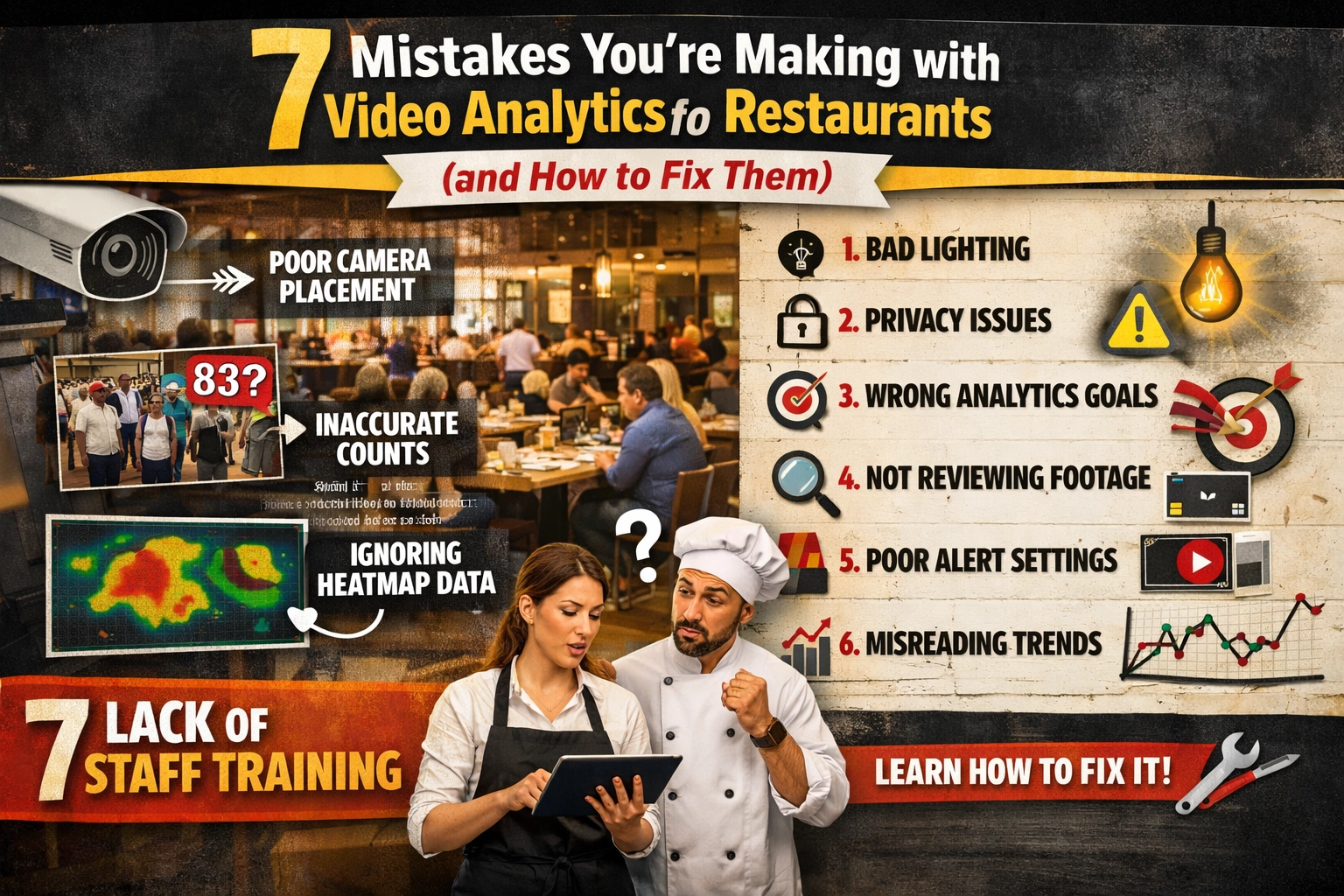
Listen, I get it. You installed cameras because the insurance guy gave you a "suggestive" look, or because you caught a line cook "tasting" the Wagyu ribeye like it was a free sample at a Costco on a Saturday. You think you’re protected. You think you’re watching.
But here’s the cold, hard truth (the kind of truth that feels like a walk-in freezer door hitting you in the face): Most restaurant surveillance is basically a high-tech version of a security guard sleeping on the job.
If you’re just using your cameras to see who dropped the tray of glasses in Section 4, you’re leaving money on the table. You’re ignoring the "digital eyes" that could be optimizing your labor, boosting your table turns, and stopping theft before it even happens. At Kuypers Creative, we see these blunders every single day.
Ready to stop treating your video system like a 90s CCTV setup and start treating it like the profit-engine it is? Aprons on. Let's fix this.
1. The "Fried Chicken Filter" (Greasy Lenses)
The Mistake: You haven’t looked at your camera feed in three months, and when you finally do, it looks like a J.J. Abrams movie: lens flares and blurry shapes everywhere. In a restaurant, grease isn't just a cooking medium; it’s an airborne invader. It settles on lenses, turning your 4K investment into a "smudge-vision" nightmare.
The Fix: This is low-tech, but vital. Add "Clean Camera Lenses" to your weekly manager checklist. Use a microfiber cloth and a non-abrasive cleaner. Or, if you’re building out a new spot, invest in cameras with protective, grease-resistant housings designed for commercial kitchens. If you can't see the parsley on the plate, you can't see if the portion sizes are killing your margins.
2. The "Paranormal Activity" Night Vision
The Mistake: Relying on cheap infrared (IR) night vision that makes everyone look like a glowing green ghost. If your footage of a 3:00 AM break-in looks like a grainy UFO sighting, the police aren't going to find anyone. Poor IR creates shadows and "hot spots" where faces are completely washed out.
The Fix: Upgrade to Full-Color Night Vision or high-dynamic-range (HDR) cameras. Modern sensors can pull color out of near-total darkness. (Boring pays, and clear footage is the ultimate boring-but-necessary win). You need to be able to tell if that person in the alley is a delivery driver or someone looking to liberate your liquor cabinet.

Caption: A comparison between grainy legacy IR and modern high-resolution color night vision.
3. The "Pixelated Potato" Resolution
The Mistake: Thinking "HD" is enough. Look, 1080p is great for watching Netflix on your phone, but in a restaurant, you need to see details. Can you see if that’s a $20 bill or a $5 bill? Can you see if the bartender actually poured a double? If the answer is "maybe, if I squint," your resolution is too low.
The Fix: Aim for 4K resolution in high-stakes areas: the POS station, the bar, and the back dock. Higher resolution allows you to "digital zoom" without the image turning into a Minecraft block. According to reports on TechCrunch, AI-driven vision is only as good as the data it receives. Garbage in, garbage out.
4. Ignoring the "Bermuda Triangles" (Blind Spots)
The Mistake: You’ve got cameras on the front door and the cash register. Great. But what about the walk-in cooler? The dumpster area? The prep station where the "magic" (and the waste) happens? Most theft and operational friction happen in the shadows.
The Fix: Map your space strategically. Use 360-degree fisheye cameras to eliminate blind spots in large dining areas, but keep tight, high-angle shots on:
- The Back Dock: Where the high-value inventory arrives (and sometimes leaves).
- The Walk-In: Because "grazing" is a margin-killer.
- The Prep Line: To monitor food safety and speed of service.
As I often say on LinkedIn, culture is what happens when you aren't looking: but having the ability to look certainly helps keep the culture accountable.
5. Operating in a Silo (No POS Integration)
The Mistake: This is the big one. Your video system and your Point of Sale (POS) system are strangers. They don't talk. They don't even like each other. When you want to investigate a "voided" transaction, you have to manually match the timestamp on the receipt to the footage. It’s a soul-crushing waste of time.
The Fix: Integrate your video analytics with your POS. Modern systems (like those we discuss in our Tech Innovation section) allow you to search by transaction. Want to see every time a drawer was opened without a sale? Click a button. Want to see every "No Sale" or high-value "Void"? It’s right there. This isn't just about catching "bad" employees; it's about identifying training gaps.

Graph: The correlation between POS-integrated video surveillance and a reduction in "unaccounted-for" inventory loss.
6. The "24-Hour Binge" (Manual Review)
The Mistake: You think you’re going to sit down every Sunday and watch 40 hours of footage. (Spoiler alert: You won’t. You’ll watch 10 minutes, get bored, and go check your fantasy football team). Relying on manual review means you only find problems after they’ve cost you thousands.
The Fix: Use AI-Powered Analytics and Alerts. Set up "virtual tripwires." If someone enters the office after midnight, you should get a push notification on your phone immediately. If the queue at the host stand exceeds five people, your manager should get an alert to open another station. Let the AI do the "watching" so you can do the "leading."
Check out the latest industry trends on National Restaurant News to see how AI is shifting from a luxury to a necessity.
7. Missing the "Human Data" (Operational Metrics)
The Mistake: Seeing video only as a "security" tool. This is the "lullaby of dying margins." If you aren't using video to track guest counts, dwell times, and table turn rates, you’re missing the most valuable data in your building.
The Fix: Use heat-mapping and occupancy sensors.
- Heat Maps: See where guests congregate. Is that one booth always empty? Maybe the AC is blowing right on it. Fix the AC, fill the booth, make more money.
- Wait Times: Analytics can track exactly how long it takes from a guest sitting down to a water glass hitting the table.
- Table Turns: Are your servers "camping" or is the kitchen lagging? The video doesn't lie.
For more on using data to drive growth, dive into our Data Analytics category.
The Bottom Line: Boring is Sexy
I’ve said it before and I’ll say it again: Boring wins. Boring pays. Boring is the new sexy.
Standardizing your video analytics might feel like a "boring" back-office task, but it’s actually the foundation of a high-performance restaurant. It’s about moving from a reactive "What happened?" mindset to a proactive "What is happening right now?" strategy.
Don't let your video system be a passive observer of your restaurant's struggles. Turn it into a tool that sharpens your operations, protects your people, and pads your bottom line.
Ready to level up your tech stack? Contact Kuypers Creative today and let's turn those cameras into a competitive advantage.
Keywords: Restaurant Video Analytics, POS Integration, Restaurant Security Mistakes, AI Restaurant Technology, Loss Prevention, Restaurant Operational Efficiency, Guest Traffic Tracking.
Metadata:
- Title: 7 Mistakes You’re Making with Video Analytics for Restaurants
- Description: Stop wasting your surveillance budget. Learn how to fix common video analytics mistakes in restaurants, from greasy lenses to POS integration and AI alerts.
- Author: Robert Kuypers
- Category: Tech Innovation
Tags: Robert Kuypers, Robert William Kuypers, William Kuypers, Rob Kuypers, Restaurant Tech, Data Analytics, Leadership, Operational Excellence.
External Links: