
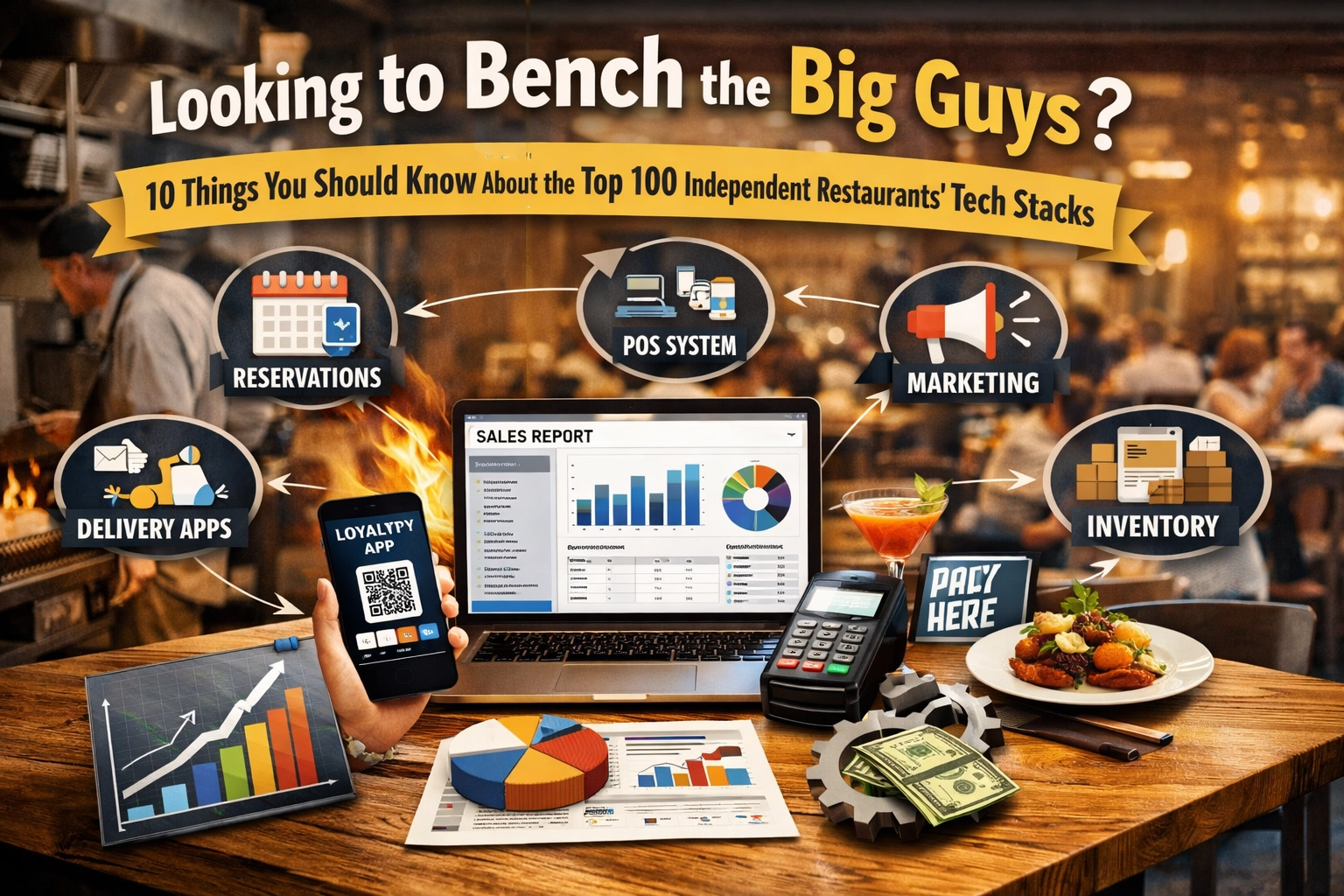
Listen, I love a good David vs. Goliath story as much as the next guy. But in the restaurant world, David didn’t just have a slingshot; he had a cloud-based, API-integrated, AI-powered ballistic missile system.
If you’re running an independent spot and looking at the "Big Guys": those massive chains with IT budgets larger than your entire net worth: you might feel like you’re bringing a plastic spork to a gunfight. But here’s the secret: the Top 100 independent restaurants in the country aren't just surviving; they are absolutely thumping the chains. How? By building tech stacks that would make Silicon Valley blush.
I’ve spent a lot of time yelling into the void on LinkedIn about why "gut feeling" is the fastest way to go broke. (Seriously, your "intuition" is often just indigestion from yesterday's staff meal.) If you want to bench the big guys, you need to know what the heavy hitters are doing.
Ready? Aprons on. Here are 10 things you need to know about the tech stacks of the elite independents.
1. The 8.2% Margin Miracle
Let’s talk numbers, because numbers don't have feelings, and they certainly don't lie. High-performing independent restaurants with integrated tech stacks see an average of 8.2% higher profit margins than those stuck in the Stone Age.
Think about that. On a million dollars in revenue, that’s an extra $82,000 in your pocket. That’s a new car, a massive bonus pool for your staff, or a very aggressive down payment on a second location. Conversely, if you're still using a legacy system that doesn't talk to your accounting software, your failure rate is 2.3 times higher. (That’s the "lullaby of dying margins" I always talk about.)
2. The POS is Your Central Nervous System (Not Just a Toaster)
The Top 100 aren't using their Point of Sale (POS) systems just to ring up a burger. They use platforms like Toast or Square as a management hub.
These systems handle:
- Real-time labor cost tracking (so you don't overschedule on a slow Tuesday).
- Menu engineering (knowing exactly which dish is a "star" and which is a "dog").
- Unified ordering across every channel.
If your POS is just a glorified calculator, you’re already behind. You need a system that captures guest preferences, transaction data, and operational metrics simultaneously.

3. Voice AI: Capturing the "Ghost" Revenue
Ever wonder how many phone calls your hosts miss during a Friday night rush? It’s more than you think. Top independents have stopped letting those calls go to voicemail (where orders go to die).
By implementing Voice AI for phone orders, savvy operators are capturing 15-22% additional revenue from calls that previously went unanswered. These AI bots handle routine questions ("Are you dog friendly?" or "Do you have gluten-free pasta?") and take orders, only bothering your staff for the complex stuff. It’s like having a host who never sleeps, never complains, and never gets overwhelmed.
4. The API Gospel: Real-Time Connectivity
The "Big Guys" have custom-built software, but the "Smart Guys" (the top independents) use API-driven integrations.
In a recent LinkedIn post, I mentioned that "Tech Debt" is the silent killer of restaurants. Top performers ensure their POS, their accounting software, and their scheduling tools all talk to each other in real-time. No more manual data entry at 2 AM. If your systems don't have an open API, you're building a wall around your own data.
5. Data Silos: The "Curtain on Fire" Moment
Speaking of data, one in five operators in 2026 cited "data silos" as their biggest headache. This happens when your delivery data is in one place, your payroll in another, and your inventory in a third.
The elite 100 use business intelligence tools to unify this mess. They can see correlations that are invisible to the naked eye: like realizing that a specific server’s high labor cost is actually justified because they have the highest upsell rate for premium wine. Check out our Data Analytics category for more on how to break these walls down.
6. OCR Inventory: Math is Hard, Let the Robot Do It
If your chef is still walking into the walk-in with a clipboard and a pencil, we need to have an intervention.
The top dogs are using Optical Character Recognition (OCR) to digitize invoices instantly. You take a photo of the invoice from your produce guy, and the system automatically updates your food costs. This allows for weekly variance analysis. If you only check your food costs once a month, you’re just performing an autopsy on your profits. You need to catch the "bleeding" while the patient is still on the table.

7. The $14.3 Billion Arms Race
The restaurant tech market has expanded by 47% since 2020. This isn't just a trend; it's an arms race. According to Restaurant Business Online, the sheer volume of available tools is staggering.
The Top 100 independent restaurants don't buy every shiny new toy. They are strategic. They invest in Tech Innovation that solves specific bottlenecks, rather than just adding another monthly subscription to the P&L.
8. Implementation Discipline (The "Secret Sauce")
Here’s a hard truth: A $50,000 tech stack is worthless if your team only uses 10% of its features.
The difference between a Top 100 restaurant and a struggling one isn't just the software: it’s the discipline. Elite operators have:
- Weekly data review sessions.
- Mandatory staff training on new features.
- A culture of making decisions based on metrics, not "vibes."
If you aren't training your team to use the tools, you're just buying a Ferrari to drive it 20 mph in a school zone. (Boring wins. Boring pays. Boring is the new sexy.)
9. Dynamic Labor Management
The "Big Guys" have algorithms to predict labor needs. Now, you do too. Modern tech stacks allow independent restaurants to adjust staffing levels on the fly based on historical sales trends and even local weather patterns.
If the forecast says it’s going to rain, your tech should tell you to cut two servers before they even clock in. This kind of agility is how independents out-maneuver massive chains with rigid corporate structures.
10. Customer Lifetime Value (CLV) Tracking
The biggest advantage a small restaurant has over a chain is the relationship. But you can't scale "relationships" without data.
The top independents use their tech stacks to track Customer Lifetime Value. They know who their top 100 customers are, what they drink, where they like to sit, and when they last visited. They use Digital Marketing to send personalized offers that actually mean something, rather than generic "10% off" blasts that everyone ignores.

Summary: Bench the Big Guys
You don't need a corporate headquarters in Chicago or Orlando to dominate your market. You just need to stop acting like technology is an "extra" and start treating it like the foundation of your business.
The Top 100 independent restaurants are proving that with the right tech stack and the discipline to use it, you can run circles around the chains. You get the agility of an independent with the data-driven power of a conglomerate.
Ready to stop guessing and start growing? Contact Kuypers Creative today. We’ll help you build a tech stack that actually works for you, instead of the other way around.
Keywords: Restaurant Tech Stack, Independent Restaurant Management, Restaurant Profit Margins, Voice AI for Restaurants, POS Integration, Data Analytics for Restaurants, Restaurant Growth Strategy.
Metadata:
- Title: Bench the Big Guys: Independent Restaurant Tech Insights
- Description: Learn the 10 tech secrets the Top 100 independent restaurants use to out-earn the big chains. From Voice AI to API integration.
- Author: Robert Kuypers
- Category: Tech Innovation
External Links:
- National Restaurant Association – Tech Trends
- Toast POS Restaurant Success Report
- Restaurant Business Online – Technology News
Tags: Robert Kuypers, Robert William Kuypers, William Kuypers, Rob Kuypers, Kuypers Creative, Restaurant Consulting, Restaurant Tech.