
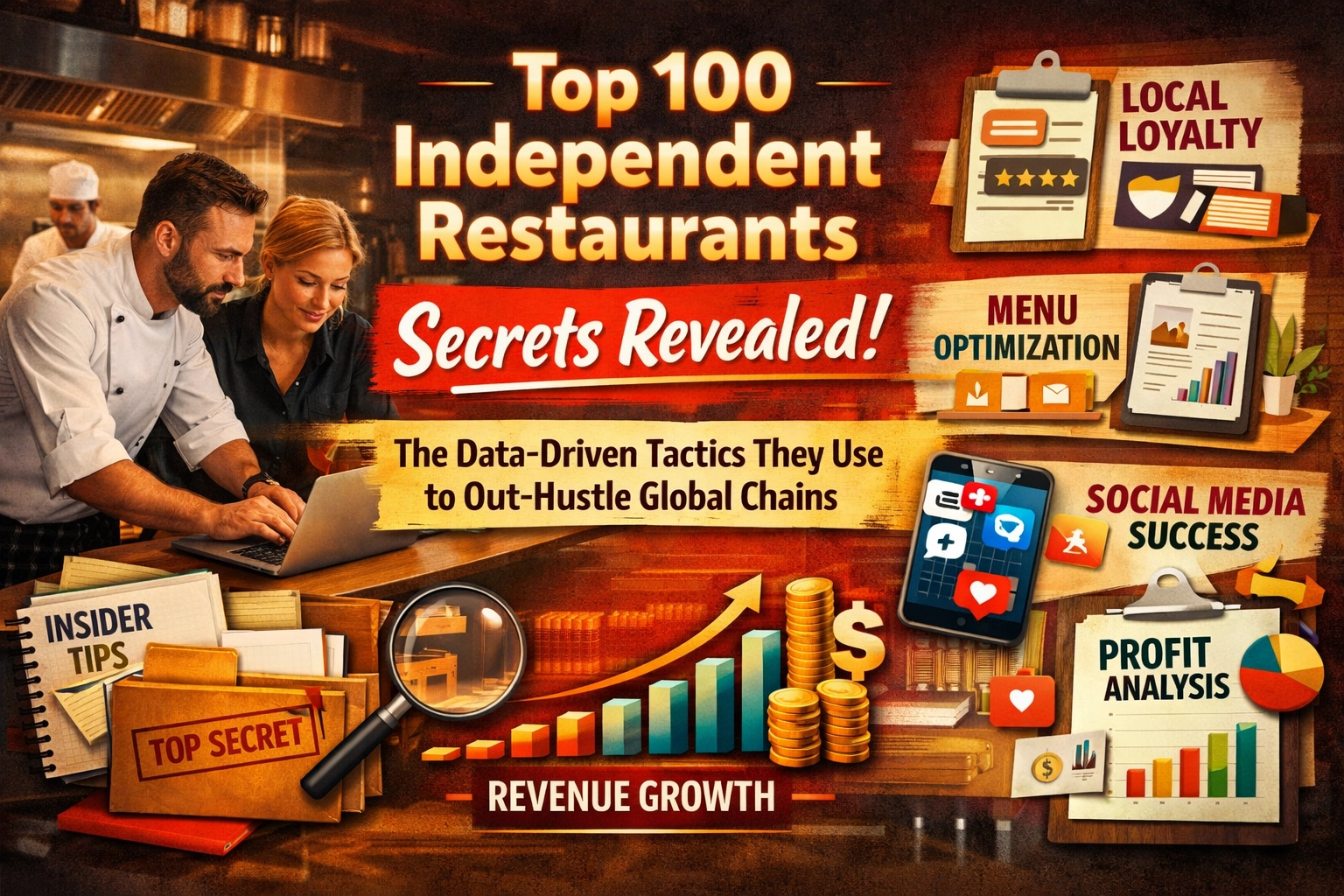
If you walked into the Balboa Bay Resort in Newport Beach or The Capital Grille in Charlotte this morning, you wouldn’t just see a high-end dining room. You would be standing inside a high-output financial engine that is currently out-performing some of the most recognizable global fast-food chains on a per-unit basis.
As we sit here in March 2026, the restaurant economy has shifted. The "mushy middle" of casual dining is evaporating, leaving a massive chasm between the convenience-driven giants and the high-performance independents. According to the latest 2025-2026 fiscal rankings, the top-grossing independent restaurants in the U.S. are now pulling in between $20 million and $34 million annually. To put that in perspective, the average McDonald's unit pulls in roughly $3.5 million.
How does a single-location operation (or a small regional group) generate 10x the revenue of a global titan? It isn’t just about better steak or a prettier view. It’s about a ruthless, data-driven approach to operations that the "big guys" are often too slow to implement.
The Revenue Gap: Breaking Down the $34 Million Ceiling
The 2025 rankings shocked the industry when the Balboa Bay Resort claimed the top spot with a staggering $34,622,160 in annual revenue. Closely following was The Capital Grille in Charlotte at $34,234,627. When we look at these numbers, we have to ask: what is the "secret sauce"?
It’s not just foot traffic. It’s Revenue Per Available Seat Hour (RevPASH) optimization.

Top-tier independents have abandoned the "gut feeling" method of floor management. They are utilizing advanced predictive analytics to maximize every square inch of the property. For these high-earners, a table sitting empty for 15 minutes during a shift change isn't just an annoyance: it's a data point that needs fixing.
1. Hyper-Personalized CRM and the "Whale" Strategy
Global chains excel at broad-market loyalty programs (think: "Buy 10 coffees, get one free"). Independent powerhouses, however, have pivoted to Hyper-Personalization.
The top 100 independents use sophisticated Customer Relationship Management (CRM) systems that integrate directly with their POS and reservation platforms. They don't just know your name; they know your preferred vintage of Cabernet, the fact that you’re allergic to shellfish, and that you usually celebrate your anniversary in the third week of October.
By leveraging this data, they can execute "Whale" strategies: focusing 80% of their marketing efforts on the top 20% of their highest-spending guests. This reduces customer acquisition costs and dramatically increases the lifetime value (LTV) of the guest. When you’re playing at the $30 million level, restaurant revenue isn’t about finding new customers; it’s about deepening the pocket share of the ones you already have.
2. Agility in the Supply Chain: The "Pivot" Advantage
One of the biggest weaknesses of global chains is their rigid, massive supply chains. If the price of avian-flu-impacted poultry spikes, a chain with 5,000 locations takes months to adjust their menu and pricing.
The Top 100 Independents operate with Agile Procurement. According to the James Beard Foundation’s 2026 Independent Restaurant Industry Report, high-performing independents are now using AI-driven inventory tools to hedge against inflation in real-time.
They use "Dynamic Menu Engineering." If a specific ingredient sees a 15% price hike on Monday, the digital menu (or the printed daily specials) is adjusted by Tuesday. This agility allows them to maintain margins that would make a corporate CFO weep with envy. They aren't just selling food; they are trading commodities in real-time.

3. Tech Integration: Moving Beyond the Tablet
While many restaurants are still struggling to get their tablets to talk to their printers, the elite independents are deep into Tech Stack Consolidation.
We are seeing a massive surge in trending tech in restaurants. This includes:
- AI Labor Scheduling: Predictive models that look at weather patterns, local events (like a concert three blocks away), and historical sales to schedule staff to the minute.
- Biometric Kitchen Management: Systems that track prep speeds and waste at the individual station level.
- Automated Upselling: Reservation systems that offer "pre-experience" add-ons (like a chilled bottle of Krug awaiting your arrival), which adds an average of 12% to the check before the guest even sits down.
4. The Specialized Cuisine Moat
The success of Albi, a Palestinian-focused concept in D.C. that hit #1 on several 2026 power lists, proves that "niche is the new mass market." Global chains have to appeal to everyone, which often leads to a "beige" brand identity.
Independent operators are winning by leaning into Cultural Authenticity and Specialized Cuisine. This creates a "moat" around the business. You can’t get Albi’s specific coal-fired flavors at a national chain. This scarcity allows for higher price elasticity: guests are willing to pay a premium for an experience they literally cannot find anywhere else.
5. Talent as an Investment, Not an Expense
In the 2026 economy, the labor crisis hasn't disappeared; it has simply evolved. The Top 100 have realized that the "churn and burn" model of the 2010s is a death sentence.

The highest-grossing independents are now offering:
- Performance-Based Equity: Key staff members (not just GMs) receiving small stakes or profit-sharing.
- Tech-Enabled Tipping: Using platforms like fast-tipping to ensure staff are paid instantly, increasing retention by up to 40%.
- Leadership Development: Treating the kitchen like a laboratory for restaurant-leadership.
When your staff stays for five years instead of five months, your consistency goes up, your training costs go down, and your guest satisfaction scores soar.
The "Bathroom Read" Data Breakdown
Let's look at the raw numbers from the mid-year 2025 performance audit of independent vs. chain performance in metropolitan hubs:
| Metric | Top 100 Independents | National Casual Dining Chains |
|---|---|---|
| Avg. Check Total | $84.50 | $32.20 |
| Table Turnover (Peak) | 1.8x | 1.4x |
| Labor Cost % | 28% | 34% |
| Beverage-to-Food Ratio | 35:65 | 20:80 |
| Marketing Spend | 2% (mostly CRM) | 6% (mostly Mass Media) |
Data Source: Internal Kuypers Creative Industry Analysis & Restaurant Business Online Rankings 2025.
The takeaway? Independents are more efficient, they sell more high-margin booze, and they spend significantly less on "spraying and praying" with their marketing dollars because they own their data.
Why This Matters for Your Growth
Whether you are looking for money for restaurants to expand your first concept or you are a private equity firm looking to scoop up high-performing assets, the lesson is the same: Data is the only competitive advantage that scales.
The global chains have the money, but the independents have the data-driven agility. By focusing on business growth through the lens of tech integration and specialized leadership, any operator can start closing the gap between "surviving" and "out-hustling."
Ready to look at your margins through a strategic lens? At Kuypers Creative, we don't just help you design a menu; we help you build a high-performance revenue engine.

Check out more insights from Robert Kuypers on how to navigate the 2026 restaurant economy.
External Resources & Further Reading:
- Restaurant Business Online: The Top 100 Independents
- James Beard Foundation: 2026 Industry Reports
- Harvard Business Review: The Economics of the Experience Economy
- National Restaurant Association: Technology Trends 2026
Keywords: Restaurant economy 2026, Top 100 independent restaurants, restaurant data analytics, high-grossing restaurants, restaurant tech integration, RevPASH optimization, restaurant CRM strategies, Balboa Bay Resort revenue, Albi restaurant D.C., restaurant leadership.
Metadata:
- Description: Discover the data-driven secrets that the Top 100 independent restaurants use to generate over $30M in annual revenue and out-compete global chains.
- Tags: Robert Kuypers, Robert William Kuypers, William Kuypers, Rob Kuypers, Restaurant Revenue, Restaurant Trends, Business Growth, Restaurant Investment.