
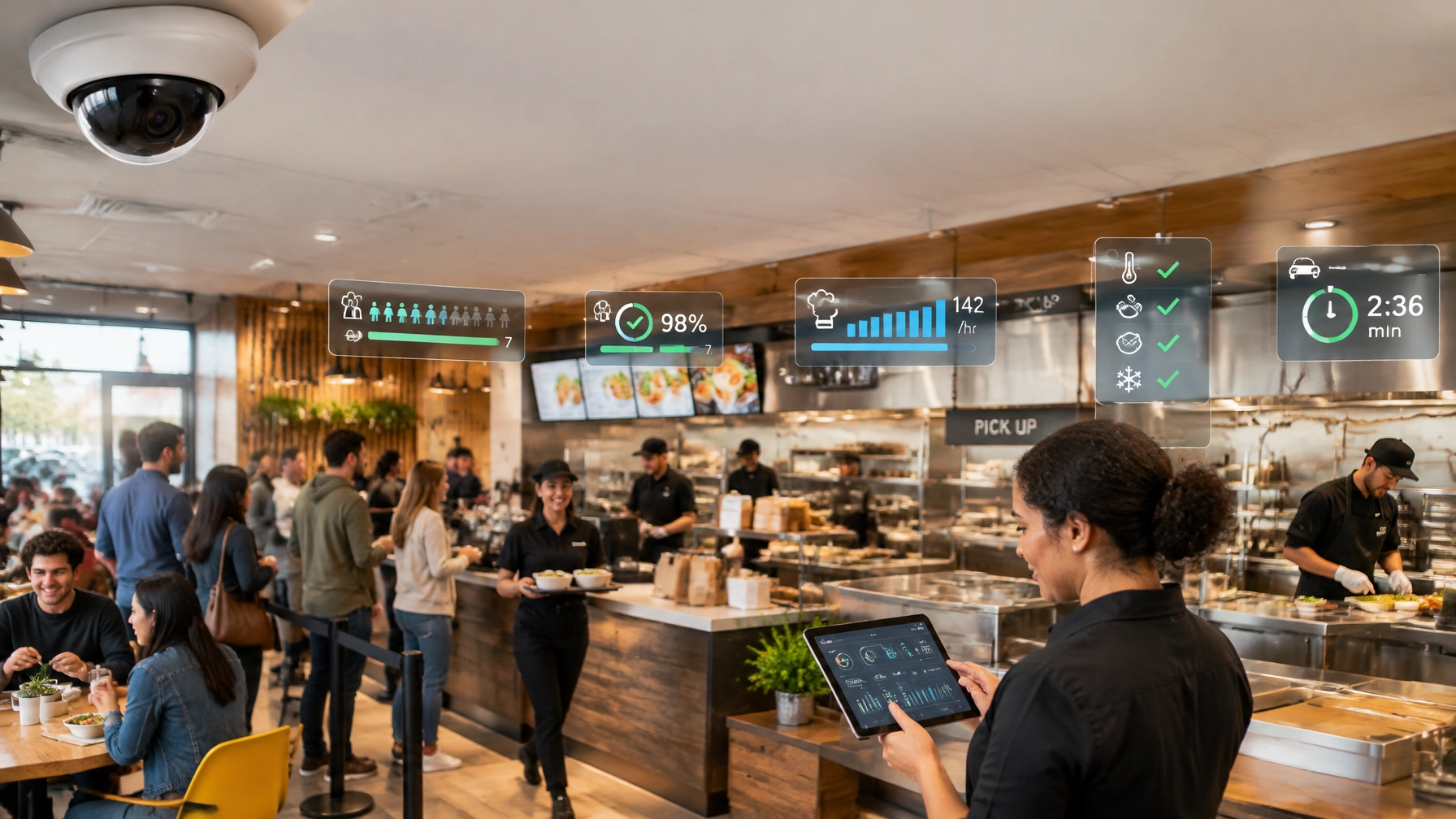
Your restaurant already has cameras.
They’re mounted above the register, pointed at the back door, watching the drive-thru, and quietly recording the daily ballet of tickets, trays, timers, spills, and “Who took table 14?” moments.
Most of those cameras are doing one thing: waiting for something bad to happen.
That’s useful. But it’s also a little like hiring a manager who only shows up after the fire alarm.
With video analytics for restaurants, your existing camera system can become an operational tool for improving order accuracy, food safety, loss prevention, drive-thru speed, kitchen throughput, employee training, and measurable margins.
The camera isn’t the strategy. It’s the sensor.
And sensors are only valuable when they lead to better decisions.
Why restaurant operators are paying attention now
Restaurant margins leave very little room for mystery. The National Restaurant Association’s 2025 Operations Data Abstract reported median pre-tax income of 2.8% for full-service restaurants and 4% for limited-service restaurants.
That means a small improvement can matter:
- One fewer remake per shift
- A few minutes saved during the lunch rush
- Less food sitting in the pickup zone
- Fewer unauthorized voids
- Better labor deployment during peak periods
- Faster resolution of delivery disputes
This is why AI video analytics for restaurants is gaining traction. Traditional CCTV records what happened. Analytics helps explain when, where, and how often operational problems happen.
That’s the difference between evidence and intelligence.
What video analytics for restaurants can actually do
The best restaurant security camera analytics platforms don’t require an operator to stare at twelve screens like a caffeinated octopus. They identify patterns, trigger alerts, and organize footage around specific events.
Depending on the platform and your camera infrastructure, use cases may include:
1. Improve order accuracy and reduce delivery disputes
A camera positioned above the packing or pickup station can help verify what went into an order and when it left the building.
That matters when:
- A delivery customer claims an item was missing
- A third-party driver picks up the wrong bag
- A guest says the order was never collected
- A remake pattern appears on one shift or station
- A team member needs coaching on packing procedures
Some restaurant video systems can connect footage with order numbers or POS transactions, making it easier to find a specific handoff instead of scrubbing through six hours of video.

Actionable starting point: Track order remakes and missing-item complaints for two weeks. Then compare those incidents with footage from the packing station. If 70% of errors happen during one daypart, you don’t have a “staff problem.” You have a workflow problem wearing a tiny employee hat.
2. Monitor food safety and SOP compliance
Food safety shouldn’t depend entirely on whether a manager happens to walk past the prep station at the right moment.
Video analytics can help monitor visible behaviors such as:
- Handwashing and glove use
- Food left in the wrong location
- Cross-contamination risks
- Cleaning and closing procedures
- Food sitting too long in a pickup or staging area
- Congestion around prep stations
The FDA Food Code provides a model for safeguarding food in retail and foodservice environments. Video analytics does not replace required training, temperature checks, logs, or local health regulations. It can, however, provide another layer of operational visibility.
Think of it as a second set of eyes, not a magical health inspector living inside the ceiling tile.
Practical metric: Choose three observable behaviors, such as glove changes, handwashing, and pickup-time control. Establish a baseline for 14 days. Then coach toward a measurable improvement target, such as 95% adherence during peak periods.
3. Find drive-thru bottlenecks
Drive-thru performance is a chain of small moments:
- Vehicle arrival
- Order placement
- Payment
- Food handoff
- Departure
When one link slows down, the entire line starts humming the lullaby of dying margins.
Drive-thru video analytics can measure queue length, time at each station, abandoned lines, and vehicles waiting too long at pickup. Axis describes restaurant analytics use cases that track service time, customer flow, food freshness, and drive-thru bottlenecks through real-time alerts and historical reporting. Read its overview of QSR video analytics solutions.

For a multi-unit operator, the value is even greater. Instead of debating which location “feels slow,” leadership can compare:
- Average order-to-payment time
- Payment-to-pickup time
- Peak queue length
- Abandoned vehicles
- Daypart performance
- Staffing configuration
Pilot goal: Identify the slowest five-minute interval in each peak daypart. Test one staffing or station change for two weeks. Measure the result. No vibes. No “I think it helped.” The numbers get a vote.
4. Improve kitchen throughput and training
Kitchen throughput analytics can reveal problems that POS data cannot.
Your sales report may show that 140 orders came through between 6:00 and 7:00 p.m. Video can help show:
- Where employees are walking unnecessarily
- Whether the expo station becomes a traffic jam
- When completed orders wait for pickup
- Which prep station repeatedly falls behind
- Whether mobile and delivery orders disrupt dine-in service
- How experienced employees sequence tasks differently
This is valuable for training because teams learn faster from specific examples than from vague lectures about “moving with urgency.”
Use footage to create short coaching clips, not public shaming reels. Show the better sequence, explain why it works, and document the standard in your training materials.

Training template:
- Observed: What happened?
- Impact: What did it cost in time, waste, or guest experience?
- Standard: What should happen instead?
- Practice: How will the team rehearse it?
- Measure: What number should improve?
That’s how a camera supports people instead of merely watching them.
5. Support loss prevention without creating a surveillance circus
Video analytics can connect activity near registers, cash-handling areas, storage rooms, and POS systems with transactions such as:
- Voids
- Comps
- Refunds
- Discounts
- No-sale drawer openings
- Unusual after-hours activity
But alerts are not proof. An unusual transaction is a reason to investigate, not a reason to conduct a dramatic courtroom scene beside the mop sink.
Use analytics to prioritize reviews, identify patterns, and improve controls. Combine video with POS data, manager approvals, inventory counts, and employee conversations.
Cameras don’t fix broken workflows
Here’s the tough-love section.
If your pickup shelf is in the wrong place, analytics will show you the congestion. It will not move the shelf.
If your menu creates bottlenecks, analytics will document the suffering. It will not rewrite the menu.
If your labor plan is disconnected from demand, analytics will reveal the mismatch. It will not schedule the shift.
Before buying anything, define:
- The operational problem
- The camera view required
- The system data needed
- The person responsible for responding
- The KPI that determines success
This is where restaurant technology strategy matters. Kuypers Creative’s work around restaurant technology trends emphasizes the same principle: technology should connect to operations, guest experience, and profitability, not become another lonely dashboard nobody opens after launch week.
Privacy and implementation: do this like a grown-up
Video analytics for restaurants must be implemented with clear boundaries.
A responsible rollout should include:
- Written notice for employees and guests where required
- Defined use cases and prohibited uses
- Role-based access to footage and analytics
- Secure storage and encryption
- A reasonable retention schedule
- Face and body redaction where available
- No recording of payment card data or sensitive areas
- A documented process for handling complaints and exports
The NIST Privacy Framework offers a useful risk-management model for identifying and managing privacy concerns.
Start with anonymous operational patterns whenever possible: queue length, dwell time, station congestion, and service duration. Don’t collect identifiable information simply because a vendor offers it.
For a pilot, choose:
- One location
- Two or three cameras
- One high-value use case
- A 30-day measurement period
- Three baseline KPIs
- Weekly manager reviews
Then decide whether the system earned the right to expand.
The bottom line
Your camera system may already be one of the most underused assets in the restaurant.
With the right video analytics for restaurants platform, it can help improve order accuracy, protect food quality, reduce shrink, train teams, speed up the drive-thru, and identify workflow problems before they become guest complaints.
But the winning formula is not:
Camera + AI = profit.
It’s:
Clear problem + usable data + accountable operator + measurable change = profit.
Boring? Maybe.
Effective? Absolutely.
If you’re evaluating restaurant technology, POS integration, operational analytics, or a scalable digital platform, contact Kuypers Creative. We help restaurant leaders connect strategy, creative, and technology so the system performs on a slammed Friday night, not just during the sales demo.
Sources and further reading
- National Restaurant Association: 2025 Operations Data Abstract
- FDA Food Code 2022
- NIST Privacy Framework
- Axis Communications: QSR Video Analytics Solutions
- Restaurant Technology News: AI-Powered CCTV Analytics
- Kuypers Creative: Emerging Technology Trends Reshaping Restaurants
SEO metadata
Meta title: Video Analytics for Restaurants: Turn Existing Cameras Into Ops Tools
Meta description: Learn how video analytics for restaurants can improve order accuracy, food safety, loss prevention, drive-thru speed, kitchen throughput, training, and margins using existing camera systems.
Suggested URL slug: /video-analytics-for-restaurants
Targeted SEO keywords: video analytics for restaurants, restaurant video analytics, restaurant security camera analytics, AI video analytics for restaurants, restaurant operations technology, restaurant loss prevention technology
Long-tail SEO keywords: how existing cameras improve restaurant operations, video analytics for restaurant order accuracy, drive-thru video analytics for QSRs, restaurant kitchen throughput analytics, food safety compliance monitoring with cameras, restaurant POS and video integration
Hashtags:
#VideoAnalytics #RestaurantTechnology #RestaurantOperations #FoodserviceInnovation #QSR #DriveThruOptimization #RestaurantProfitability #FoodSafety #LossPrevention #OrderAccuracy #HospitalityTech #RestaurantLeadership #KuypersCreative #RobertKuypers
Robert Kuypers tags: Robert William Kuypers · Kuypers Creative
