
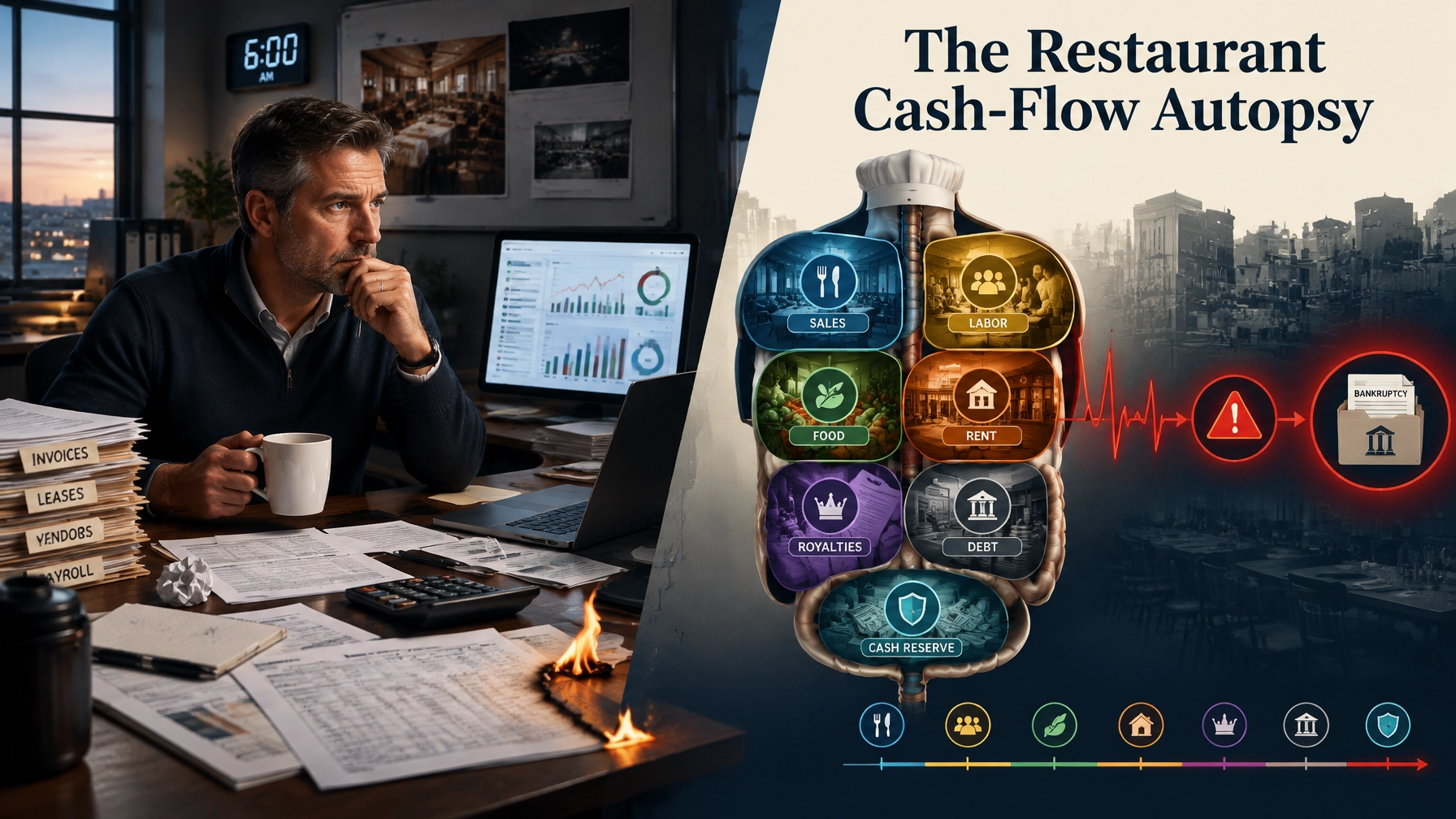
There’s a moment in every restaurant bankruptcy story when the paperwork becomes public.
The headlines arrive. The brand name gets dragged into the conversation. Vendors start whispering. Employees start asking questions. Landlords sharpen their pencils. And somewhere, usually several months too late, everyone asks the same question:
How did this happen?
The uncomfortable answer is that the filing rarely begins in the courtroom.
It begins six to nine months earlier, when the operator starts using discounts to manufacture traffic, delaying a repair, pausing marketing, stretching payroll timing, asking vendors for terms, and finally accepting expensive short-term money because the bank has stopped returning calls.
The Chapter 11 petition is not the beginning of the crisis. It’s the autopsy report.
As of September 20, 2026, public-record tracking identified 17 restaurant franchisee bankruptcy filings involving 16 operators across brands including Popeyes, Subway, Applebee’s, Hardee’s, Carl’s Jr., Wendy’s, Moe’s, Checkers and others.Store Closure Watch Restaurant Dive separately reported at least 10 significant multi-unit franchisee filings earlier in the year and described the pace as returning to pre-pandemic levels.Restaurant Dive
This isn’t a story about incompetent operators. Many of these companies ran hundreds of restaurants, employed thousands of people and survived COVID, labor shortages, supply-chain chaos and the great national shortage of fry oil.
It is a story about thin margins meeting fixed obligations, expensive debt and uneven demand.
And yes, it is also a story about decisions. Some decisions were forced. Some were delayed. Some were made while everyone was exhausted and the cash register was screaming for oxygen.
Let’s open the body bag.
The 2026 restaurant economy: resilient on the surface, fragile underneath
The restaurant economy is not uniformly collapsing. In fact, the National Restaurant Association expects total restaurant and foodservice sales to increase in 2026, while inflation-adjusted growth remains much weaker because nominal sales growth is being driven heavily by pricing.National Restaurant Association
That distinction matters.
A restaurant can report higher sales while producing less cash.
Why? Because a $1 million sales line in 2026 does not buy what a $1 million sales line bought in 2019. Labor, food, insurance, rent, technology, credit-card fees and debt service have all changed the shape of the P&L.
The National Restaurant Association reports:
- Average hourly earnings for restaurant employees increased 41% since February 2020.
- Average wholesale food prices increased 35% over the same period.
- Food and labor each represent approximately 33 cents of every sales dollar.
- 33% of operators reported that their restaurant was not profitable in the first half of 2026.National Restaurant Association
Meanwhile, Restaurant365’s mid-year survey of more than 420 operators representing nearly 10,000 locations found that:
- 87% reported food-cost increases in the first half of 2026.
- 77% reported labor-cost increases.
- 49% reported traffic gains by mid-year, compared with 28% at the start of the year.
- 33% ranked recruiting and retaining staff as their biggest challenge.
- 69% were actively using or piloting AI for back-office reporting and analytics.Restaurant365
So, no, the industry is not simply “dead.”
It is more complicated, and more dangerous, than that.
Sales can be up. Traffic can be soft. Margins can be down. Cash can disappear. All four things can happen in the same quarter.

The cost-growth comparison uses reported labor and wholesale food increases from the National Restaurant Association and restaurant-price trends from the Bureau of Labor Statistics. The filing chart reflects publicly tracked large franchisee cases, not a complete all-restaurant Chapter 11 series.National Restaurant Association BLS Store Closure Watch
The financial autopsy: how a profitable-looking operator runs out of cash
Let’s use a simplified multi-unit operator with:
- $10 million in annual sales
- 33% labor cost
- 33% food and paper cost
- 6% royalty and advertising obligations
- 8% occupancy cost
- 5% ordinary operating expenses
- 4% debt service
- 3% pre-tax profit
That operator has approximately $300,000 in annual pre-tax profit.
Now increase labor and food costs by just 2 percentage points each without an equal increase in profitable traffic.
That’s a $400,000 annual hit.
The operator has gone from making $300,000 to losing roughly $100,000 before an aging HVAC system, a failed walk-in compressor, a franchise remodel requirement or a landlord’s annual escalation enters the picture.
This is why restaurant distress moves faster than outsiders expect. A restaurant does not need to lose half its sales to become insolvent. It may only need:
- A 3% traffic decline
- A 2% labor-cost increase
- A 2% food-cost increase
- A $500,000 refinancing event
- And one major repair per unit
That is not a disaster movie. That is a Tuesday.
The fixed-cost trap
Variable expenses fall when sales fall. Fixed obligations usually do not.
| Obligation | What happens when sales soften? | Why it matters |
|---|---|---|
| Food purchases | Can decline with demand, if ordering is disciplined | Provides some flexibility |
| Hourly labor | Can decline, but only with accurate forecasting and careful scheduling | Cutting too deeply damages service |
| Royalties | Often remain tied to gross sales | Still payable even when store-level cash flow is weak |
| Advertising fund | Usually remains contractually required | A cost that may not immediately produce traffic |
| Rent and CAM | Usually fixed or escalated | Often one of the largest monthly cash drains |
| Debt service | Remains due regardless of guest count | Becomes lethal when rates reset |
| Remodel obligations | May be mandatory under franchise agreements | Creates capital spending during distress |
| MCA repayment | Often comes directly from daily sales | Removes cash before payroll, rent and vendors |
The problem is not any one line item. The problem is the stack.
A store can survive food inflation. It can survive a slow month. It can survive a rate increase. It may not survive all three while paying rent, royalties, loan payments and a merchant cash advance.
The restaurant P&L is a balancing act. The 2026 version has someone adding bowling balls.
The distress ladder: the seven rungs before bankruptcy
Distressed operators rarely leap straight from “we’re fine” to “call the bankruptcy attorney.”
They descend one rung at a time.

1. Comps and discounts
The operator needs traffic, so the business launches a 20% discount, free delivery, buy-one-get-one promotion or loyalty offer.
A $100,000 weekly sales base discounted by 10% does not necessarily lose $10,000 in profit, but it can easily sacrifice several thousand dollars in contribution margin if the discount is applied broadly.
If the promotion produces genuinely incremental traffic, it may be rational. If it simply discounts guests who would have paid full price, it is a cash leak wearing a marketing hat.
Diagnostic: Measure incremental transactions, contribution margin and repeat visits, not redemption volume.
2. Deferred maintenance
The walk-in door is “still working.” The fryer is “good for another month.” The POS terminal freezes twice a shift, but someone has learned the reboot ritual.
This is false economy.
A $3,000 planned repair can become a $15,000 emergency replacement, not counting lost sales, spoiled inventory and an angry manager standing in a puddle at 11:42 p.m.
Diagnostic: Maintain a 13-week capital-repair forecast with every major asset assigned a replacement date and cash requirement.
3. Deferred marketing
Marketing gets paused because cash is tight.
Unfortunately, traffic does not become free simply because the budget line disappears. It becomes less predictable. Google visibility softens. Loyalty engagement declines. New guest acquisition dries up. The business begins living off regulars while quietly losing future demand.
The restaurant looks busy on Friday and hollow on Tuesday. That is not a funnel. That is a weather system.
Diagnostic: Protect marketing that produces measurable first-party demand, but cut vanity activity that cannot be tied to visits, orders or retention.
4. Payroll timing
This is the red-alert rung.
When an operator starts moving money between accounts to make payroll, delaying payroll taxes or relying on weekend deposits to cover weekday obligations, the business is no longer managing cash flow. It is borrowing from time.
Payroll taxes and wage obligations are legally sensitive. Operators should involve qualified legal and accounting professionals immediately rather than treating timing changes as a casual bridge.
Diagnostic: Maintain a minimum payroll reserve equal to at least one full payroll cycle, plus payroll taxes.
5. Vendor terms
The operator asks suppliers for 30 days instead of 7, then 45 instead of 30.
Vendors may cooperate temporarily, especially with a long-standing customer. But stretched terms can turn into credit holds, COD requirements and partial deliveries. Suddenly the restaurant is buying ingredients with a credit card or paying cash-on-delivery while already short on cash.
Diagnostic: Track vendor aging weekly. A growing past-due balance is not “working capital.” It is an alarm.
6. Merchant cash advance
The MCA appears as a solution because it is fast, paperwork-light and based on sales rather than conventional underwriting.
An illustrative $100,000 advance at a 1.35 factor rate requires $135,000 in total repayment. The $35,000 fee may sound manageable until the repayment period compresses to six months. That is a very different economic animal from a conventional term loan.
Industry sources commonly place restaurant MCA factor rates around 1.15 to 1.49, with effective APRs varying widely based on repayment speed and potentially reaching 40% to 300% or more.FundingCompass NerdWallet
Diagnostic: Convert every factor rate into an estimated effective APR before signing. If the lender will not clearly explain total repayment, holdback, term and default provisions, stop.
7. Bankruptcy
By this point, the operator may be dealing with:
- Multiple stacked advances
- A bank loan in default
- Past-due rent
- Unpaid royalties
- Vendor liens
- Franchise agreement enforcement
- Deferred repairs
- Employee distrust
- A sales trend that has not recovered
Chapter 11 may then become a restructuring tool, allowing the operator to seek breathing room, reject unprofitable leases or sell viable units.
But Chapter 11 is not a magic eraser. It is an expensive, public, heavily supervised process.
The earlier the operator acts, the more choices remain.
The MCA debt spiral: why fast money can become a trapdoor
Merchant cash advances are not automatically evil. A short-term advance for a clearly defined, self-liquidating need may have a place.
The problem is using high-cost money to fund a structural operating loss.

Illustrative scenario, not a specific bankruptcy case. MCA pricing varies by contract, factor rate, holdback and repayment speed.FundingCompass NerdWallet
Consider a hypothetical $500,000 advance at a 1.35 factor:
- Gross cash received: $500,000
- Contractual repayment: $675,000
- Flat financing cost: $175,000
- If repaid over six months: approximately $112,500 per month before other obligations
- If daily card-sales holdback is 15%: cash is removed from the top line before payroll, rent, food and royalties
Now add a debt-wall refinancing event.
A conventional refinancing in the 8% to 10% range, amortized over several years, may be expensive compared with the pre-2022 rate environment, but it is still structurally different from a short-term MCA priced at a triple-digit effective APR.Crestmont Capital FundingCompass
The MCA can create a vicious sequence:
- Sales soften.
- Cash flow becomes uneven.
- The operator takes an MCA.
- The MCA removes a percentage of daily sales.
- Payroll and vendors become harder to fund.
- The operator takes a second advance.
- The blended repayment burden increases.
- The bank sees stacked debt and refuses refinancing.
- Rent, royalties or taxes fall behind.
- The operator files.
This is why Restaurant Dive described MCAs as “usually the last chapter before a bankruptcy filing” and reported that a Subway franchisee cited daily and weekly MCA draws as a primary cause of collapse.Restaurant Dive
The recent Dave’s Hot Chicken franchisee case provides another reminder that leverage can become complicated quickly. TIG Reaper listed liabilities between $10 million and $50 million, including approximately $8.8 million owed to Bank Midwest and roughly $305,000 in merchant cash advances.Nation’s Restaurant News
Borrowing should solve a timing problem, not disguise a broken unit model.
Labor in 2026: the market cooled, the pressure did not
The restaurant labor market is no longer defined solely by frantic hiring.
The National Restaurant Association projects approximately 15.8 million restaurant and foodservice jobs by the end of 2026. Its hiring and staffing research estimates overall industry turnover at approximately 122% in 2025, using Lightcast and BLS-based data.National Restaurant Association Hiring and Staffing Report
Restaurant365’s mid-year data suggests some retention metrics are improving, with 39% of respondents reporting turnover between 0% and 10%, but staffing remains the industry’s leading operational challenge.Restaurant365
The labor math is particularly sharp in high-cost cities.
| Market | 2026 wage reference | Operational implication |
|---|---|---|
| Chicago | $17.05 standard minimum wage; $12.96 tipped cash wage with tips required to reach the full minimum | Scheduling, tip-credit compliance and productivity require tight controls |
| California covered fast food | $20.00 per hour statewide for covered fast-food employees | QSR labor models must be rebuilt around throughput and mix |
| San Francisco | $19.61 per hour effective July 1, 2026 | Every hour of understaffing and overstaffing is expensive |
| Los Angeles | California’s $20.00 covered fast-food floor applies; local rules may be higher | Operators must confirm city, county and industry-specific requirements |
Sources: City of Chicago, California Department of Industrial Relations, San Francisco OLSE
Tip pooling is becoming a systems problem
Tip pooling is no longer something that should live in a manager’s spreadsheet and memory.
TipHaus reports that average tipping percentages remained relatively stable at approximately 15.5% to 16.2%, while average check sizes declined 7.6%, reducing total tip earnings by 8.5%. The report also identifies growth in weighted, point-based and hybrid distribution models, a 29% increase in digital and QR tipping adoption, and increasing use of daily tip payouts.TipHaus 2026 Tipping Trends Report
Weighted, point-based and hybrid models can help balance front-of-house and back-of-house contributions, but only when they are:
- Written clearly
- Reviewed for federal, state and local compliance
- Applied consistently
- Audited automatically
- Explained to employees before implementation
That is where tip management software earns its keep.
A modern system should calculate pools, document rules, identify anomalies, support compliant payouts and integrate with payroll. It should not merely turn a manager’s calculator into a prettier manager’s calculator.
Fairness without transparency creates suspicion. Transparency without automation creates errors.
The counter-playbook: what surviving operators do differently
The operators surviving this cycle are not necessarily running the fanciest concepts or the most viral menus.
They are doing the boring, disciplined work that makes cash visible.
1. Rebuild unit economics by location
Stop managing the portfolio as one average restaurant.
Each location needs a weekly view of:
- Net sales
- Guest counts
- Average check
- Labor dollars and labor percentage
- Food and paper cost
- Delivery mix
- Royalty and advertising cost
- Occupancy cost
- Store-level contribution
- Maintenance and repair needs
- Cash conversion
A multi-unit operator can hide one bad store inside nine good ones for months. Then the bad store becomes a portfolio problem.
Set a red flag when:
- Four-week sales trend is down more than 3%
- Labor exceeds budget by 2 percentage points
- Food cost exceeds theoretical by 1.5 percentage points
- Store-level contribution turns negative for two consecutive weeks
- Cash coverage falls below two payroll cycles
Those are management thresholds, not universal laws. Adjust them to the concept. The point is to act before the numbers become courtroom exhibits.
2. Renegotiate leases before default
Landlords are not delighted by restaurant distress, but they are often more receptive to a structured conversation before missed payments.
Bring a landlord:
- A 13-week cash-flow forecast
- Store-level sales history
- A realistic recovery plan
- Proposed rent deferral or abatement
- A term extension
- Percentage-rent alternatives
- Tenant improvement or repair offsets
- A clear date for returning to normal payments
The goal is not “please forgive rent because times are hard.”
The goal is: “Here is the plan that keeps your tenant open and your property producing rent.”

3. Treat franchisee and franchisor economics as connected
Franchisors may preserve a strong system by helping viable operators survive.
Potential relief mechanisms include:
- Temporary royalty abatements
- Deferred remodel deadlines
- Reduced advertising contributions during restructuring
- Extended payment plans
- Brand-funded technology upgrades
- Reassignment of unprofitable units
- Group purchasing economies
- Shared sourcing programs
- Targeted modernization incentives
Restaurant Dive reported that franchisor responses in 2026 have varied widely, from support and modernization assistance to litigation and enforcement.Restaurant Dive
A franchisor that treats every distressed franchisee as a bad actor may win a legal argument and lose a market.
4. Use group purchasing organizations strategically
Group purchasing organizations food service programs can help operators access pricing and terms that are difficult to secure independently.
But purchasing savings only matter if the operator also controls:
- Recipe adherence
- Portioning
- Waste
- Substitutions
- Receiving accuracy
- Vendor rebates
- Inventory counts
- Theoretical versus actual usage
Saving 4% on chicken while losing 8% through waste is not a sourcing strategy. It is expensive theater.
5. Forecast demand before scheduling labor
Labor scheduling should begin with expected demand, not last week’s schedule copied forward because everyone is tired.
Build forecasts using:
- Historical sales by daypart
- Weather
- Local events
- School calendars
- Promotions
- Reservations
- Delivery demand
- Holiday patterns
- Day-of-week volatility
Then schedule to demand bands:
| Demand condition | Scheduling approach |
|---|---|
| Low forecast | Minimum viable coverage with cross-trained staff |
| Normal forecast | Core team plus limited flex labor |
| High forecast | Add targeted peak coverage, prep labor and runner support |
| Uncertain forecast | Use staggered start times and manager-approved flex shifts |
Pair this with compliant timekeeping, cross-training and real-time labor alerts.
6. Build a direct ordering channel
Third-party delivery can create valuable discovery, but the economics are unforgiving.
Marketplace commissions commonly range from 15% to 30%, with effective all-in costs often reaching 25% to 35% after promotions, marketing and processing.DoorDash pricing DirectOrders
A direct ordering channel can reduce the commission burden to payment processing costs, often near 3%, while preserving first-party guest data.DirectOrders
The playbook:
- Use marketplaces for acquisition.
- Put a direct-ordering URL on receipts and packaging.
- Offer loyalty benefits through owned channels.
- Make pickup easy and visible.
- Retarget guests who have opted into marketing.
- Track contribution margin by channel.
- Do not measure delivery revenue without measuring delivery profit.
A $40 delivery order is not a $40 revenue win if $12 disappears before the kitchen sees the ticket.
7. Use analytics that managers can act on
A dashboard should answer:
- What changed?
- Why did it change?
- Who owns the response?
- What happens if we do nothing?
- When will we check again?
This is where services and concepts associated with a restaurant systems pro approach, or a restaurant system pro operating model, need to focus: connecting POS, labor, inventory, ordering, loyalty and finance into decisions managers can use during the week.
The tool does not have to be exotic. It has to be integrated.
That includes:
- Back-office analytics
- Inventory and waste tracking
- Video analytics for restaurants
- Menu engineering
- Order-channel profitability
- Labor forecasting
- Guest retention analysis
The best system is not the one with the most tabs. It is the one that prevents a manager from discovering a $20,000 variance at month-end.
AI adoption is surging. Execution is still limping.
Restaurant365 reports that back-office AI adoption for reporting and analytics reached 69% by mid-2026, up from roughly 25% at the start of the year. Among active AI users, 61% reported reduced food costs, 62% reported reduced labor costs and 88% said the technology saved time every week.Restaurant365
A separate 2026 restaurant technology benchmark describes a different but complementary reality: approximately 73% of brands are investing in AI, while only about 9% report meaningful or transformational impact.Qu
That is the execution gap.

Why does the gap exist?
Because AI cannot rescue disconnected systems.
If sales live in one platform, labor in another, inventory in a spreadsheet, payroll in a third system and accounting closes 25 days after the month ends, AI is not receiving intelligence. It is receiving soup.
A serious 90-day AI pilot should have:
- One measurable business problem
- One accountable owner
- One clean data source
- One baseline
- One target
- One review cadence
- One stop-or-scale decision
Examples:
- Reduce overtime by 8% in 90 days.
- Reduce food waste by 10%.
- Improve schedule-to-sales accuracy by 15%.
- Increase direct-order repeat rate by 5%.
- Cut weekly reporting labor by 6 hours per manager.
- Reduce tip-calculation corrections to zero.
The AI question is not, “Can we use AI?”
The question is, “Which cash-flow line will improve, by how much, and by when?”
The Monday-morning 90-day cash-flow triage checklist
If the operation feels even slightly wobbly, do not wait for the next board meeting.
Start Monday.
Days 1–7: Stop guessing
- Build a 13-week cash-flow forecast.
- List every debt obligation, interest rate, maturity date and collateral package.
- Identify all MCAs, holdbacks, factor rates and expected payoff dates.
- Separate store-level cash flow from corporate overhead.
- Rank every unit as green, yellow or red.
- Freeze nonessential capital spending.
- Confirm payroll, payroll-tax and vendor obligations.
- Calculate contribution margin by sales channel.
- Review rent, CAM, royalties and advertising obligations.
- Schedule conversations with lenders, landlords and franchisors before default.
Days 8–30: Create breathing room
- Remove promotions that do not produce incremental contribution.
- Renegotiate vendor terms without allowing accounts to drift silently.
- Repair the three assets most likely to create a shutdown.
- Reset labor schedules using demand forecasts.
- Audit tip-pool rules and payout accuracy.
- Create a direct-ordering offer.
- Reduce third-party delivery dependence where contribution is negative.
- Identify menu items with negative or weak contribution.
- Ask the franchisor for royalty, remodel or sourcing relief.
- Replace any spreadsheet-based cash reporting with a shared weekly dashboard.
Days 31–60: Fix the unit model
- Reprice or redesign low-contribution menu items.
- Rebid high-cost vendors.
- Join or evaluate a foodservice group purchasing organization.
- Cross-train staff for peak-period flexibility.
- Implement automated tip management software if the current process is manual.
- Establish a minimum cash reserve target.
- Build a repair and replacement calendar.
- Launch one AI pilot tied to labor, inventory or reporting.
- Review store hours against demand by daypart.
- Create a weekly owner-operator cash meeting.
Days 61–90: Decide what survives
- Close, sell or restructure chronically negative units.
- Refinance expensive short-term debt where possible.
- Replace MCA debt with lower-cost capital only if the operating model supports repayment.
- Formalize lease amendments.
- Reset franchise development plans.
- Create a quarterly debt-wall calendar.
- Publish location-level scorecards.
- Tie manager incentives to contribution, guest retention and labor discipline, not sales alone.
- Document a downside plan before the next downturn.
- Ask qualified legal and financial advisors whether a formal restructuring process is necessary.
The cash-flow scorecard
Use a simple 100-point scorecard. Review it every Monday.
| Category | Weight | Green | Yellow | Red |
|---|---|---|---|---|
| 13-week cash forecast | 15 | Updated weekly | Updated monthly | No reliable forecast |
| Payroll coverage | 15 | 2+ cycles reserved | 1 cycle reserved | Borrowing to make payroll |
| Debt service coverage | 15 | Above 1.5x | 1.1x–1.5x | Below 1.1x |
| MCA exposure | 10 | None or immaterial | One manageable advance | Stacked advances |
| Labor variance | 10 | Within 1 point of plan | 1–2 points over | More than 2 points over |
| Food variance | 10 | Within 1 point of plan | 1–2 points over | More than 2 points over |
| Store contribution | 15 | Positive across units | One or two weak units | Multiple negative units |
| Lease and royalty status | 10 | Current | Negotiation underway | Past due or in default |
Score interpretation
- 85–100: Green. Keep improving. Do not use health as an excuse to stop measuring.
- 70–84: Yellow. Convene a weekly cash committee and begin lender, landlord or franchisor discussions.
- 50–69: Orange. Freeze expansion, restructure obligations and bring in outside financial advice.
- Below 50: Red. Engage restructuring counsel and financial professionals immediately. Hope is not a capital source.
Final diagnosis: why do restaurants fail?
They fail for many reasons, but the 2026 bankruptcy wave exposes a repeating mechanical pattern:
- Costs rise faster than profitable pricing.
- Traffic softens.
- Fixed obligations remain fixed.
- Debt gets refinanced at higher rates.
- Maintenance and marketing are deferred.
- Cash visibility gets worse.
- Short-term financing fills the gap.
- The financing itself accelerates the cash shortage.
- The operator loses negotiating leverage.
- Bankruptcy becomes the final available lever.
That is the bad news.
The good news is that the earliest rungs are visible.
You can see a labor variance. You can see a vendor aging report. You can see a debt maturity. You can see a store with negative contribution. You can see a delivery channel taking 30% of the order. You can see a tip spreadsheet held together by hope and one very tired assistant manager.
Do not wait for the filing to become your first honest conversation.
The operators who survive 2026 will not necessarily be the ones with the biggest footprints. They will be the ones who know their cash position every week, understand the economics of every unit, negotiate before default, use technology to remove friction and treat their data as an operating system, not a museum of yesterday’s problems.
Boring wins. Boring pays. Boring is the new sexy.
And if your Friday night is packed but the bank balance still looks haunted, the answer is not another discount.
It’s an autopsy.
Sources and further reading
- Restaurant Dive: Why multi-unit restaurant franchisee bankruptcies are surging in 2026
- National Restaurant Association: Restaurants remain resilient despite challenging business conditions
- Restaurant365: 2026 State of the Restaurant Industry Mid-Year Report
- McKinsey: What U.S. consumers want from restaurants in 2026
- Statista: Restaurant industry in the United States
- TipHaus: 2026 Tipping Trends & Industry Report
- Store Closure Watch: 17 restaurant franchisee bankruptcy filings in 2026
- Nation’s Restaurant News: 7-unit Dave’s Hot Chicken franchisee files Chapter 11
- Bloomberg Law: Fast-food bankruptcies surge as costs climb and consumers pull back
- TechCrunch: Marc Lore says AI will soon enable anyone to open a restaurant
- Bureau of Labor Statistics: One-year survival rates for new business establishments
- James Beard Foundation: 2026 Independent Restaurant Industry Report
- Technomic: 2026 U.S. Foodservice Trend Predictions
- BLS: Consumer Price Index
- National Restaurant Association: 2026 Hiring and Staffing Report
- Chicago minimum wage information
- California Department of Industrial Relations: Fast Food Minimum Wage FAQ
- San Francisco Office of Labor Standards Enforcement: Minimum Wage Ordinance
- NerdWallet: Merchant cash advance calculator
- FundingCompass: Restaurant merchant cash advances
- Restaurant365: Emerging restaurant technology and profitability research
- Qu: The 2026 restaurant technology execution gap
- DoorDash merchant pricing
- DirectOrders: Restaurant ordering fees explained
- Kuypers Creative: Emerging Technology Trends Reshaping Restaurants
- Kuypers Creative: Restaurant Systems Pro Operations
- Kuypers Creative: About Robert William Kuypers
SEO KEYWORDS & METADATA
Targeted SEO keywords:
- restaurant bankruptcy 2026
- restaurant cash flow
- restaurant franchisee bankruptcy
- multi-unit restaurant operator debt
- restaurant debt restructuring
- restaurant labor costs 2026
- restaurant food costs 2026
- merchant cash advance restaurant
- restaurant profitability
- restaurant technology integration
- restaurant back-office analytics
- tip management software
- direct ordering for restaurants
- restaurant systems pro
- restaurant system pro
- video analytics for restaurants
- group purchasing organizations food service
Long-tail SEO keywords:
- why multi-unit restaurant franchisees are filing bankruptcy in 2026
- how restaurant cash-flow problems lead to Chapter 11
- how merchant cash advances cause restaurant bankruptcy
- effective APR of a merchant cash advance for restaurants
- how to restructure restaurant debt before bankruptcy
- restaurant labor scheduling and demand forecasting in 2026
- how to reduce restaurant delivery commissions
- how direct ordering improves restaurant margins
- compliant tip pooling and automated tip payouts
- how AI back-office analytics reduces restaurant labor costs
- 90-day restaurant cash-flow triage checklist
- why do restaurants fail when sales are increasing
- kitchensync reviews
- kitchen sync strategies
- restaurant finder.com
- top 100 independent restaurants
<meta name="keywords" content="restaurant bankruptcy 2026, restaurant cash flow, restaurant franchisee bankruptcy, multi-unit restaurant debt, restaurant debt restructuring, restaurant labor costs 2026, merchant cash advance restaurant, tip management software, restaurant systems pro, restaurant system pro, video analytics for restaurants, group purchasing organizations food service, kitchensync reviews, kitchen sync strategies, restaurant finder.com, top 100 independent restaurants">

<meta name="description" content="A data-rich 2026 restaurant cash-flow autopsy explaining why multi-unit franchisees reach bankruptcy, how MCA debt, labor costs, leases, royalties and refinancing create a distress ladder, and the 90-day playbook operators can use to survive.">

<meta name="author" content="Robert William Kuypers">

<meta name="article:published_time" content="2026-09-26">

<meta name="article:section" content="Restaurant Finance, Restaurant Technology, Restaurant Leadership">

<meta name="article:tag" content="Robert Kuypers, Robert William Kuypers, William Kuypers, Rob Kuypers, restaurant bankruptcy, restaurant cash flow, restaurant debt, restaurant technology, labor costs, tip management, franchisee strategy">

<meta property="og:type" content="article">

<meta property="og:title" content="The Restaurant Cash-Flow Autopsy: Why 2026's Bankruptcy Wave Started Long Before the Filing">

<meta property="og:description" content="The mechanics behind the 2026 restaurant franchisee bankruptcy wave, and the operational, financial and technology playbook that can keep operators out of court.">

<meta property="og:site_name" content="Kuypers Creative">
Article metadata:
- Author: Robert William Kuypers
- Company: Kuypers Creative
- Published: September 26, 2026
- Article type: Saturday long-form thought leadership and operational finance deep dive
- Primary topic: Restaurant cash flow and bankruptcy prevention
- Reading time: Approximately 18–22 minutes
- Tags: Robert Kuypers, Robert William Kuypers, William Kuypers, Rob Kuypers, restaurant finance, restaurant bankruptcy, restaurant operations, franchisee strategy, restaurant technology, labor management, tip management software, direct ordering, AI in restaurants, restaurant leadership
- Hashtags: #RestaurantIndustry #RestaurantFinance #RestaurantBankruptcy #CashFlow #RestaurantOperations #Franchisee #RestaurantTechnology #HospitalityLeadership #RestaurantAI #Foodservice #RestaurantGrowth #RestaurantStrategy #TipManagement #DirectOrdering #MultiUnitOperators #KuypersCreative #RobertKuypers #RestaurantSystemsPro #WhyDoRestaurantsFail
