
Updated September 12, 2026
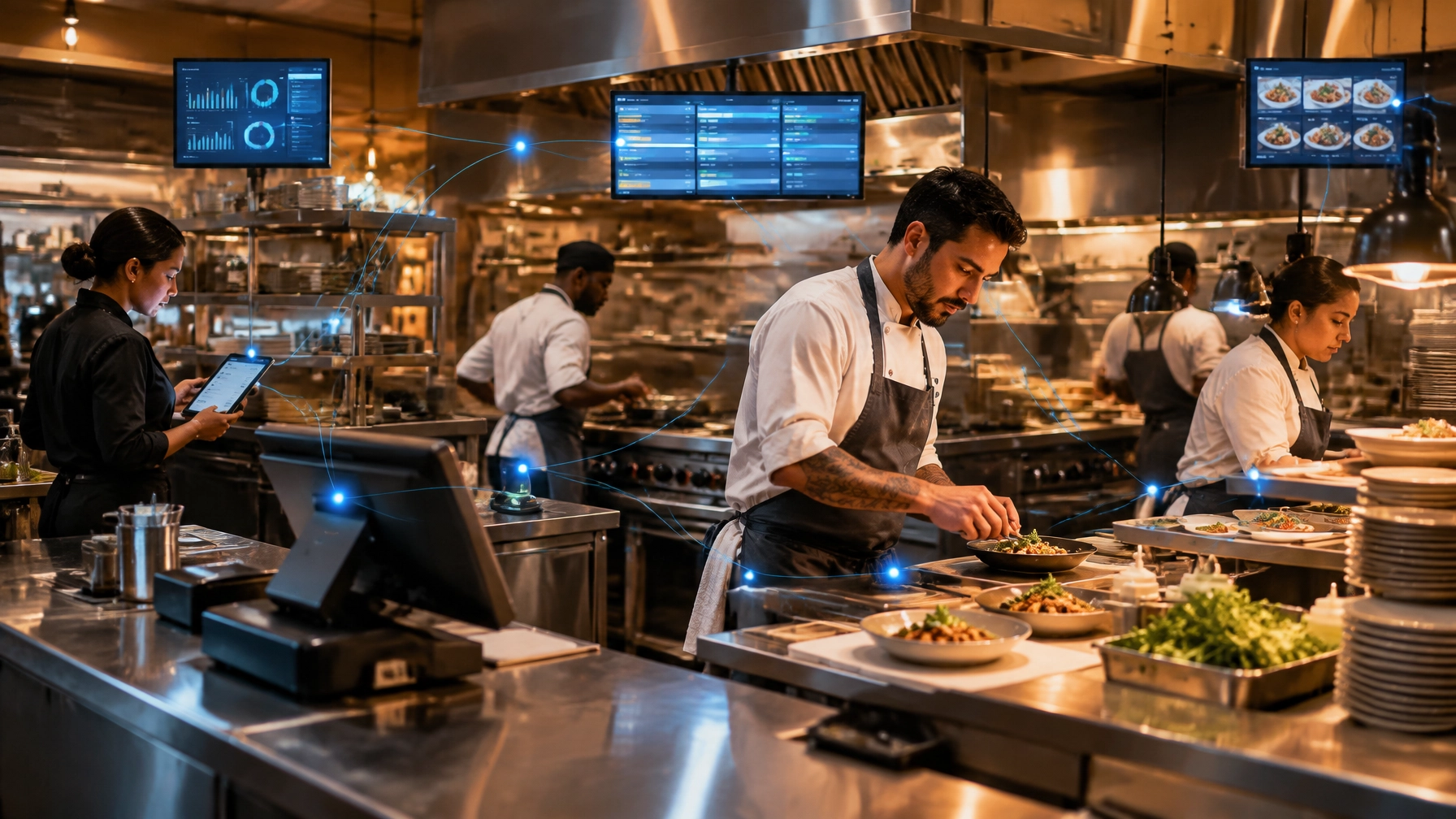
The modern restaurant may run on more software than the average technology startup.
There’s a POS. An online ordering platform. A kitchen display system. A labor scheduler. An inventory tool. A loyalty platform. Three delivery marketplaces. A bookkeeping system. A payroll platform. Maybe a voice-ordering bot. Possibly an AI menu optimizer. And somewhere in the manager’s office, a spreadsheet named FINAL_FINAL_v7_USE_THIS_ONE.xlsx.
Yet the data still lives in six disconnected dashboards.
That is the central restaurant technology problem in 2026: not a lack of technology, but a lack of integration.
Restaurants are buying AI faster than they are connecting the systems AI needs to work. The result is an expensive digital kitchen where every appliance is “smart,” but nobody can find the light switch.
The opportunity is enormous. The National Restaurant Association projects $1.55 trillion in U.S. restaurant and foodservice sales in 2026, but official forecasts still point to modest real growth amid significant cost pressure. The Association also reports that 42% of operators were unprofitable in 2025. National Restaurant Association
In this environment, integration is not an IT preference. It is a margin strategy.
1. The Integration Gap: Everybody Wants AI, Few Have Prepared the Kitchen
Qu’s 2026 State of Digital & Beyond report surveyed 168 QSR and fast-casual brands representing approximately 94,000 locations.
The headline numbers are both exciting and slightly alarming:
- 73% of brands are actively investing in AI or plan to invest in it.
- Only 9% report meaningful or transformational AI impact.
- 43% report limited value.
- 37% cite fragmented systems and data as a major barrier.
- 55% identify operational execution as the top barrier to improving the guest experience.
- 62% say improving order flow across all channels is their top operational priority for 2026.
That is the restaurant industry in one neat little data package: AI spending is accelerating, while the pipes underneath it are still leaking.
Qu’s report also found that AI investment is concentrated in marketing, CRM, personalization, predictive analytics, voice ordering, inventory forecasting, kitchen automation, and computer vision. Those are valuable use cases: but only when the underlying information is accurate, current, and available across the business.
An AI forecast built on incomplete sales data is not intelligence. It is a very confident guess wearing a blazer.
The Restaurant365 2026 mid-year report describes an emerging Restaurant Profitability Gap between operators using AI to convert operational data into action and those still relying on disconnected reports, manual processes, and instinct.
Among active AI users, Restaurant365 reports:
- 61% seeing reduced food costs.
- 62% seeing reduced labor costs.
- 88% saving time every week.
- Nearly one-third reporting overall cost reductions of 6% or more.
The lesson is not “buy AI immediately.”
The lesson is: connect the data that makes AI useful, then deploy it against a measurable business problem.

2. Anatomy of the Modern Restaurant Tech Stack
A restaurant technology stack is not one piece of software. It is an ecosystem of systems that should behave like one operating model.
Here is where the major components fit: and where data commonly breaks.
| System | What it should do | Common integration failure |
|---|---|---|
| POS and payments | Capture sales, modifiers, tenders, discounts, voids, and guest data | Sales data does not reach labor, inventory, or finance tools in real time |
| Online ordering | Accept first-party orders across web, app, kiosk, and delivery | Menu changes, availability, or pricing fail to sync |
| Third-party delivery | Extend reach through marketplaces | Orders arrive late, duplicate, or require manual re-entry |
| KDS/Kitchen display | Route orders to stations and track ticket times | Digital orders bypass the correct station or lack timing data |
| Inventory and purchasing | Track theoretical usage, invoices, waste, and reorder points | Recipes, invoices, and POS depletion use different item names |
| Labor and scheduling | Align staffing with forecasted demand | Schedules are based on last week’s sales instead of actual demand |
| Loyalty and CRM | Build direct guest relationships | Marketplace customers remain anonymous |
| Back office and accounting | Turn transactions into P&Ls and prime-cost reporting | Operators see the truth weeks after the money is gone |
| Analytics and AI | Identify patterns and recommend action | Models inherit bad, incomplete, or contradictory data |
The most common failure is not that a system lacks features. It is that two systems define the same thing differently.
One platform calls an item “Chicken Bowl.” Another calls it “BOWL-CHK-01.” The POS records a modifier as an add-on. Inventory records it as a recipe component. Accounting sees a vendor invoice. Marketing sees a menu click.
Congratulations: you have created four versions of reality.
The data breaks that matter most
-
Order-to-kitchen break
An online order reaches the POS but does not route correctly to the KDS. -
Sales-to-labor break
Sales data exists, but scheduling software cannot use it to forecast staffing needs. -
Sales-to-inventory break
The POS sells 100 bowls, but inventory cannot accurately calculate how much chicken, rice, sauce, and packaging were consumed. -
Operations-to-finance break
Managers see labor or food-cost problems, but the P&L does not reflect them until the accounting period closes. -
Guest-to-brand break
A guest orders through a third-party marketplace, receives the food, and disappears from the restaurant’s customer database forever.
Integration is the bridge between “we have data” and “we can make a decision.”
3. Where Restaurant Technology Integration Actually Pays
The best restaurant technology integration projects do not begin with a dashboard. They begin with a decision.
A. Order flow and throughput
Qu found that 62% of brands consider improving order flow across channels their top operational priority. That makes sense. A restaurant can advertise aggressively, increase digital demand, and still lose money if the kitchen cannot absorb the volume.
Integrated order flow should connect:
- First-party web orders.
- Branded mobile apps.
- Kiosks.
- Third-party delivery platforms.
- Drive-thru systems.
- POS.
- KDS.
- Pickup notifications.
- Capacity and throttling rules.
The goal is not merely to make orders arrive. The goal is to make the entire operation understand:
- What was ordered.
- Where it should be prepared.
- When it should be ready.
- Whether the kitchen has capacity.
- Whether the guest received an accurate ETA.
- Whether the order was profitable.
This is why tools such as Deliverect are increasingly positioned as orchestration layers rather than simple delivery aggregators. In 2026, Deliverect launched AI agents designed to optimize menus, resolve ordering issues, and automate digital back-office tasks across its network.
When order flow works, throughput improves without turning the expo line into a battlefield. When it fails, the kitchen becomes a live-action game of telephone: with fries.
B. Labor scheduling versus demand
Labor remains one of the largest controllable expenses. The National Restaurant Association continues to describe food, labor, insurance, energy, and payment fees as major operator challenges. Common planning benchmarks place total prime costs: food and labor: around 60% to 66% of sales for healthy operators, with labor and food each often representing roughly 33 cents of every dollar in high-cost operating environments.
These are planning benchmarks, not official NRA targets. The principle is still clear: small improvements matter because restaurant margins are thin.
A connected labor system can pull:
- Historical sales by daypart.
- Weather and event data.
- Reservations and catering volume.
- Digital order volume.
- Production times.
- Employee availability.
- Actual labor hours.
Then it can compare forecasted labor to actual labor: not just produce another colorful schedule.
Restaurant365’s 2026 research reports that AI users are reducing labor costs and improving forecasting. That is the difference between automation and integration. A scheduling tool that cannot see demand is merely a digital clipboard.
C. Inventory, waste, and menu profitability
Inventory software becomes far more useful when it is connected to the POS, recipes, purchasing, invoices, and accounting.
The operator should be able to answer:
- Which menu items are selling?
- Which items are profitable?
- Which ingredients are being wasted?
- Which vendor prices changed?
- Which locations are over-portioning?
- What is theoretical food cost versus actual food cost?
- Which menu items should be promoted, repriced, redesigned, or removed?
This is where platforms such as Restaurant Systems Pro can function as a back-office management layer for independents. The platform is designed around food and labor cost control, inventory, performance tracking, and operational accountability, with integrations or data connections involving systems such as Toast, Brink, POSitouch, MICROS, and SpotOn.
It is also important to clarify what Restaurant Systems Pro is: and is not. It is a back-office management platform, not a kitchen display system.
The same distinction applies to KitchenSync. Our KitchenSync review examines its AI bookkeeping, payroll integration, prime-cost reporting, and multi-unit analytics. KitchenSync is a financial management and bookkeeping platform, not a KDS.
KitchenSync marketing and reviews discuss the potential for approximately a 15% profit improvement, but available evidence does not prove that figure as a universal outcome. The practical takeaway is more useful: financial software can expose margin leaks, but it cannot repair a restaurant that refuses to act on the information.
4. First-Party Data Versus Third-Party Dependency
Third-party delivery platforms provide reach. They also introduce commission costs and data limitations.
Industry estimates commonly place third-party delivery commissions between 15% and 30% per order, depending on platform, plan, market, and services included. Statista’s online food delivery outlook provides broader market context for the continued scale of digital ordering.
The loyalty difference is even more revealing. Research cited by Restaurant Dive found that approximately 41% of first-party orders are associated with loyalty members, compared with roughly 3% of third-party marketplace orders.
That is not a small data wrinkle. That is the difference between renting demand and building an asset.
A connected ordering strategy should use third-party marketplaces for discovery and acquisition while moving repeat customers toward:
- Branded web ordering.
- Mobile apps.
- Loyalty enrollment.
- SMS and email.
- Personalized offers.
- Direct feedback loops.
- First-party delivery or integrated delivery fulfillment.
Third-party platforms can fill the funnel. They should not own the entire relationship.
5. The New Profit Layer: Tools Beyond POS and KDS
Restaurant tech integration in 2026 is expanding into areas that used to be managed through manual review, paper logs, and the manager’s increasingly haunted facial expression.
Video analytics for restaurants
AI-powered video analytics can connect camera footage to POS events and operational workflows.
Use cases include:
- Investigating voids, refunds, discounts, and no-sales.
- Detecting sweethearting and suspicious cash activity.
- Reviewing drive-thru dwell times.
- Measuring queue length and people counts.
- Monitoring service bottlenecks.
- Supporting handwashing and HACCP compliance.
- Comparing performance across locations through cloud dashboards.
Vendors in this category include Solink, Envysion, iFovea, and VuFindr.
The important integration is not “camera plus AI.” It is video plus POS plus time plus location plus operational context.
If the system flags a $200 refund, the manager should be able to see the transaction and the relevant footage without spending half an afternoon scrubbing video like a detective in a low-budget crime drama.
Tip management software
Tip management is another area where disconnected systems create both administrative work and compliance risk.
Modern tip management software can automate:
- Tip pooling.
- Tip allocation.
- POS and labor-data imports.
- FLSA and state-rule workflows.
- Digital payouts.
- Same-day electronic payments.
- Pay-card distribution.
- Employee-facing transparency.
Relevant vendors include TipHaus, Ferry, Fourth, and Gratuity Solutions. TabPres is another name operators may encounter in this category.
The integration question is simple: Does the platform pull accurate sales, labor, refunds, and shift data from the POS: or does someone still reconcile it manually on Friday afternoon?
If the answer is the latter, congratulations. Your software has successfully recreated a spreadsheet.
Procurement and GPO technology
Group purchasing organizations are often treated as a purchasing decision rather than a technology decision. That is outdated.
Organizations such as Foodbuy, Entegra, Dining Alliance, and Leverage Buying Group aggregate purchasing volume, negotiate contracts, and provide access to rebates or discounted pricing.
Typical savings estimates include:
- 10% to 30% in targeted categories, depending on products and contracts.
- Approximately 3% to 5% blended COGS improvement as a planning assumption for operators who capture savings across enough categories.
The blended figure is not a guaranteed GPO result; it depends on product mix, distributor participation, purchasing discipline, and contract compliance.
Modern GPOs increasingly add:
- E-procurement portals.
- Invoice analysis.
- Predictive purchasing.
- Automated inventory synchronization.
- Contract-price monitoring.
- SKU rationalization.
- Multi-unit purchasing dashboards.
In other words, procurement is becoming part of the data stack. If the purchasing system cannot tell you what you bought, what you paid, and whether it was used, the restaurant is still flying through a fog of invoices.
6. The Race Toward the AI-Native Restaurant OS
McKinsey’s 2026 restaurant outlook describes a shift from isolated automation toward end-to-end business redesign. AI is moving from a tool used for individual tasks to a growth enabler embedded across discovery, ordering, personalization, staffing, procurement, and service.
That is the logic behind the emerging restaurant operating system.
Several 2026 developments illustrate the race:
- Owner, an AI-native restaurant platform including POS, raised $240 million from Goldman Sachs Alternatives at a reported $2.3 billion valuation.
- Choice raised $7.1 million in Series A funding for a consolidated restaurant OS connecting ordering, payments, reservations, loyalty, marketplace integrations, and POS connections.
- allO raised $14 million to build an AI-native restaurant operating system with digital administrative agents.
- Deliverect AI launched agents for menu optimization, support, and digital revenue protection.
- TechCrunch reported that Marc Lore’s Wonder Create initiative aims to let people use AI to build restaurant brands, menus, pricing, recipes, and marketing, then deploy those virtual concepts across technology-enabled kitchens.
Lore’s vision is provocative: AI may soon allow almost anyone to create a restaurant concept.
But creating a brand is not the same as operating a profitable restaurant. The hard parts remain familiar:
- Food safety.
- Consistency.
- Labor.
- Supply chain.
- Guest retention.
- Unit economics.
- Real-world execution.
AI can generate a menu in under a minute. It cannot magically make a bad food-cost percentage disappear.
7. The Integration Roadmap for Restaurant Operators
Here is a practical sequence for connecting restaurant technology without turning the operation into a science experiment.
Step 1: Map the systems
List every platform, spreadsheet, vendor portal, device, and manual process involved in:
- Ordering.
- Production.
- Staffing.
- Purchasing.
- Accounting.
- Guest data.
- Marketing.
- Compliance.
Do not skip the “temporary” tools. Some restaurants have been using temporary systems since 2018.
Step 2: Identify the data breaks
For each handoff, ask:
- What data moves automatically?
- What data is re-keyed?
- How often does it sync?
- Who owns the master record?
- What happens when the connection fails?
Step 3: Define the business decision
Choose one measurable problem:
- Reduce average ticket time by 10%.
- Reduce food waste by 15%.
- Lower labor variance by 2 percentage points.
- Increase first-party order mix by 10%.
- Reduce refund investigation time by 50%.
- Improve tip reconciliation accuracy to 99%.
No vague goals such as “leverage AI better.” That is how projects become expensive wallpaper.
Step 4: Connect the smallest useful workflow
Start with one end-to-end journey:
Demand forecast → labor schedule → POS sales → kitchen production → inventory depletion → financial reporting.
Or:
First-party order → POS → KDS → pickup notification → loyalty profile → repeat offer.
Step 5: Measure for 30, 60, and 90 days
Track:
- Baseline performance.
- Implementation cost.
- Adoption by managers and staff.
- Exception rates.
- Labor hours saved.
- Food-cost movement.
- Guest conversion.
- Revenue and margin impact.
Step 6: Remove tools that do not earn their place
The objective is not to own the most technology. It is to operate the cleanest system that produces better decisions.
8. What the Winners Will Look Like
The James Beard Foundation’s 2026 Independent Restaurant Industry Report, created with Deloitte, found that restaurants with moderate, intentional technology adoption report stronger business performance than low-tech or high-tech extremes.
That finding should be printed above every restaurant IT purchasing desk.
More technology does not automatically produce more profit. More disconnected technology often produces more meetings.
The winners will not necessarily be the restaurants with the most AI tools. They will be the operators who connect a focused set of systems to the P&L and establish clear accountability for the results.
This is also where Datassential’s 2025 restaurant failure research offers a useful correction to conventional wisdom. Datassential reported a 0.9% first-year failure rate in its tracked database: the lowest it recorded since at least 2018: and directly challenged the tired “90% of restaurants fail in year one” myth. Datassential
The point is not that restaurant ownership is easy. It is not. The point is that bad assumptions are not strategy.
Discovery, data, and reputation now matter together. Restaurants appear across Google, Yelp, Restaurantji, RestaurantDirectory, social platforms, delivery marketplaces, and curated lists such as Yelp’s 2026 Top 100 Places to Eat. Restaurant Business’s Top 100 Independents list requires approximately $11 million in annual food-and-beverage sales at a single location; MILA Miami led the 2025 list with reported sales of approximately $51.1 million. Restaurant Business
The modern restaurant therefore needs two kinds of integration:
- Operational integration: systems that work together.
- Market integration: brand, discovery, ordering, loyalty, and reputation that work together.
The Final Course: Technology Must Connect to the P&L
Technology is not the strategy.
AI is not the strategy.
A shiny dashboard is definitely not the strategy (although it may look excellent in a board presentation).
The strategy is building a restaurant that can turn demand into profitable, repeatable execution.
That requires systems that share data, teams that trust the information, and leaders who connect every technology investment to a measurable business outcome.
The connected kitchen is not necessarily the most futuristic kitchen. It is the one where the order, the ingredient, the labor hour, the guest relationship, and the financial result can be understood as parts of the same operation.
That is the real restaurant technology opportunity in 2026.
Stop collecting tools. Start connecting decisions.
At Kuypers Creative, we help restaurant owners and hospitality leaders connect brand strategy, digital experience, data analytics, custom technology, and operational growth into one scalable system. If your restaurant has more dashboards than decisions, contact us to start mapping the gaps.
SEO Metadata
Primary keyword: restaurant technology integration 2026
Secondary keywords:
- Restaurant tech stack
- Connected kitchen technology
- Restaurant POS integration
- Restaurant AI systems
- Restaurant operating system
- Restaurant data analytics
- Restaurant automation
- Restaurant digital transformation
- Restaurant back-office software
- Restaurant technology consulting
Long-tail keywords:
- How to integrate restaurant technology systems in 2026
- Best restaurant technology stack for multi-unit operators
- How AI and POS integration improve restaurant profitability
- How to connect restaurant POS, inventory, labor, and accounting systems
- Restaurant technology integration strategy for independent restaurants
- How to reduce third-party delivery commissions with first-party ordering
- Best AI tools for restaurant operations and back-office management
- How to build a connected kitchen and restaurant operating system
- Restaurant video analytics for loss prevention and operations
- How restaurant technology integration improves food and labor costs
SEO title: Restaurant Technology Integration in 2026: The Connected Kitchen
Meta description: Restaurant technology in 2026 is not about buying more AI. It is about integrating POS, labor, inventory, ordering, loyalty, finance, and operations to improve margins.
Suggested URL slug: /restaurant-technology-integration-2026-connected-kitchen/
Tags: Robert Kuypers, Robert William Kuypers, William Kuypers, Rob Kuypers, Restaurant Technology, Restaurant Consulting, Restaurant Tech Integration, Connected Kitchen, Restaurant AI, Restaurant POS, Restaurant Data Analytics, Restaurant Operations, Hospitality Technology, Digital Transformation, Foodservice Technology, Restaurant Profitability, KitchenSync, Restaurant Systems Pro, First-Party Ordering, Restaurant Automation
#RestaurantTechnology #RestaurantTech #ConnectedKitchen #RestaurantAI #HospitalityTechnology #RestaurantConsulting #RestaurantData #RestaurantAnalytics #RestaurantOperations #FoodserviceTechnology #RestaurantProfitability #DigitalTransformation #POSIntegration #RestaurantAutomation #FirstPartyOrdering #KitchenSync #RestaurantSystemsPro #RobertKuypers #KuypersCreative
