
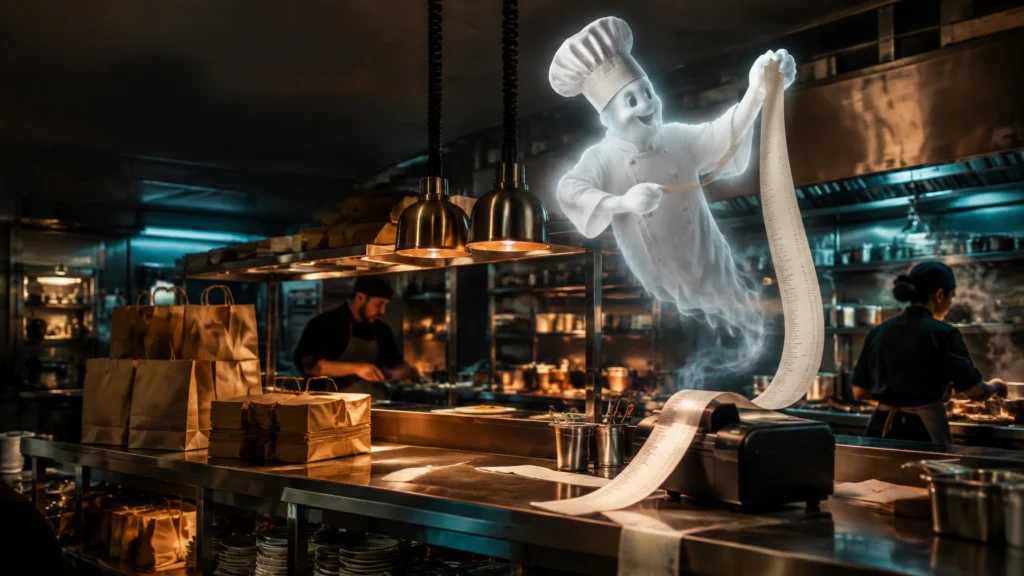
In 2020, the restaurant of the future was supposed to have no tables, no servers, no dining room, and possibly no earthly connection to the restaurant business as we knew it.
Investors saw a huge opportunity: delivery was surging, real estate was expensive, and a kitchen could sell through several virtual restaurant brands at once. The boldest forecasts put the global opportunity at $1 trillion. Travis Kalanick’s CloudKitchens was valued at a reported $15 billion in 2021. Reef Technology, meanwhile, was widely described as a billion-dollar company.
Fast-forward to 2026. Some operators have shut down, others have downsized, and the biggest names are finding new ways to describe what they do. But the category hasn’t vanished. It has been forced to answer a less glamorous question:
Can a kitchen without a dining room make money after the hype, delivery fees and investor cash are gone?
The answer is yes, but usually not in the way the original pitch promised. The models with the best chance today tend to use kitchens and teams that already exist, sell something guests actually want, and know their margin down to the order. The ghost kitchen idea didn’t disappear. It got a reality check, and a much smaller lease.
1. The hype was real. So was the delivery demand.
A ghost kitchen, also called a cloud kitchen or dark kitchen, is generally a food-preparation operation without a traditional dining room, focused on takeout and delivery. But the definition gets blurry fast. Does a restaurant’s delivery-only brand count? What about a shared commissary, an industrial facility, a kitchen pod, or a brick-and-mortar restaurant with a digital-only menu?
That definitional fog matters. Statista’s overview describes a delivery-only restaurant with no dining space or pickup service. IBISWorld, using its own industry classification, puts the U.S. category at about 7,606 businesses in 2025 and estimates a market size of $2.9 billion in 2026. Other counts have put the U.S. total far higher, around 40,000 ghost kitchens in 2023 or more than 34,000 ghost restaurants in late 2024-because they count different things.
The global market estimates are also all over the map. For 2026, MarkWide Research estimates about $78.4 billion, while Grand View Research estimates $88.7 billion and Research and Markets puts its figure near $113 billion. Those figures are not measuring identical market baskets, so they aren’t apples-to-apples comparisons. Still, they show that forecasters continue to see a substantial category, even while individual operators struggle.
The underlying consumer behavior was not imaginary. People order food online. Delivery and off-premise sales are meaningful channels. The leap that failed was assuming those trends would automatically make standalone, delivery-only kitchens profitable at scale. Demand for food delivery isn’t the same as demand for a new, unfamiliar restaurant brand, or a guarantee that every sale will leave money behind.

Illustrative industry arc: the sequence of events is simplified; it is not a market forecast.
2. What went wrong: fewer dining-room costs, plenty of other costs
The original logic sounded clean: remove dining-room rent, servers and tables; cook food; send it out. But there was a catch. A delivery-only kitchen still has to pay for food, labor, packaging, rent, order systems, customer acquisition and, often, a third-party marketplace that may take 15% to 30% of an order.
There’s also no walk-in traffic to discover the restaurant, no bartender selling high-margin drinks, and no dining room to build familiarity. Each order has to find the brand through an app, a direct channel, paid marketing, word of mouth, or a promotion that may make the already-tight margin tighter.
The figures in QSR Pro’s 2026 review illustrate the pressure. In a limited sample of tenants across five CloudKitchens locations, 41 of 71 restaurants closed within a year. A 58% closure rate in that sample. That is a sobering data point, not a universal industry-wide ghost kitchen failure rate. The sample is too small and specific to stand in for every operator. But it does show how punishing the model could be for tenants trying to cover occupancy costs, ingredients, labor and app commissions at once.
A Restaurant Dive interview with industry expert Alon Lagstein describes the cost stacking clearly: a brand could pay for space, pay delivery commissions, and in some arrangements pay additional sales-based fees, while the customer faces delivery charges. There isn’t an infinite pile of margin hiding under that pile of fees.
The restaurant business has never been famous for leisurely margins, and delivery-only doesn’t magically cure that. The question “why do restaurants fail?” has a familiar answer: weak unit economics, inadequate demand, cost control problems, and inconsistent execution. A ghost kitchen may remove a dining room, but it doesn’t remove those risks. It can make them harder to see until the bills arrive.
3. The corporate wreckage, and the important footnotes
REEF Technology is one of the clearest examples of the sector’s retrenchment. It closed all three New York ghost-kitchen locations in 2024 and pivoted facilities toward grocery delivery. In early 2025, it cut roughly 750 roles. Then in January 2026, a trailer manufacturer filed for bankruptcy protection and alleged that REEF stopped paying for as many as 650 food trailers, with about $1.4 million in disputed debt. The filing is an allegation in a dispute, not a finding that resolves the claim. The business story, however, is plain enough: REEF’s food-kitchen operation contracted sharply. Bisnow reported the New York closures; a REEF company profile and timeline tracks the wider pullback.
CloudKitchens has taken a different path. In July 2026, Travis Kalanick’s company was folded under a new parent, Atoms, which raised $1.7 billion in a round led by Andreessen Horowitz. That was funding for Atoms and its broader ambitions around restaurant automation and other businesses, not a $1.7 billion check devoted solely to ghost kitchens. Nation’s Restaurant News reported that CloudKitchens had previously been valued at $15 billion in 2021. Recent reporting put the new valuation around $10 billion, below that earlier mark. Estimates place CloudKitchens’ 2026 revenue near $1.1 billion, but it is a private company, so that figure is not a public audited breakdown of the kitchen business.
That distinction matters: CloudKitchens isn’t simply a failed startup story. It has substantial operations and is investing in automation. But its broader corporate bet increasingly looks like infrastructure, software and robotics, not just renting out kitchen space. The company’s future may depend as much on whether automation improves operating economics as on whether virtual brands can keep filling kitchens.
The point isn’t that every operator failed or that delivery is over. The point is that the original recipe: build expensive facilities, fill them with new concepts, rely on app discovery, and wait for scale, was much less forgiving than the pitch deck suggested.
4. The host-kitchen model: use the kitchen you already pay for
The more durable play is often the host kitchen model: a restaurant adds a delivery-only brand or menu to an existing operation, using idle capacity during slower hours.
Think of a restaurant with a kitchen, prep team and rent already in place. If it has real unused capacity between lunch and dinner, a compatible virtual brand might add sales without adding a new lease. The incremental order still has costs (food, packaging, marketplace commission and perhaps extra labor) but the operator may not need to take on a second rent bill just to test the idea.
That is a different economic question from “Can I build a standalone delivery business from scratch?” It’s “Can I earn a worthwhile contribution from capacity I already have?”
One Grubhub and Technomic benchmark, based on a 2022 survey of independent restaurants, found 41% operated at least one virtual brand. That survey is not a current census, but the figure remains widely cited as an industry benchmark. And in 2026 reporting, the success divide is striking: standalone ghost kitchen tenants have faced very high churn, while virtual brands run inside existing restaurants using spare capacity have been reported to have roughly a 70% success rate. Yet only about 34% of restaurants launching a virtual brand reportedly reach profitability after 12 months. Those figures come from different sources and methodologies, so don’t treat them as a controlled head-to-head experiment. They point in the same direction, though: access to an existing kitchen can improve the odds, but it doesn’t guarantee profit.
Food cost discipline matters too. Several 2026 virtual-brand guides and reports associate better performance with food costs held around 24% to 28% and warn against relying too heavily on delivery commissions of 15% to 30%. Those are useful targets to test against your own menu and operating model, not a universal margin promise. Your own recipe costs, labor, pricing, order mix and contract terms decide the actual result.

Illustrative economics only. No margin or cost figures are implied; actual results depend on operator, contract and market.
5. Thighstop: a virtual brand that knew its job
Wingstop’s Thighstop is a handy example of what a virtual brand can do when it has a clear purpose.
Wingstop launched the brand in June 2021 amid a chicken-wing supply squeeze. It used the concept to sell chicken thighs and test interest in a product beyond the core wing menu. The experiment generated attention, then the product moved into Wingstop’s regular menu just months later. Restaurant Dive’s coverage described the move as a way to test a menu item and build buzz before bringing it under the main brand.
That’s the lesson: a virtual brand can be a lab, not a lifestyle. It can test demand, fill a daypart, use ingredients already on hand, or extend a known brand into a digital channel. It doesn’t need to become a permanent second identity with its own sprawling menu, separate inventory and mysterious Instagram account.
The test still needs clear measures. Did the offer increase incremental contribution? Did it bring new customers or just shift orders from the primary brand? Could kitchen teams execute it without slowing core tickets? Was the product good after delivery, not just photogenic before it left the pass?
If those questions have useful answers, the virtual brand has done its job. If not, shut it down before it becomes a tiny second restaurant hiding inside the first.
6. Chipotle’s counter-model: build for digital orders, not just delivery apps
Chipotle shows another path: treat digital demand as core restaurant infrastructure rather than a borrowed storefront on a delivery platform.
The company has invested in digital ordering and fulfillment, with dedicated digital makelines designed to handle online orders separately from the traditional service line. Its work with Hyphen on a cobotic makeline is one example: the system was designed to assemble bowls and salads for digital orders while employees continued to prepare other items on a separate line. Chipotle’s own newsroom description explains how that test worked.
This is not a simple comparison. Chipotle has brand recognition, scale and capital that an independent restaurant does not. But the strategic contrast is useful. The aim is to own more of the system: the brand, the menu, the guest relationship, the operation and the data. A dedicated digital kitchen or makeline is not the same as renting a small production bay and hoping a new app listing catches fire.
The comparison also underlines a larger choice: does digital ordering strengthen your own restaurant system, or do you become dependent on someone else’s platform for discovery, customer data and repeat business?
7. A ghost with no name is a trust problem
A storefront can appear, disappear and rebrand quickly on a delivery app. That flexibility can help an operator test concepts, but it can also leave guests unsure who made the food, where it came from, or whether the virtual restaurant is connected to a real licensed business.
This isn’t just a branding concern. It touches traceability, food safety, accurate licensing and accountability. A 2026 BMC Public Health study of dark kitchens in Sydney found that more than a third of the dark-kitchen brands in its original sample had temporarily or permanently closed or become inactive within the study period. The researchers describe the brands as “shapeshifting” and note the monitoring challenges created when businesses change names or operate through multiple online storefronts.
The FAO’s 2026 legislative study on food e-commerce points to broader regulatory gaps: online food commerce can make it harder to identify sellers, provide essential information, and enforce food-safety responsibilities. And China’s 2026 “ghost food” crackdown is a cautionary tale for platforms. CNN reported that authorities found tens of thousands of bogus food vendors and issued major penalties to delivery platforms over licensing verification and oversight.
For operators, the practical implication is simple: be easy to identify. Keep licenses and permits current, use accurate storefront information, identify the responsible operator, and make sure your packaging, menus and platform listings describe what guests will actually receive. Trust is not an optional garnish.
8. Your Monday-morning checklist before launching a virtual brand
Before signing a ghost-kitchen lease or adding another storefront to your delivery menu, answer these questions in writing:
- Is the demand real? Define the target guest, delivery radius, daypart and reason to choose this brand. “People like burgers” is not a strategy; it is a fact about people.
- Is capacity genuinely idle? Map orders and labor by hour. If the new menu pushes core tickets late, it is not spare capacity. It is a traffic jam wearing a different logo.
- What is the incremental-margin math? Start with sales, then subtract food, packaging, incremental labor, marketplace commission, payment costs, promotions, refunds and any host or licensing fee. Compare contribution, not gross sales.
- Can food costs stay in range? Model recipes carefully and test the actual delivered portions. A food-cost target around 24%–28% may be a useful screening band for some concepts, but your menu economics have to prove it.
- What does the commission stack do? Model third-party delivery commissions at the actual contracted rate. Include sponsored listings or discounts if they’re required to win visibility. A busy dashboard can still hide a very quiet profit line.
- Can your team execute it cleanly? Limit new ingredients, stations and procedures. Test order accuracy and packaging under real service conditions.
- Will it strengthen or dilute the main brand? Make sure the virtual brand has a clear reason to exist and doesn’t disappoint guests who expect the quality of your primary concept.
- Who owns the guest relationship and data? Know what information you receive, what you can use, and what happens if a platform or partner relationship ends.
- Can you exit cleanly? Set a pilot period, say 60 to 90 days, and decide in advance what results justify continuing. A small test beats a long lease and a dramatic farewell post.
- Are systems ready? Confirm the POS, menu sync, inventory and kitchen workflows can handle the added orders. Restaurant tech is a connected stack: restaurant systems pro or restaurant system pro searches often lead operators to broader tools like tip management software, video analytics for restaurants, and integrations with group purchasing organizations food service. Those tools won’t fix bad unit economics, but reliable systems can help teams track labor, loss, purchasing and execution as a concept grows.
Want to pressure-test a scenario? Kuypers Creative’s Restaurant Opportunity Calculator lets operators explore assumptions and see how changes in costs or sales may affect an illustrative annual impact. The calculator is a planning aid, not a forecast or guarantee. Keep the assumptions visible. Keep the math honest.
So, what happened to the kitchen with no dining room?
The ghost kitchen wasn’t a restaurant-industry replacement. It was a format, and formats are only as good as their economics.
The original standalone model often asked a new brand to solve too many expensive problems at once: pay for facilities, hire a team, earn app visibility, cover commissions, build consumer trust and maintain quality without a dining room or built-in audience. Some operators found demand; too many couldn’t make the numbers work.
The models that still make sense are more grounded: an existing restaurant using spare kitchen capacity, a proven brand testing a focused virtual offer, a digital kitchen designed to support an established operation, or automation that demonstrably improves throughput and labor efficiency. Franchisors continue to see sales potential in virtual brands, too, but the opportunity depends on the operator, brand controls and unit economics, not on the novelty of having a ghost in the kitchen.
In 2026, the smart question isn’t “How many virtual brands can we launch?” It’s “Which orders add profitable demand without breaking the kitchen we already have?”
That’s less thrilling than a trillion-dollar forecast. It’s also much more likely to pay the rent.
Sources and further reading
- Forbes: “Ghost Kitchens Are Getting Ghosted. Can They Survive?”
- QSR Pro: Ghost Kitchens in 2026-What Actually Survived the Hype Collapse
- QSR Pro: Ghost Kitchen Reckoning and Consolidation
- Nation’s Restaurant News: Atoms raises $1.7 billion
- IBISWorld: Ghost Kitchens in the U.S.
- Restaurant Dive: Structural problems that challenged ghost kitchens
- Restaurant Dive: 41% of independent restaurants operate virtual brands
- Restaurant Dive: Wingstop adds thighs after Thighstop test
- Chipotle: Testing a digital makeline with Hyphen
- FAO: Safer food e-commerce legislation
- BMC Public Health: Dark kitchens and regulatory challenges
SEO title: Ghost Kitchens in 2026: What Happened, What Failed, and What Still Works
Meta description: A data-informed look at ghost kitchens in 2026: why standalone models struggled, how host kitchens and virtual restaurant brands can work, and what operators should check before investing.
Suggested URL slug: ghost-kitchens-2026-virtual-brands-host-kitchen-economics
SEO keywords: ghost kitchens 2026, virtual restaurant brands, cloud kitchen economics, ghost kitchen failure rate, host kitchen model, third-party delivery commissions, restaurant revenue streams, restaurant systems pro, restaurant system pro, tip management software, video analytics for restaurants, group purchasing organizations food service
Tags: Robert Kuypers, Robert William Kuypers, William Kuypers, Rob Kuypers
Hashtags: #GhostKitchens #VirtualRestaurants #RestaurantTech #RestaurantOwners #RestaurantGrowth #Foodservice #RestaurantStrategy #CloudKitchens #HospitalityInnovation #RestaurantMargins
