
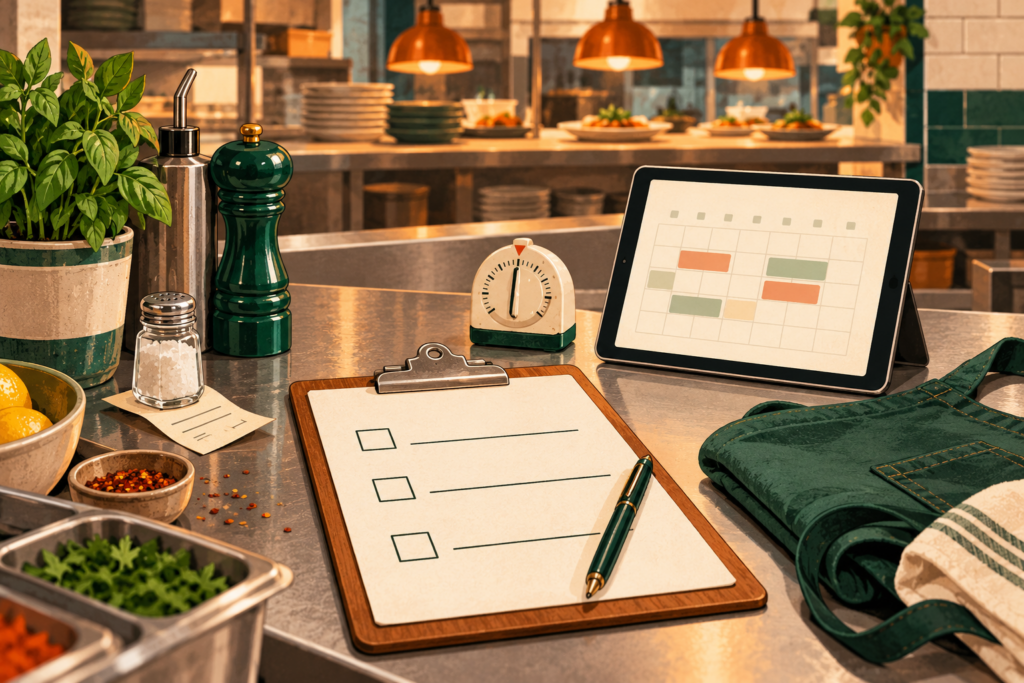
A restaurant does not need a second general manager who speaks in bullet points and cannot find the walk-in.
It needs a few annoying jobs done properly.
That is a useful way to approach the latest wave of restaurant AI: pick one task, decide who checks the work, and find out whether the tool earns its place. The grand transformation can wait until somebody has dealt with the schedule.
The development worth watching
On October 6, 2026, Toast announced Toast IQ Team and an expansion of Toast IQ Grow. Its release describes an AI Scheduling Agent, labeled beta, that builds schedules around employee availability, expected sales and overtime risk. It also lists beta agents for menu work, phone answering and configurable operational tasks through its Test Kitchen early-access program. These are the vendor’s descriptions, not a Kuypers Creative product test. Read Toast’s announcement.
The interesting operator question is narrower than the product launch: what, exactly, are you willing to let a system do without asking you first?
Here is our take. Start with a job small enough that its mistakes are visible. A vague brief like “improve operations” gives you an impressive-looking answer and a deeply unimpressed shift manager.
Write the job on one card
Before enabling a tool, write a plain-language job description. For a scheduling pilot, it could be:
Prepare a proposed schedule using approved availability. Flag unresolved coverage and conflicts. Do not publish the schedule. The general manager reviews every shift before release.
That is a proposed operating rule, not a claim about any particular product’s permissions. Confirm that your actual system can support it before starting.
The card should answer four questions:
- Input: Which records may the tool use, and who keeps them current?
- Output: What should a manager receive—a suggestion, a draft, or an action already taken?
- Boundary: What must never change without a person approving it?
- Owner: Who reviews the result and handles exceptions?
If the answer to the last question is “the team,” keep writing. The team is busy. A named person has a chance.
Count the cleanup, too
For the first few comparable runs, record the time spent preparing the inputs, reviewing the output and correcting mistakes. Compare that total with the time the existing process takes. This is a simple proposed pilot method, not a promise of savings.
You are looking for less work overall—not merely a faster first draft followed by an archaeological dig through errors.
Keep a small exception log. Record what needed correction, why it mattered and whether the same problem happened again. A tool that needs one unfamiliar setting corrected is a different proposition from one that repeatedly overlooks a constraint your managers consider basic.
Ask the people doing the work what got easier and what got stranger. Give them a specific prompt: “What did you have to check twice?” That answer is more useful than asking whether they are excited about innovation while they are carrying six plates.
Make the stop button boring
A pilot needs an exit plan before the first real shift depends on it.
Keep the existing approved process available. Decide how to pause the new workflow, who may do so, and how the team will know which version is authoritative. Check what happens to pending drafts or actions when the pilot stops. Ask the vendor to demonstrate the behavior rather than accepting an enthusiastic nod.
For changes involving employees, customer communications, prices or payments, be especially deliberate about review and permissions. The point is to reduce avoidable surprises, not to create a new Friday-night guessing game.
Let useful work earn the next assignment
Set a review date and a small set of success criteria before the pilot begins. Did total handling time improve? Did corrections become less frequent? Could another manager explain the workflow without its original champion standing beside them?
If the answer is no, narrow the job or stop. If the answer is yes, expand one responsibility at a time. A vendor announcement establishes what a company says it offers; your own checks establish whether a workflow fits your restaurant.
There is room for ambition here. There is also room for a clipboard.
Before the next demo, bring one recurring task and one non-negotiable boundary. Ask the salesperson to show both. The shiny part will get plenty of attention. Make sure the boring part gets a turn.
